Food Tracking Apps Free to Start: How to Choose
TL;DR. Most food tracking apps free to start charge later for the parts that keep you logging past week two. Before comparing names, decide what you actually need: a large database for speed, accurate micronutrients for detail, or your food sitting next to your training and sleep. One honest note. We make one of the apps on this list, so read the criteria first and judge ours against them like any other.
Decide what you need before you compare names.
Almost every complaint about a food tracker comes from picking one built for a different job.
Speed. You will log several times a day, every day. Barcode scanning, saved meals and recent items decide whether you keep going past week two.
Database quality. Large crowd sourced databases are fast but contain many versions of the same food with different numbers. Curated databases are smaller and more consistent.
What it does with the data. A tracker that only shows today is a diary. A tracker that shows your intake against your weight trend over weeks is a tool.
Where the rest of your data lives. If your food is in one app and your training in another, nothing can show you the relationship between them.
The three food tracking apps free to start, compared.
MyFitnessPal describes itself as a nutrition tracking app with a macro and calorie calculator, food tracker and fasting app. Its strength is the size of its food database, which makes logging fast.
Cronometer describes itself as the most accurate nutrition tracking app and calorie counter. It leans towards curated data and detailed micronutrients, which suits people who care about more than calories and protein.
The Health Project, which we make, holds your food alongside your training, your sleep and any health markers you want to keep, so you can read them against each other. Targets are set by you or by your coach.
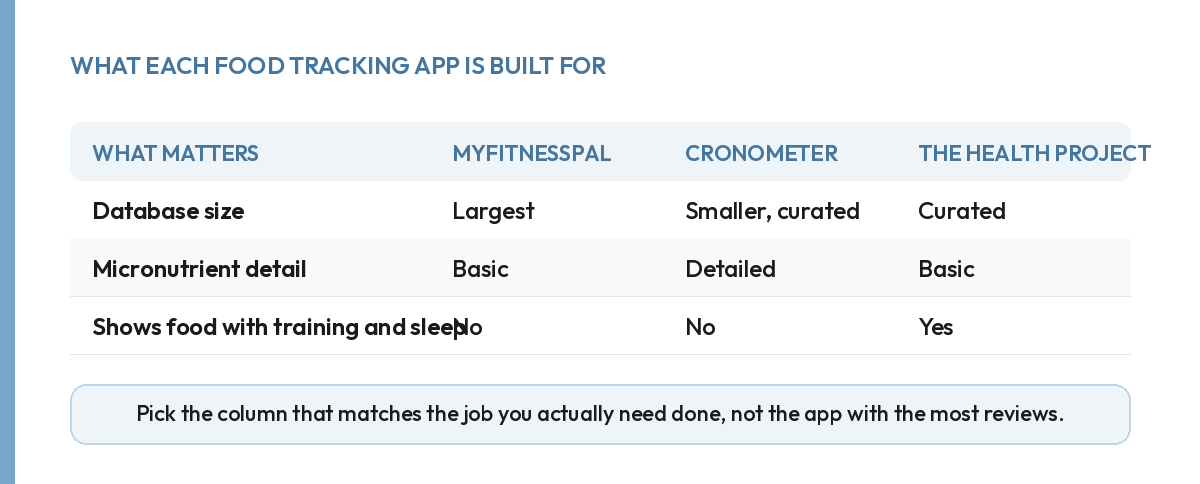
We are not going to tell you we are the best one on this page. We are telling you what we built it to do, so you can decide whether that is the job you need doing.
Inside The Health Project, you log food two ways: photograph a meal, or search the food library, and calories and macros are filled in for you. It tracks calories, protein, carbs and fat, plus micronutrients such as fiber, sodium and vitamin C, and water alongside them. Your targets are set by you or by your coach, and are meant to move as your weight, training and recovery change. There are no meal plans and no obligation to log a set number of times. The point is that the same food entry sits next to the training session and the night of sleep it belongs with.
What does free actually get you?
Free tiers are genuine, and they normally stop at the same places.
- Detailed macro breakdowns and custom targets
- Barcode scanning, on some apps
- Data export
- Removing ads
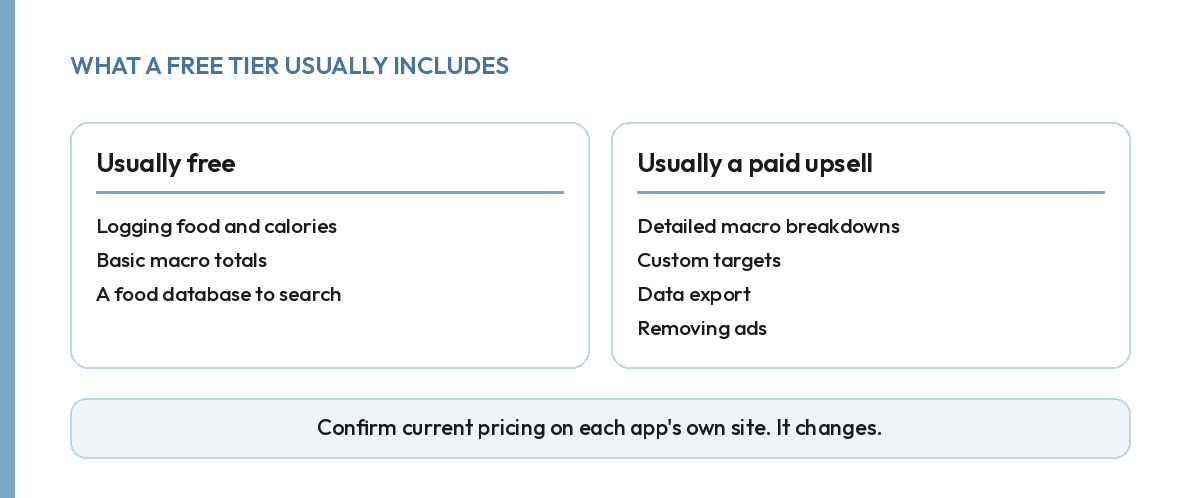
Check the current pricing on each app's own site before you commit. It changes, and any figure in a blog post goes stale quickly.
A one week way to test any of them.
Do not judge a food tracking app on the first day. The first day is spent finding your usual foods in its database and working out its shortcuts. Judge it after a full week.
Pick one app for the week. Do not switch mid week to compare, because switching resets the habit you are trying to test, not just the app.
Log everything the same way each day: same time of day, same level of detail, whether that is a full macro breakdown or a rough estimate. The app matters less than the consistency of how you use it.
At the end of the week, look at the week's average, not any single day. A single day tells you almost nothing. A week starts to tell you something.
Common mistakes that make tracking feel harder than it is.
Switching apps every few days because none of them feels perfect. Every tracker has friction somewhere. Pick one and give it a real week before you decide it is the wrong one.
Logging only the meals that look good and skipping the rest. A tracker that only sees half your food cannot show you anything useful.
Guessing portions instead of weighing food for the first week. A kitchen scale for a few days teaches your eye what a real portion looks like, and you can put it away after that.
Comparing your numbers to someone else's targets. Your targets come from your own weight, training and goals, set by you or by your coach, not from a number you saw online.
The thing that decides whether tracking works.
Not the app. Consistency of method.
Self-reported food intake is systematically underreported, and underreporting increases at higher body weights.
Source: Ravelli and Schoeller, traditional self-reported dietary instruments are prone to inaccuracies.
That is not a reason to skip tracking. It is a reason to log the same way every day, so your numbers are consistently wrong rather than randomly wrong. A consistent error still shows you a real change.
The same idea applies to any number you track over time, not only food. See how the same logic applies to VO2 max, where the direction over months matters more than any single reading. For the full method, including what to do with a week of numbers, see how to track calories eaten.
How to pick, in one paragraph.
If you want the fastest logging and the biggest database, MyFitnessPal is built for that. If you want the most careful nutrient data, Cronometer is built for that. If the reason you are tracking is to see your food next to your training and your sleep, that is what we built. For more on judging that kind of app, see health tracker apps: how to choose one.
FAQ.
What is the best free food tracking app?
It depends on whether you are optimising for logging speed, data accuracy, or having everything in one place. Those are three different apps.
Are free calorie counters accurate?
The app arithmetic is accurate. The inputs are not, because self-reported intake is systematically underreported.
Do you need to pay for a food tracker?
No. Free tiers are enough to track calories and protein consistently.
Can you track food without counting calories?
Yes. Logging protein only, or photographing meals, still creates a record you can review.