Macro Calculator Apps: What They Get Wrong
TL;DR. A macro calculator app hands you one number and stops there, and that number comes from a formula built mostly on people who do not train. A systematic review of resting metabolic rate formulas in athletes found that the most commonly used one, Mifflin-St Jeor, lands within 10 percent of someone's actual number only about 52 percent of the time in athletes, worse than a coin flip's worth of confidence for a number people build their whole diet around. The fix is not a better formula. It is treating the number as a starting guess and adjusting it as real results come in.
Macro calculator app: what the number actually is.
Every macro calculator app is doing the same two-step job under the hood. First, it estimates how many calories your body burns at rest using a formula based on your height, weight, age and sex. Second, it multiplies that resting number by an activity factor you picked from a dropdown, then splits the total into protein, carbs and fat using a fixed ratio or a rule of thumb like grams per pound of body weight.
Nothing about that process looks at your actual results. It is a prediction, made once, from a handful of inputs that do not include the thing that matters most for accuracy: how your specific body actually responds.
Where the underlying formula comes from.
The formula behind most calculators, called Mifflin-St Jeor, was developed from a study of adults in the early 1990s and has held up reasonably well for the general population since. It was not developed on athletes or regularly resistance trained people, which matters because more muscle mass changes resting energy needs in a way the formula was never built to account for.
How far off it can be for someone who trains.
A systematic review and meta-analysis of resting metabolic rate prediction equations, tested specifically in athletes, found that Mifflin-St Jeor predicted resting metabolic rate within 10 percent of the measured value in only 52.17 percent of cases, compared with 80.22 percent for a formula built specifically for athletic populations. The review's own conclusion was that Mifflin-St Jeor and similar general-population formulas should be avoided for athletes because their bodies do not match the population the formula was built from. Source: systematic review and meta-analysis, accuracy of RMR prediction equations in athletes.
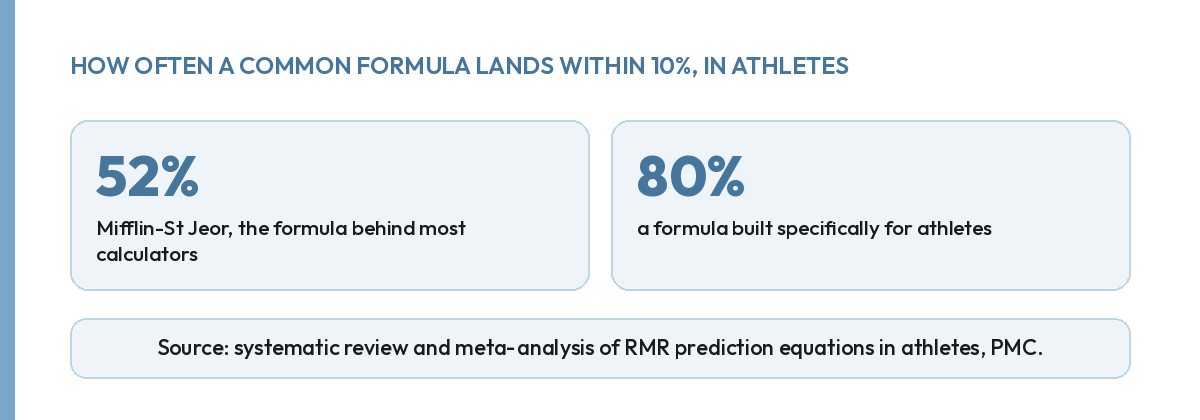
In plain terms: nearly half the time, the number a typical calculator gives someone who trains regularly is off by more than 10 percent in either direction, which on a 2,500 calorie target is 250 calories or more, enough to stall fat loss or blunt muscle gain over a period of months if nobody ever checks whether it was right.
What a static calculator can't see.
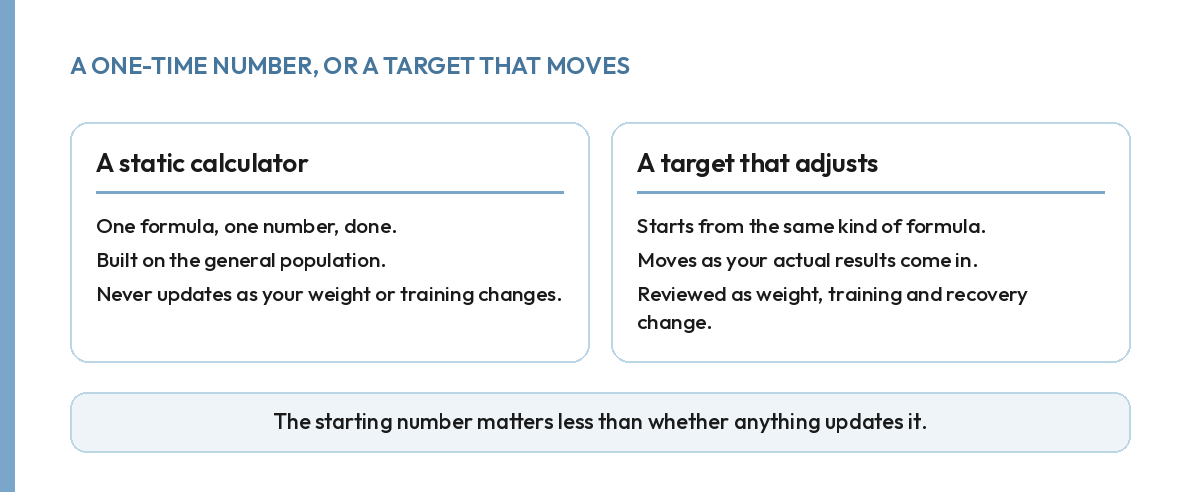
A one-time calculation cannot see your actual metabolism, and it cannot see what happens after you start following it either. Weight loss itself lowers your calorie needs as you get lighter. Building muscle raises them a little. A harder training block raises them more. A calculator run once, at the start, has no way to catch any of that, which is exactly why the same number that felt right in week one often stops working by week six without anyone changing anything about the plan.
Does a more accurate formula fix it?
Only partly. A formula built for athletes, like the one in the comparison above, narrows the error, but no formula eliminates it, because a formula is still a prediction from population averages rather than a measurement of you specifically. The real fix is not finding the perfect formula. It is treating whatever number you start with as a working guess, then watching what actually happens to your weight and performance over two to three weeks and adjusting from there.
What actually works instead: adjusting over time.
Start with a calculator's number, since you need somewhere to start. Then track your weight and how your training is going for two to three weeks without changing anything. If weight and performance are moving the way you want, the number was close enough. If they are not, adjust it based on what actually happened rather than running the calculator again with slightly different inputs and hoping for a better guess. This is the same idea behind what calorie balance actually means: the target only means anything once it is checked against real results.
How The Health Project sets your targets.
Inside the app, your nutrition targets start from the same kind of formula every calculator uses, because there is no way around needing a starting point. The difference is what happens after: targets are set by you or by a coach, and they are meant to be adjusted as your weight, training and recovery change rather than left as a one-time number nobody revisits. There is no requirement to log every bite for this to work, and our guide to tracking what you actually eat covers the lighter ways to keep enough data to know whether the number needs to move.
We show you the trend. We do not tell you what your result means. If something looks off, that is a conversation for your doctor.
FAQ.
Are macro calculator apps just wrong?
Not wrong exactly, but built on a formula that research shows lands within 10 percent of the real number for only about half of athletes. It is a reasonable starting point, not an accurate final answer.
Why are these formulas less accurate for people who train?
Most were built and tested on general, largely untrained populations. More muscle changes how many calories your body burns at rest in a way the original formula was never designed to capture.
So what should I use instead of a one-time calculator?
Use a calculator's number as a starting point, then adjust it every couple of weeks based on what is actually happening to your weight and performance, rather than trusting the first number it gives you.
Does The Health Project use a different formula?
It starts from the same kind of formula everyone does, since there is no way around needing a starting point. What is different is that the target is reviewed and adjusted as your weight, training and recovery change, rather than left as a one-time number.