What Is Calorie Balance?
TL;DR. What is calorie balance? It is the difference between the energy you take in and the energy you use. More in than out and you gain weight over time. Less in than out and you lose it. Both sides of that equation are estimates, and food logs are systematically underreported. That does not make tracking useless. It makes your own trend more useful than the absolute number.
What is calorie balance?
Calorie balance is energy in minus energy out.
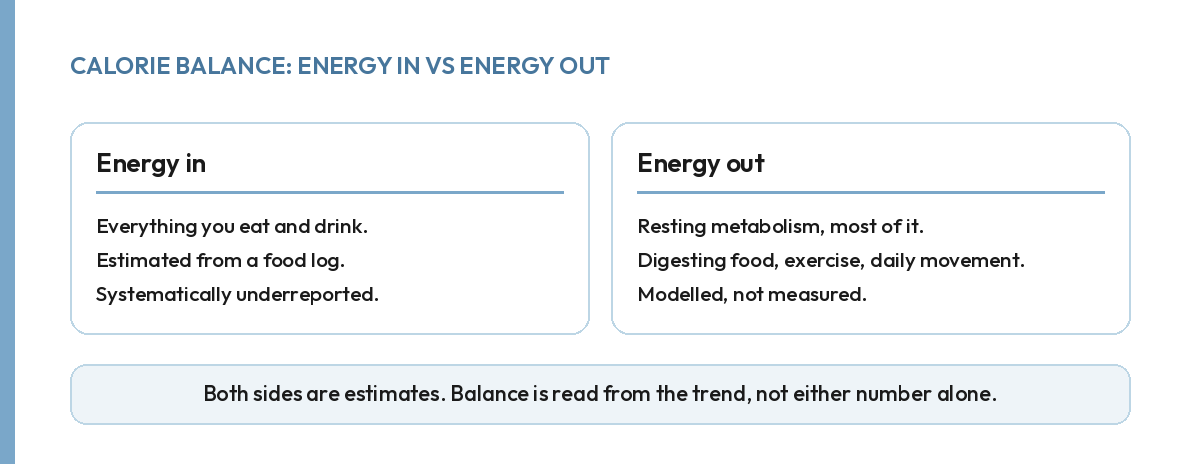
Energy in is everything you eat and drink.
Energy out has four parts. Your resting metabolism, which is most of it. The energy used digesting food. Deliberate exercise. And everything else you do while awake, which is larger than people expect and drops quietly when you diet.
A surplus means you gain over time. A deficit means you lose. Balance means you hold.
Why your app's number is an estimate.
Both sides are estimated, and neither is measured.
Energy in is underreported, consistently. A review of self-reported dietary instruments found strong and consistent systematic underreporting of energy intake across studies of adults and children. Underreporting increases with body mass index, and foods are not underreported equally.
Source: Ravelli and Schoeller, traditional self-reported dietary instruments are prone to inaccuracies.
Energy out is modelled, not measured. The calorie figure on your watch comes from a formula using your heart rate, weight and age. It is not measuring the energy you used.
Does that mean tracking is pointless?
No, and this is the part worth getting right.
An estimate that is wrong in the same direction every day is still useful. If your log says 2,000 and the truth is 2,300, then the day it says 1,700 is genuinely a lower day. The error is roughly consistent, so the change is real even when the number is not.
What this rules out is using a single week of numbers to calculate exactly what your body needs. What it allows is using your own trend against your own weight trend, which is what actually works.
The same logic applies to reading your VO2 max trend: the absolute number matters less than the direction it moves.
How to use calorie balance properly.
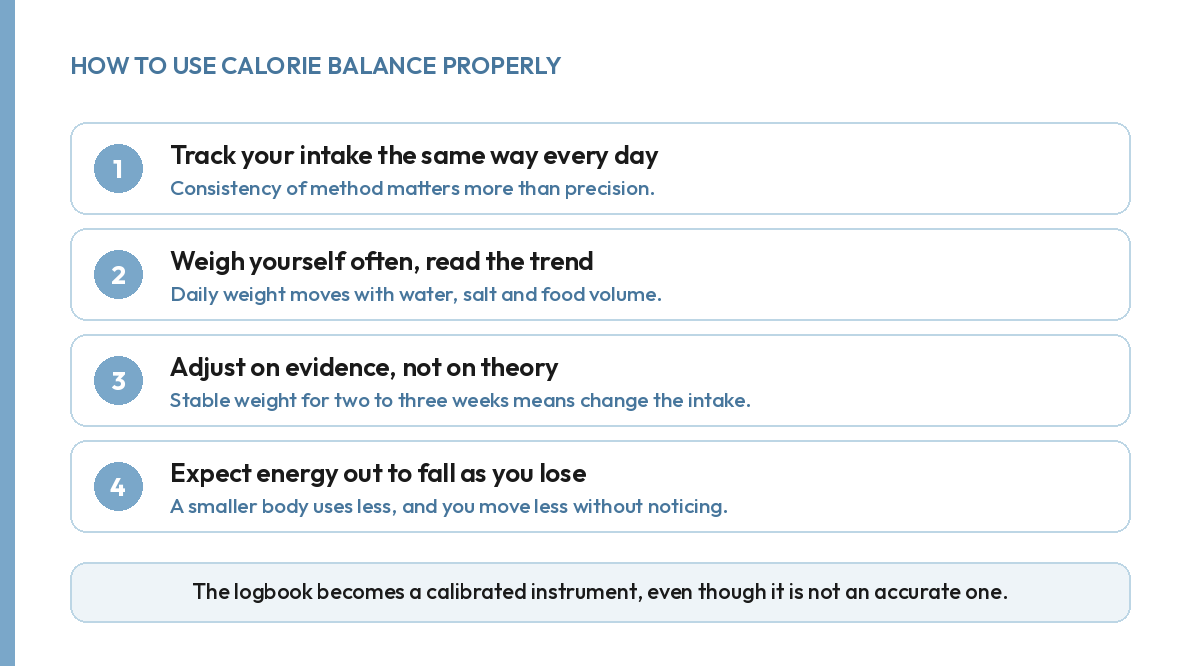
Track your intake the same way every day. Consistency of method matters more than precision. If you are only getting started, here is how to track calories eaten without it taking over your day.
Weigh yourself often and read the trend, not the day. Daily weight moves with water, salt and food volume. The weekly average is the signal.
Adjust on evidence, not on theory. Two to three weeks of stable weight while you are trying to lose means the deficit is not there in practice, whatever the arithmetic says. Change the intake, not the spreadsheet.
Expect energy out to fall as you lose. A smaller body uses less, and people also move less when dieting without noticing.
Where this goes wrong.
Three habits break the method before it has a chance to work.
Switching how you log halfway through. If you log loosely for two weeks then start weighing food on a scale, the two periods are not comparable. The error changed, not just your intake.
Reading a single day's weight as the result. One weigh-in absorbs a big meal, a salty dinner or a poor night's sleep. None of that is fat gained or lost. The seven day average is the only number worth acting on.
Expecting the deficit to stay constant. Your energy out drops as you lose weight, and your daily movement quietly falls with it. A deficit that worked in week one can stall by week six without anything going wrong. That is expected, not a failure.
A worked example.
You log 2,100 calories a day for three weeks and your weekly average weight does not move.
You do not need to know your true expenditure. You know your maintenance sits at whatever your logging habit calls 2,100. Drop to what your logging habit calls 1,850 and watch the trend for two more weeks.
If your weight had dropped instead, you would have learned the opposite: your logging habit's 2,100 already sits inside a deficit for you, and there was no need to cut further. Either way, the number itself never had to be accurate. It only had to be consistent.
The logbook becomes a calibrated instrument, even though it is not an accurate one.
Why this needs to be in one place.
This only works when your intake and your weight trend can be read against each other over time. Two apps that do not talk to each other cannot show you that, and choosing between food tracking apps is only half the decision if your training and sleep live somewhere else entirely.
This is what we built The Health Project for.
Logging is fast. Photograph a meal or search the food library, and your calories and macros are filled in for you.
Your targets move with you. Set your own targets, or have your coach set them, and adjust them as your weight, training and recovery change. It is not a fixed number handed to you once and left alone.
Everything sits together. Your weight, your training and your sleep sit next to your intake, so a stall shows up as a pattern instead of a mystery. Your weekly check-in, a two minute reflection on weight, energy, sleep, stress and wins, is where you actually look at the trend rather than the daily number.
FAQ.
Is calorie balance the only thing that matters for weight?
For body weight, energy balance is the driver. What you eat still affects your hunger, your training and your health.
Why am I not losing weight in a calorie deficit?
Usually because the deficit is smaller than the log suggests. Underreporting is systematic and it increases at higher body weights.
How accurate are the calories on a fitness watch?
They are model estimates from heart rate and body data, not measurements. Use them for trends, not arithmetic.
Should you eat back the calories you burned?
Be careful. Those numbers are the least reliable in the whole system.