Medical Tracking Apps: What to Look For
TL;DR. Medical tracking apps range from symptom diaries built for one condition to general trackers that hold any marker you type in. For chronic conditions, the category has real evidence behind it: a review of 17 systematic reviews found self-monitoring associated with up to a 27 percent reduction in hospitalisations and up to a 54 percent reduction in heart failure readmissions compared with no monitoring. When you are choosing one, judge it on whether it accepts your own numbers, whether it shows trends instead of verdicts, and whether it survives being carried into an actual doctor's appointment.
Medical tracking apps: what actually matters.
The category covers more ground than the name suggests. Some apps are built around one condition, like a diabetes log or a migraine diary. Others are general purpose, built to hold whatever marker you throw at them, from blood pressure to a full lab panel.
What they share is the job: turning something that used to live in a notebook, or nowhere at all, into a record you can actually look back on.
Does tracking your symptoms and markers actually help?
For chronic conditions, the evidence is stronger than for most health app categories. A review of 17 systematic reviews and meta-analyses covering heart failure, hypertension and COPD found self-monitoring associated with up to a 27 percent reduction in all-cause or disease-specific hospitalisations compared with usual care. For heart failure specifically, one meta-analysis found self-management interventions reduced the odds of readmission by up to 54 percent.
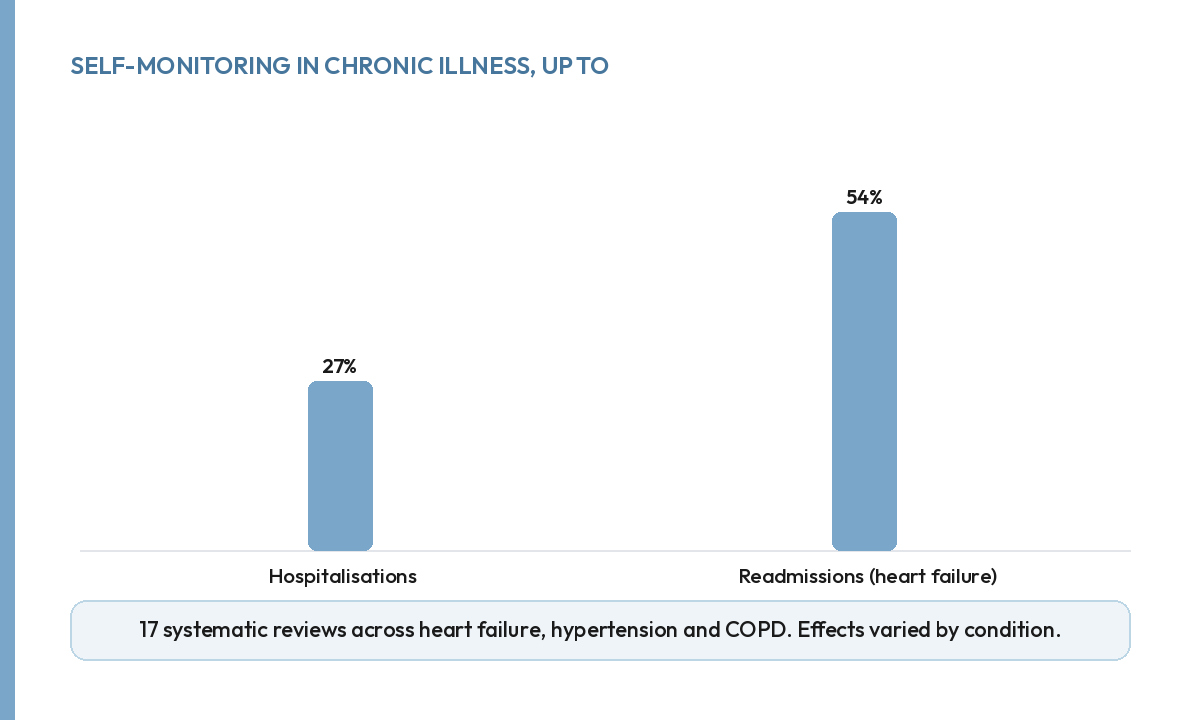
Source: a systematic review of reviews on self-monitoring in chronic illness and healthcare utilisation.
Effects were not uniform across every condition or every outcome. Primary care visits did not change much in COPD or hypertension studies, and some reviews found telemonitoring shifted care toward more outpatient contact rather than eliminating it outright. The honest read is that tracking helped most where a worsening trend is genuinely visible before it turns into a crisis, which is exactly the pattern in heart failure and COPD.
What to look for in a medical tracking app.
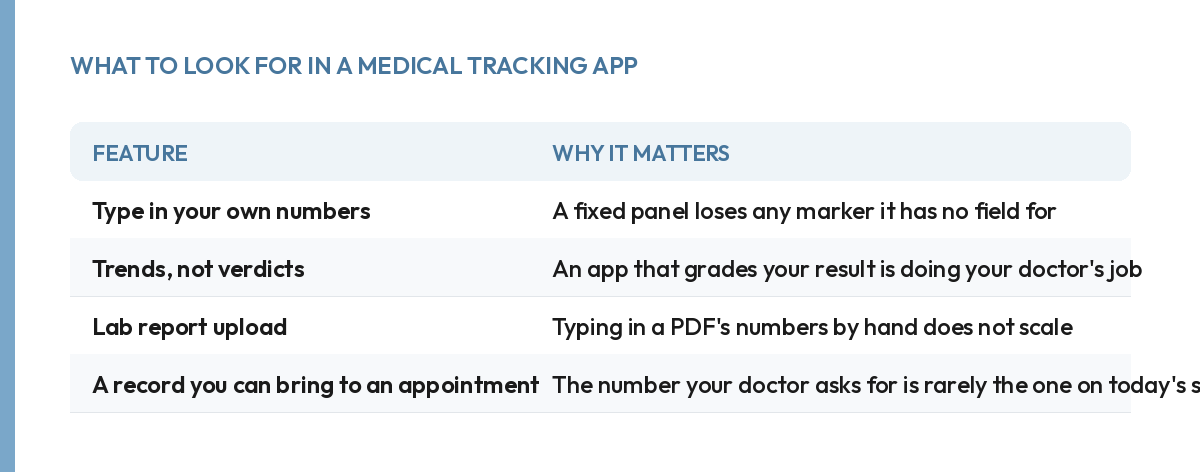
Whether you can type in your own numbers. A fixed panel is the most common limitation in this category. If your doctor orders a marker the app has no field for, that result has nowhere to live.
Whether it shows trends or verdicts. A line across months is information. A green checkmark or a red flag next to a number is a judgment call, and it is one most apps are not qualified to make.
Whether it takes a lab report directly. Retyping a PDF full of numbers by hand does not survive contact with a real week. Upload support is the difference between a tool you use once and one you keep using.
Whether the record actually helps at an appointment. The number your doctor wants is rarely the one glowing on today's screen. A history you can scroll through, or print, matters more than a slick dashboard on the day you happen to open the app.
Where medical tracking apps go wrong.
The most common failure is scope creep in the wrong direction: an app that started as a simple log adds a feature that tells you what a result means, or scores it against a target it invented. That crosses from tracking into advice, and advice about a lab result belongs with a clinician who has the rest of your history, not an app that only has the number you typed in.
The second common failure is the opposite one. An app so narrow it only covers one condition, one marker, or one device, so the moment your situation involves anything else, you are back to a second app and a notebook.
A third, quieter failure is losing the habit itself. A symptom diary or a marker log is only useful if you actually keep filling it in, and the apps that get abandoned fastest are usually the ones that ask for the most typing at the worst possible moment, mid-flare or mid-appointment. The fix is rarely more features. It is fewer taps between noticing something and logging it, and a format flexible enough that a bad day does not also have to be the day you fall behind on the record of it.
Where The Health Project fits, and where it does not.
Any marker can be entered by hand or uploaded from a lab report inside The Health Project, and it sits next to your training, nutrition and sleep rather than alone. Hormones, body composition, resting heart rate and HRV are all included, with trends shown over time so a slow drift is visible before it becomes a problem you notice by feel.
We do not interpret a marker for you, flag one as abnormal, or offer a verdict on a lab result. That stays a conversation with your own doctor, by design, not by omission. How our training side works covers the rest of what a hub-style tracker should do beyond the medical side specifically.
If tracking VO2 max or your day to day intake with calorie tracking is part of what you are trying to bring together with your health markers, that is exactly the gap a single hub is meant to close.
FAQ.
Do medical tracking apps actually help?
For chronic conditions specifically, self-monitoring has been associated with meaningfully lower hospitalisation and readmission rates in reviews of heart failure, hypertension and COPD care.
Should a medical tracking app tell you what a result means?
Be cautious of any app that does. Showing a trend is different from interpreting it, and interpretation is your doctor's job.
Can you track lab results without a wearable device?
Yes. The most useful apps in this category let you type in a number or upload a lab report directly, with no device required.
What is the biggest limitation of most medical tracking apps?
A fixed panel of markers. If the app has no field for a value your doctor ordered, that result has nowhere to go.