Nutrition and Brain Health: What Matters
TL;DR. Nutrition and brain health are connected through one dietary pattern that keeps showing up across the research: something close to a Mediterranean-style diet, built around olive oil, fish, vegetables, nuts and whole grains, with less red meat, refined sugar and processed food. In one systematic review, people with the highest adherence to this pattern had a 54 percent lower risk of developing Alzheimer's disease than those with the lowest adherence, and scored 1.4 times higher on a standard cognitive test. That is population research, not a promise for any one person, but the direction is consistent enough to act on.
Nutrition and brain health: the pattern that keeps showing up.
Across dozens of studies on diet and cognitive function, one dietary pattern comes up more consistently than any single nutrient: an eating style close to what is eaten around the Mediterranean, heavy on unrefined foods and unsaturated fat, light on processed food and red meat. It is the same broad pattern often recommended for heart health, which is not a coincidence, since a lot of what protects blood vessels also protects the blood supply to the brain.
What the Mediterranean-style pattern actually includes.
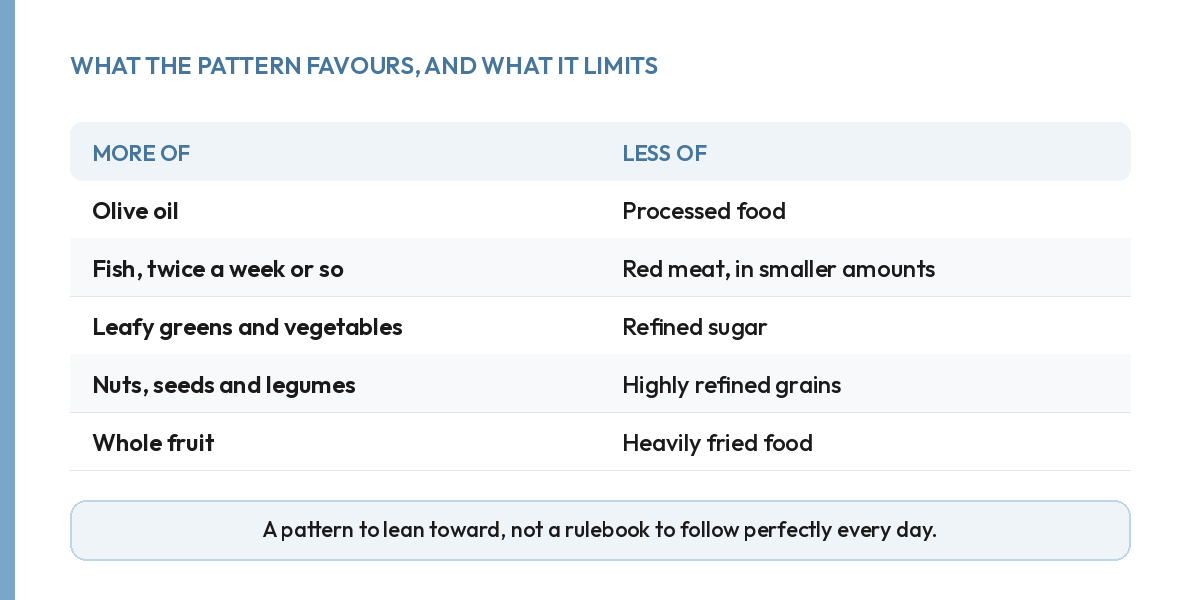
The foods most often credited are olive oil as the main fat, fish a couple of times a week, plenty of vegetables and whole fruit, nuts, seeds and legumes, and unrefined grains over refined ones. Antioxidants from fruit and vegetables, omega-3 fatty acids from fish and olive oil, and fiber from whole plant foods are the specific components researchers point to most often as the likely drivers.
None of this requires eating exactly like a specific region or following a strict meal plan. It is closer to a set of defaults: reach for olive oil over other fats, fish over red meat a couple of times a week, and whole foods over processed ones, most of the time rather than every single meal.
What the research links it to.
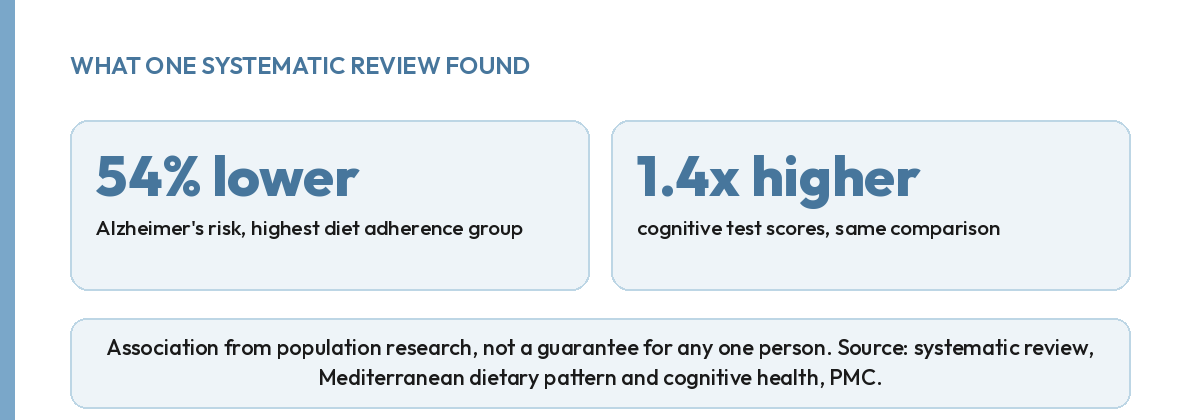
A systematic review of studies on the Mediterranean dietary pattern and cognitive health found that people with the highest adherence to the pattern had a 54 percent lower risk of developing Alzheimer's disease compared with the lowest adherence group, and scored 1.4 times higher on the 3MS cognitive test used in that comparison. Source: Mediterranean dietary pattern and cognitive health, a systematic review.
Those numbers come from comparing groups of people over time, not from a controlled experiment where diet was the only thing that changed, so they describe an association rather than proof that diet alone caused the difference. Genetics, exercise, sleep and general health all play a role too. Still, the direction of the finding is consistent across a large number of separate studies, which is exactly what makes population research like this worth paying attention to.
Does one meal change anything?
Not on its own, and this is worth being honest about. The research behind these numbers reflects a sustained pattern over years, not a single good meal or a single bad one. One salmon dinner does not meaningfully change your risk of anything, in the same way one fast food meal does not undo months of eating well. What moves the number is the pattern most days add up to over a long stretch of time, which is a more forgiving standard than it sounds: an occasional meal outside the pattern does not undo the ones that follow it.
Five practical swaps.
Small, repeatable swaps beat an all-or-nothing overhaul. Cook with olive oil instead of butter or other refined oils most of the time. Put fish on the menu once or twice a week if you are not already eating much of it. Add a vegetable or a piece of fruit to a meal that currently has neither. Swap a refined grain, white bread, white rice, for a whole grain version when it is an easy substitution. Reach for a handful of nuts instead of a packaged snack a couple of times a week.
None of these need to happen at once. Picking one and holding it for a month tends to stick better than trying to do all five from day one, and the pattern does not ask you to track every gram of any nutrient to get the benefit. Consistency in the general direction matters far more than precision in any single week.
If you already track your food for training or weight goals, the good news is you rarely need a separate system for this. The same log that shows your protein and calories also shows whether fish, vegetables and whole grains are actually showing up on your plate most days, or whether the pattern above is still mostly an intention.
Where this fits with training and sleep.
Diet is one input alongside training and sleep, not a replacement for either. Your nutrition targets inside The Health Project track calories, protein and the wider set of nutrients this pattern is built on, and they are meant to be adjusted as your training and recovery change rather than followed rigidly. If tracking what you eat feels like the missing piece, our rundown of free food tracking apps and how to actually log what you eat cover the practical side of getting started.
We show you the trend. We do not tell you what your result means. If something looks off, that is a conversation for your doctor.
FAQ.
Is there one food that is best for brain health?
No single food does it. The research points to an overall pattern, olive oil, fish, vegetables, nuts and whole grains, rather than any one ingredient on its own.
Does diet actually lower dementia risk?
Population research links higher adherence to this pattern with a meaningfully lower risk in the groups studied. That is an association from research, not a guarantee for any one person, and it works alongside other factors like exercise, sleep and genetics.
How much fish do I need to eat?
Roughly twice a week is the amount most commonly used in the research behind this pattern.
Does this mean I have to give up red meat and sugar completely?
No. The pattern is about eating less of them and more of the foods above, not eliminating them entirely.