Sleep Trackers Best for Watching the Trend, Compared
TL;DR. The sleep trackers best known for accuracy in 2026 are the Oura Ring 4, WHOOP 5.0, Apple Watch, Fitbit and Circular Ring 2, each built around a different priority: staging accuracy, recovery coaching, all-in-one convenience, budget simplicity, or subscription-free features. All five are good at sensing sleep. None of them, on their own, show that sleep next to your training and your nutrition, which is the part that actually changes what you do with the number.
The sleep trackers best known for accuracy, five compared.
There is no single best device, because "best" depends on what you already own and what you care about most. Here is where five well reviewed trackers each stand out.
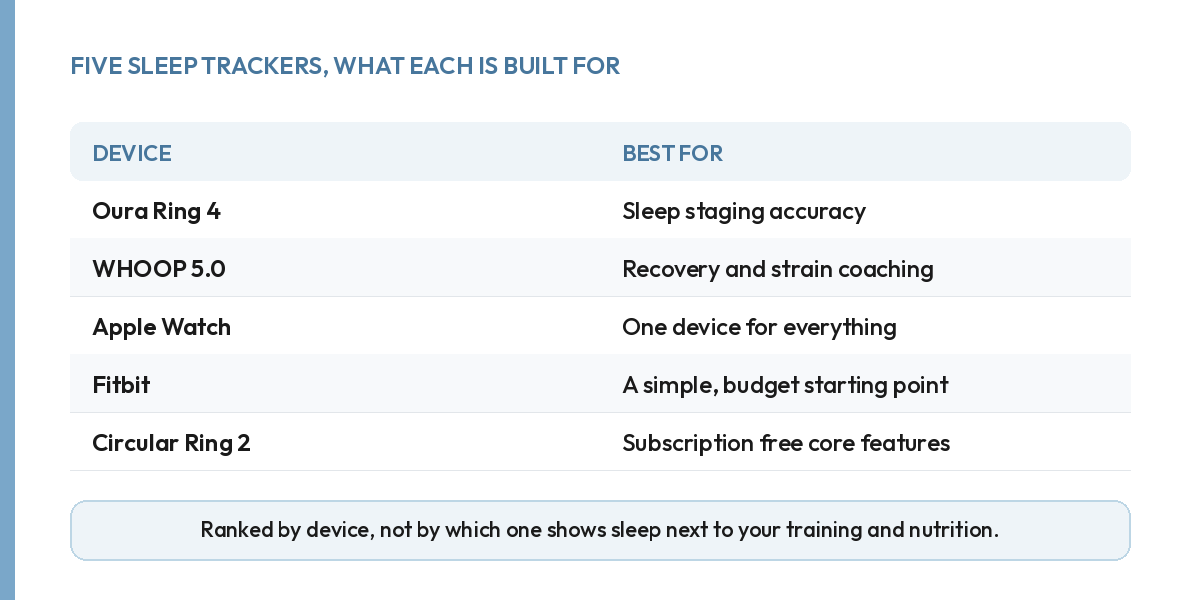
Oura Ring 4. Rated by Sleep Foundation as the top sleep tracker of 2026, with sleep-staging accuracy tested against clinical polysomnography. If sleep is your single priority, this is the device most reviewers point to first.
WHOOP 5.0. A subscription wristband built around recovery and training load rather than sleep alone. It estimates sleep from heart rate variability and motion, then reports it alongside a strain and readiness score aimed at people training hard.
Apple Watch. Not a sleep specialist, but the "one device for everything" option: sleep, workouts, heart rate and notifications in a single watch you were probably already wearing.
Fitbit. The basics-first option. Sleep stages, a nightly score, and a lower price than most of the others on this list, with fewer of the extra metrics WHOOP and Oura report.
Circular Ring 2. The newest and most feature-dense ring on this list, with a proactive coaching layer and over a dozen features that do not require an ongoing subscription.
Sources: Sleep Foundation, best sleep trackers of 2026 and Tom's Guide, best sleep trackers 2026.
What none of these device rankings tell you.
Every roundup like the one above answers the same question: which device senses sleep most accurately, using the same movement and heart rate signals we cover in what a sleep tracker app actually measures. None of them answer a different question that matters just as much: where does that number live once you have it.
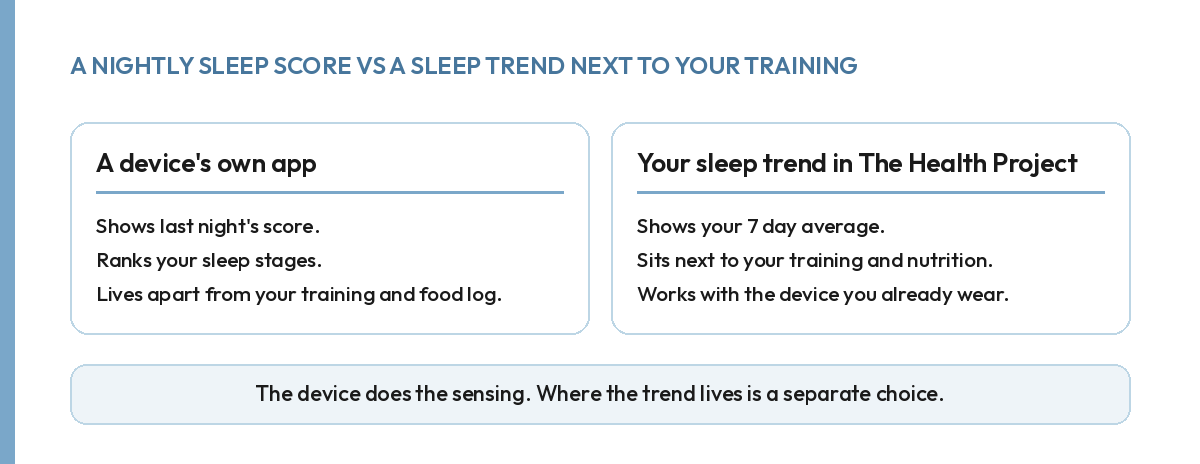
A device's own app shows you last night's score and how your stages broke down. What it does not show is that score sitting next to the training you logged the same week, or the calories and protein you actually ate. Sleep, training and eating all affect each other, but reviewing them in three separate apps makes that connection easy to miss.
What actually changes once you can see the connection.
Say your sleep score has been low for a week. Looked at on its own, that is just a number trending down. Looked at next to your training log, it might line up with a week where your training volume jumped, or a week you started a new programme. Looked at next to your nutrition, it might line up with eating later than usual most nights. None of that is visible from inside a sleep tracker's own app, because a sleep tracker's own app was never built to show your training or your food.
This is not a case against any of the five devices above. The sensing is the hard part, and all five do it well. The part that gets ignored is not the sensor, it is where the number goes afterward, and whether it ever sits next to the other two things that explain most of why sleep changes in the first place: how hard you trained, and how you ate.
Which sleep tracker is the most accurate?
Of the five above, the Oura Ring 4 is the one most consistently rated most accurate for sleep staging against clinical testing. If staging precision is the only thing you care about, that is the honest answer. For most people trying to understand their own sleep well enough to act on it, consistency matters more than precision down to the last percentage point.
Bringing your sleep tracker into one place.
In your sleep inside The Health Project, sleep comes from whichever device you already wear: Apple Health, Google Fit, Garmin, Fitbit, Oura or Whoop. You set a sleep target, and you see your nightly trend and your 7 day average next to your training and your nutrition, rather than in a separate app that never talks to either. The same approach applies to VO2 max: the device measures it, and the trend is where the number becomes useful.
We show you the trend. We do not tell you what a single low night means. That is a conversation for your doctor if a pattern concerns you.
None of this asks you to buy a new device or switch away from one you like. Whichever of the five trackers above you already wear, or plan to buy, connecting it takes a few minutes, and the sensing it does stays exactly the same. What changes is only where the number lives afterward, and what it sits next to once it gets there.
FAQ.
Which sleep tracker is the most accurate?
The Oura Ring 4 is widely rated the most accurate for sleep staging, tested against clinical sleep studies. Accuracy is only one factor. What you do with the number matters as much as how precise it is.
Do I need a ring or is a watch good enough?
A watch is good enough for most people. A ring tends to be more comfortable to sleep in and slightly more accurate for sleep staging, but either one gives you a usable trend if you wear it consistently.
Can I use my existing sleep tracker with a coaching app?
Yes, if the app connects to it. The Health Project reads sleep data from Apple Health, Google Fit, Garmin, Fitbit, Oura and Whoop, so you keep the device you already have.
Does a higher sleep score mean better recovery?
Not on its own. A single night's score is affected by travel, alcohol, illness and stress. The trend over several weeks tells you far more than any one night.