Sleep Trackers App: What They Measure and What They Miss
TL;DR. A sleep trackers app estimates your sleep from movement, heart rate and sometimes sound. It is generally decent at total time asleep and much weaker at breaking that into stages. Use it for the trend across weeks, not for last night's score, and check it against your training and your energy rather than on its own. One honest note, we make an app that holds sleep data among other things.
How a sleep trackers app estimates your night.
None of these devices measure sleep directly. Measuring sleep properly means recording brain activity, which needs electrodes and a laboratory. A sleep trackers app never does this. It infers.
Consumer trackers estimate instead, usually from some combination of movement, heart rate, heart rate variability and breathing. A period of stillness with a slow, steady heart rate reads as sleep. Restlessness and an elevated heart rate read as awake or light sleep. Phone apps that sit on your mattress use movement and sound picked up by the microphone instead of a sensor on your body.
That estimate is reasonable for the coarse question, were you asleep, and much weaker for the fine one, which stage were you in. Stage classification (light, deep, REM) is built from statistical patterns in movement and heart rate that correlate with lab-measured stages on average, across many people. Your one night is not the average, so the stage line moves around more than the total time line does.
Which sleep numbers can you actually trust?
Reasonably trustworthy. Roughly when you fell asleep, roughly when you woke, total time asleep, and how much all of that moves across weeks.
Treat with caution. Deep sleep and REM percentages. Stage estimates are the weakest part of consumer sleep tracking.
Ignore entirely. A single night's score. Sleep varies enormously night to night for reasons that have nothing to do with your health: a late meal, a hot room, one drink, an argument, a different pillow.
The rule. If a number would change what you do tomorrow, check it is based on a trend and not one night.
The main kinds of sleep trackers app.
Rings. Oura describes its ring as giving round the clock insights into sleep, fitness and stress. Worn on the finger, so it is not on your wrist while you sleep, and small enough that most people forget it is there.
Straps. Whoop is a screenless band aimed at recovery and strain rather than notifications. No display means less temptation to check it at 3am.
Watches. Apple Watch, Garmin and Fitbit all estimate sleep alongside training. Convenient if you already wear one for the day, though charging overnight often collides with bedtime, which is the main complaint people have about watch-based sleep tracking.
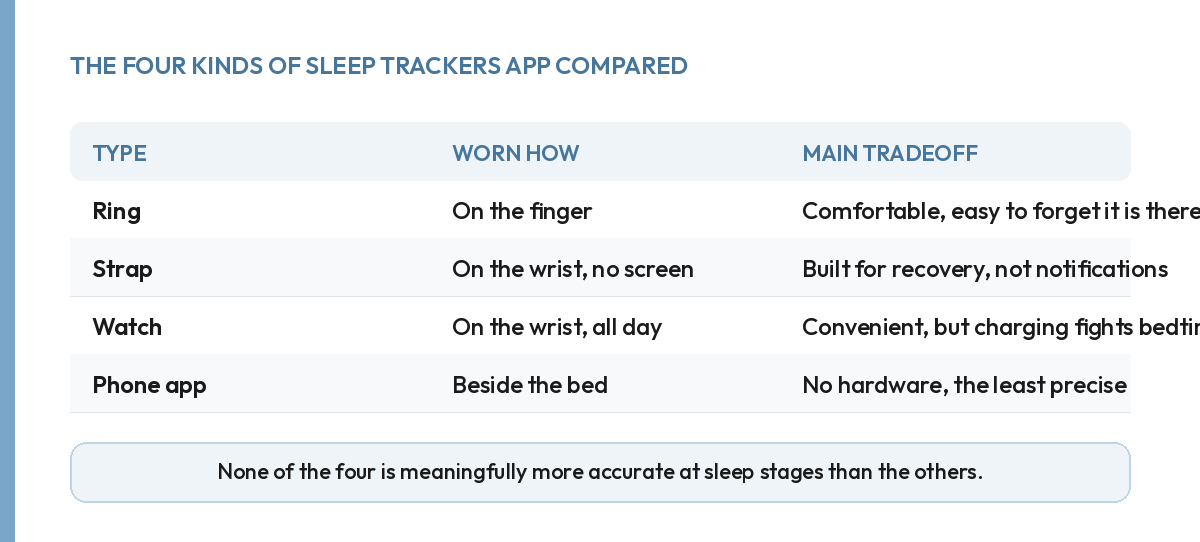
Phone apps. Sleep Cycle describes itself as using sound analysis to track and improve sleep. No extra hardware and nothing to charge, and the least precise of the four because it is reading the room, not your body.
What a good sleep trackers app adds beyond the score.
A score on its own tells you almost nothing you can act on. The useful question is not how you slept last night. It is whether your sleep gets worse in your heaviest training weeks, whether your resting heart rate drifts when it does, and whether the weeks you slept best were the weeks you lifted best or ran fastest.
Answering that needs your sleep sitting next to your training, and almost every sleep app is built to keep it separate. A ring app shows you a ring's data. A watch app shows you a watch's data. Neither one is looking at what you actually did in the gym that same week.
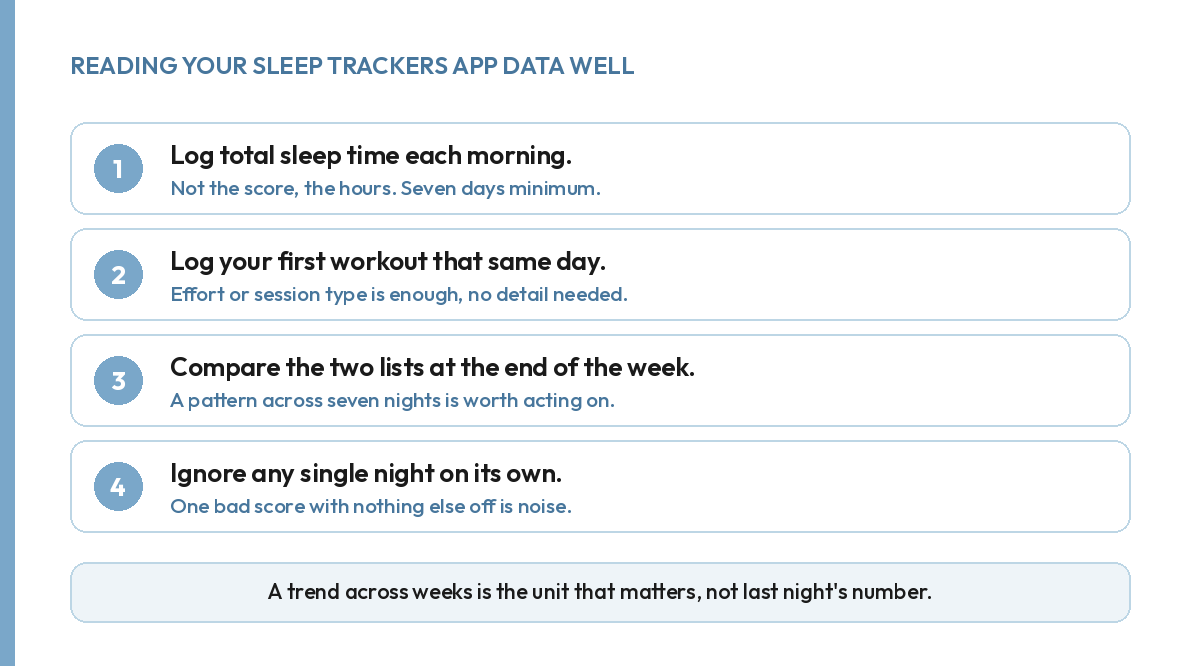
What to do this week, whatever app you use. Write down your total sleep time each morning next to your first workout of the day, for seven days. At the end of the week, look at the two lists side by side rather than at either one alone. A pattern across seven days is worth acting on. A single night almost never is.
This is what we built The Health Project for. Set a sleep target and see your trend against it, next to your training, your nutrition and your recovery markers. It connects with your Apple Health, Google Fit, Garmin, Fitbit, Oura and Whoop, so whatever you already wear keeps working, and your sleep sits next to the training log rather than in a separate app.
We show you the trend. We do not diagnose anything. Persistent poor sleep is worth raising with your doctor rather than solving with a device.
Choosing between them.
If you already train with a watch or a heart-rate strap, the simplest option is to let that same device estimate your sleep rather than buying a second one. A ring is worth the extra cost mainly for comfort, since sleeping with nothing on your wrist is a real preference for some people. A phone app is the right starting point if you are not sure you will keep tracking at all, since it costs nothing to try and needs no hardware.
None of the four is meaningfully more accurate at stages than the others. Choose on comfort and what you already own, not on a claimed accuracy number, and judge it the same way you would judge your training data: by whether the trend across weeks lines up with how you actually feel. Switching between two different trackers in the same month will make it look like your sleep changed when only the measuring device did, so pick one and stay with it for at least a month before comparing numbers.
FAQ.
How accurate are sleep tracker apps?
Reasonable for total sleep time, weaker for sleep stages. Best used for trends across weeks.
Do you need a wearable to track sleep?
No. Phone apps estimate from sound and movement, less precisely.
Should you worry about a bad sleep score?
No. Single nights vary for many harmless reasons. A sustained change is the thing worth noticing.
Can a sleep tracker diagnose a sleep disorder?
No. If you suspect one, that is a conversation for your doctor.