The Calorie Balance Equation, Explained
TL;DR. The calorie balance equation is energy in minus energy out, and the equation itself is correct: a genuine surplus adds weight over time, a genuine deficit removes it. What breaks is the assumption that energy out holds still while you diet. Researchers modeling the popular 3,500 calories per pound rule against a validated dynamic model found it can overestimate a year's weight change several times over, because it ignores that your body burns less as you lose. Movement and activity, the part people obsess over, is only 15 to 30 percent of what you burn each day, and it varies by up to 350 kcal between two similarly sized people.
The calorie balance equation, in one line.
Energy in minus energy out. That is the whole equation, and it is not wrong. It comes directly from the laws of thermodynamics, and no diet, supplement or training programme gets around it.
What goes wrong is not the equation. It is treating both sides of it as fixed numbers you can calculate once and rely on for months.
Does losing weight really work like 3,500 calories equals one pound?
Not the way it is usually applied, no.
The 3,500-calorie rule, cut that many calories and lose a pound, comes from a rough estimate of the energy stored in a pound of body fat. The problem is not that estimate. It is that the rule treats your energy out as constant, when it is not.
Researchers at the National Institutes of Health who study body weight directly have said so plainly: the 3,500-kcal rule leads to overestimation of weight loss in individuals and populations, because it treats the difference between what you eat and what you burn as a fixed number instead of a moving one. Run the static version of the rule out over months, and it predicts an exaggerated weight change with no plateau, which is not what actually happens to a real person on a real diet.
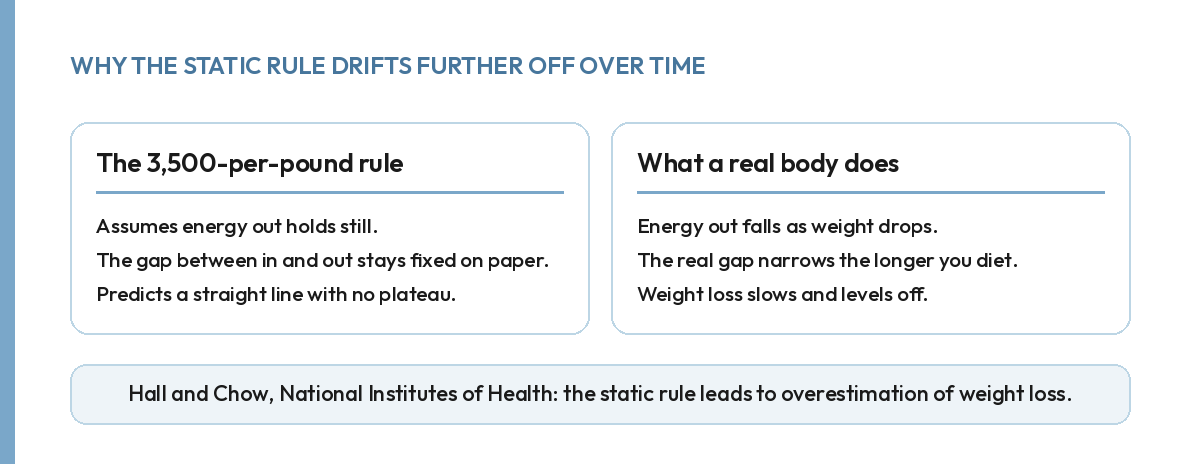
Source: Hall and Chow, why the 3,500 kcal per pound weight loss rule is wrong, International Journal of Obesity.
The direction is the point: a static per-pound rule gets less accurate the longer you run it, because your body is not a spreadsheet that holds still while the plan executes.
Where energy out actually goes.
Energy out has four parts, and they are not equal in size.
Resting metabolism, the energy your body uses just staying alive, is the largest share by far. Digesting food takes a smaller, fairly steady slice. Movement and activity, including both deliberate exercise and everyday fidgeting, walking and standing, makes up roughly 15 to 30 percent of the total, and that share is genuinely different from person to person.
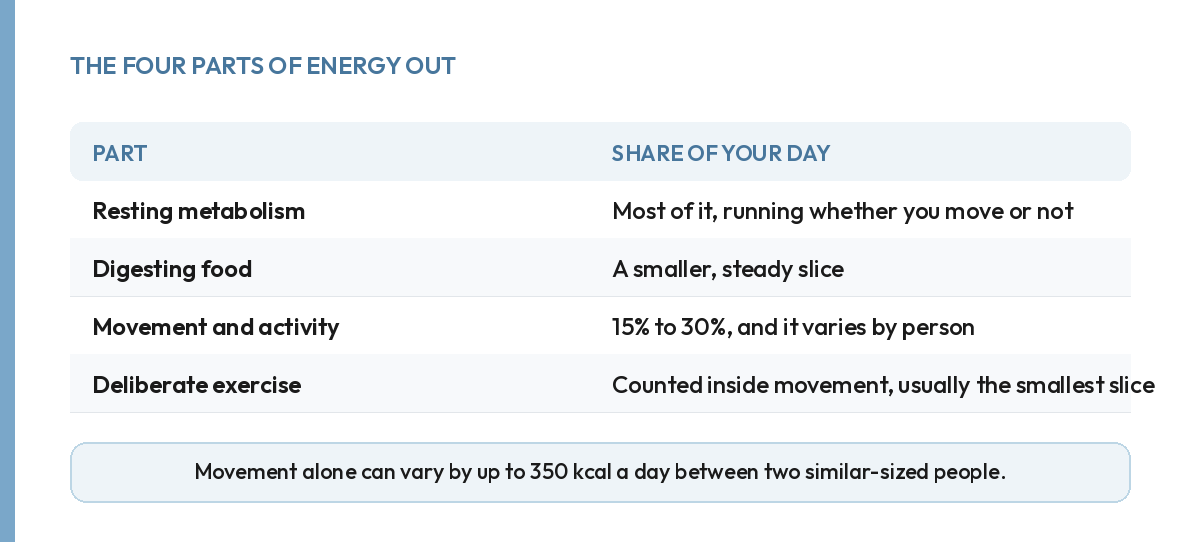
Source: a review of non-exercise activity thermogenesis, a component of total daily energy expenditure.
That variability is bigger than most people expect. The same review notes that two similarly sized people can differ by up to 350 kcal a day purely from how much they move outside of deliberate exercise, which is roughly what a brisk 45 minute walk burns. None of that shows up on a bathroom scale or in a training log. It shows up as one person's maintenance calories running noticeably higher than another person who looks the same size on paper.
Why the equation stops matching the scale.
Here is the part that actually explains most stalled weight loss. As you lose weight, your resting metabolism drops because a smaller body needs less energy to run. Movement often drops too, quietly, without a conscious decision to move less.
So a deficit that was real in week one can shrink to nothing by week six, with your intake completely unchanged. The equation has not failed. The right side of it, energy out, moved while you were not looking at it.
This is exactly what calorie balance in practice is really about: not calculating a perfect number once, but tracking your own trend and adjusting when the evidence, not the arithmetic, says the deficit has closed.
Using the equation without the false precision.
Do not treat any calorie number, yours or an app's, as exact. How many calories you should eat a day is a starting estimate, never a fact, and the same is true of any number a fitness watch reports for a workout.
Watch the trend, not the day. Two to three weeks of a stable weekly average while you are meant to be in a deficit is the real signal that energy out has adjusted, not a reason to trust the original math harder.
Expect to adjust more than once. A plan that assumed a fixed deficit for six months is built on the version of the equation that does not hold. One built to be revised every few weeks is built on the version that does.
This is what we built The Health Project for. Your training, your nutrition and your weight sit together, so when a deficit that used to work stops moving the scale, you can see whether your movement quietly dropped rather than guessing at a number nobody can calculate exactly in the first place. If you would rather have someone read that trend and adjust the plan for you, that is what my coaching is for.
FAQ.
What is the calorie balance equation?
Energy in minus energy out. Eat more than you use and you gain weight over time. Use more than you eat and you lose it. The equation is correct. The part that trips people up is that energy out moves.
Is the 3,500 calories equals one pound rule accurate?
No. Researchers who modeled it against a validated dynamic model found the static rule can overestimate real weight change by many times over a year, because it ignores that energy use falls as your body changes.
What burns the most calories in a day?
Resting metabolism, by a wide margin. Movement and activity account for roughly 15 to 30% of what you burn, and that share varies a lot from person to person.
Why does weight loss stall even when I am still in a deficit on paper?
Because the deficit on paper assumes energy out stays fixed. It does not. As you lose weight and move a little less without noticing, the same intake that once created a deficit can quietly become maintenance.