How Many Calories Should I Eat a Day?

TL;DR. How many calories should I eat a day? For most adults it falls somewhere between 1,600 and 2,400 for women and 2,000 and 3,000 for men, depending on activity level. That range is a starting point, not an answer. The number that actually works for you changes as your weight, your training and your recovery change, which is why a target set once and never touched again tends to stop working within a few weeks.
How many calories should I eat a day?
There is no single correct number, because the honest answer depends on your age, sex, height, current weight, muscle mass and how active you are. What follows is the general range most adults fall into, then why that range is only a starting point rather than a plan.
What determines how many calories you need.
Your daily calorie need, often called your maintenance level, comes from two things added together. The first is your resting energy use, the calories your body burns just staying alive: breathing, circulating blood, keeping you warm. The second is everything on top of that: walking, training, fidgeting, digesting food. Age, sex, height, weight and muscle mass all move the resting number. Activity level moves the rest.
Two people of the same age, sex and weight can have noticeably different needs if one of them trains five days a week and the other sits at a desk. That is the biggest single reason a one-size number is wrong for most people who ask this question. It is also why calorie balance is a moving target rather than a fixed sum: energy in and energy out both shift as your week changes.
Typical daily calorie ranges, by sex and activity level.
These are general population ranges, not personal targets. Cleveland Clinic puts sedentary women at roughly 1,600 to 1,800 calories a day and sedentary men at roughly 2,000 to 2,200, rising for very active adults to about 2,200 to 2,400 for women and 2,600 to 3,000 for men.
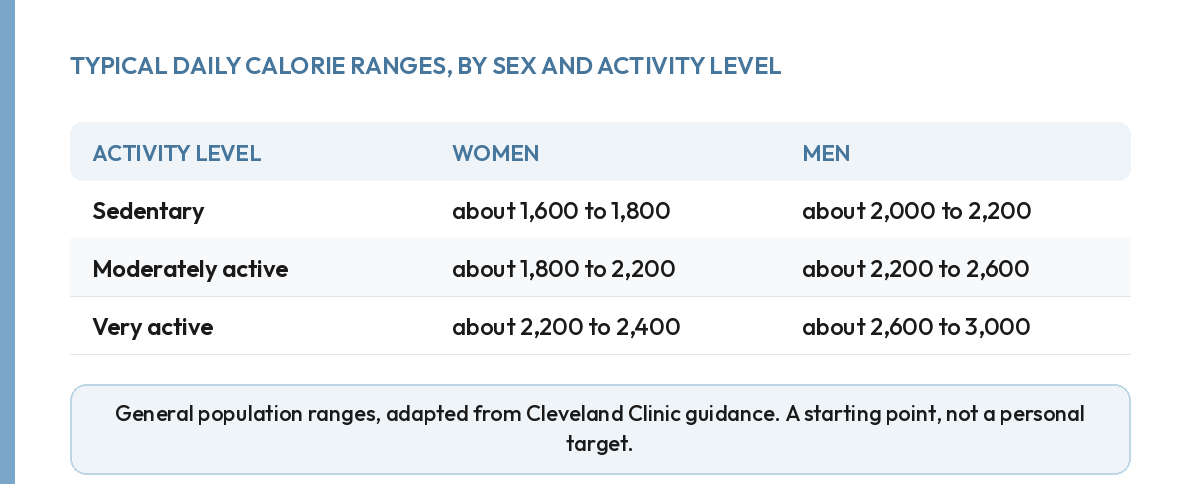
Source: Cleveland Clinic, how many calories a day should I eat.
The same guidance sets a floor: most women should not go below about 1,200 calories a day, and most men should not go below about 1,500, without a doctor's supervision. Below that, the body starts giving up more than fat.
Why a generic number stops working.
Type this question into a search engine and you mostly get the same shape of answer: a table like the one above, or a calculator that asks your age, sex, height, weight and activity level once and hands back a single figure. That figure is a reasonable starting estimate. What it is not is something that keeps up with you.
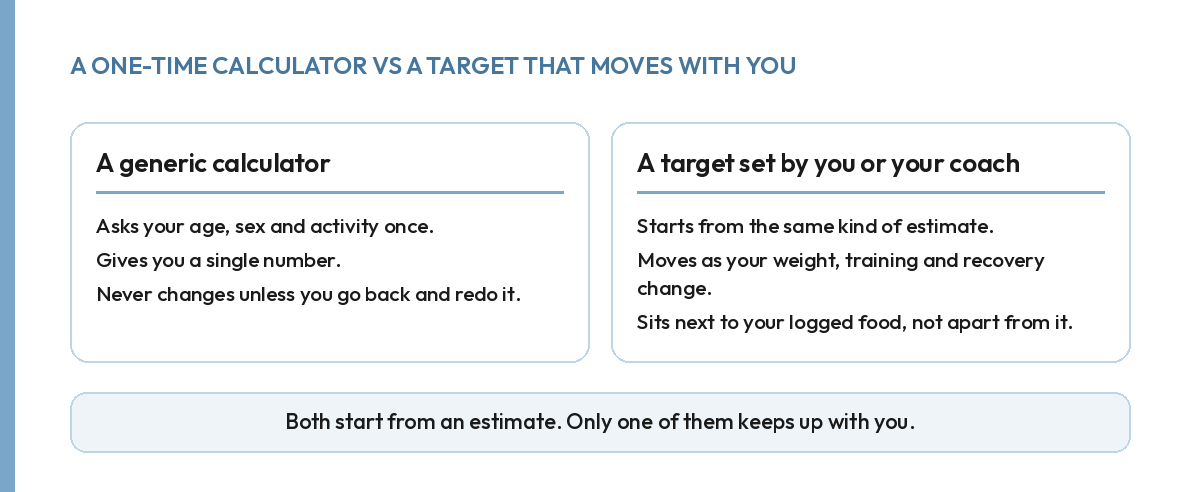
Your real need moves. It drops as you lose weight, because a lighter body burns less. It rises on a week where training volume goes up. It changes around a stressful month, a long recovery stretch, or a stretch of poor sleep. A calculator answers the question once. Your actual body keeps asking it every week.
How many calories should I eat to lose weight?
A common starting point is about 500 calories a day below your maintenance level, which tends to produce a loss of roughly a pound a week. That math only works if the maintenance number underneath it is close to correct, and it stops working the moment your weight, and therefore your maintenance level, moves.
This is the part most calorie advice skips. The deficit is easy. Knowing when to recalculate the number it is subtracted from is the part that actually determines whether the plan holds up past the first few weeks.
What about protein and other macros?
Calories are only half the picture. The same total can come from very different mixes of protein, carbohydrate and fat, and the mix changes how you feel and how much muscle you keep while losing weight. A common starting point for someone training regularly is roughly 0.7 to 1 gram of protein per pound of body weight, with carbohydrate and fat filling in the rest of the target. This is another number that should move with your training, not sit fixed for months.
A single VO2 max reading or a single calorie number both suffer from the same problem: neither one means much without the trend behind it. The same logic that applies to tracking VO2 max over time applies here. One day's total tells you almost nothing. Weeks of totals, compared against how your weight and training are actually moving, tell you whether the number is right, which is also why how you log what you eat matters as much as the target itself.
How your target should change over time.
In your nutrition inside The Health Project, your calorie target is set by you or by your coach, and it is built to be adjusted rather than fixed. As your weight changes, your training changes, or your recovery changes, the target moves with it instead of quietly going stale. You log a meal by photographing it or searching the food library, and calories and macros are filled in against whatever target is current that week.
There are no required meal plans and no obligation to log everything forever. The target is there for the weeks you want a number to aim at, sitting next to your logged training and your sleep rather than living in a separate app that never talks to either.
FAQ.
How many calories should I eat to lose weight?
Roughly 500 calories a day below the number that keeps your weight steady, which produces a loss of about a pound a week for most people. Your own starting point still has to come from your own maintenance level, not a general rule.
Is 1,200 calories a day too low?
For most women it is close to the floor doctors use as a lower bound, and for most men it is below it. Going under that level for long is more likely to cost you muscle and energy than to speed up fat loss.
Do I need to eat the same number of calories every day?
No. Training days, rest days, travel and stress all change what you need. A weekly average matters more than hitting one number every single day.
Why did my calorie target change after I lost weight?
A lighter body burns fewer calories at rest and during activity. A target that does not come down as you do will slow your progress or stall it.