Cardio Conditioning Class vs Training on Your Own
TL;DR. A cardio conditioning class and training on your own land closer together than either side of that argument usually admits. A meta-analysis of 30 randomized trials and 2,830 adults found near identical attendance, 81 percent, for supervised class-style training and unsupervised training alone, with the class format only modestly ahead on strength outcomes. The real difference is not fitness gained. It is what keeps you showing up: a class gives you a set time and someone else setting the pace, training alone gives you flexibility and costs less. Pick based on which one you will actually do in six months.
Cardio conditioning class or training on your own: the real difference.
The argument usually gets pitched as one being objectively better. The evidence does not support that framing.
What the research actually shows is that both formats work, both are roughly as likely to fail through non-attendance, and the difference between them shows up in how each one is used, not in some inherent superiority of instructor-led group cardio over doing your own thing.
Which one actually gets you fitter?
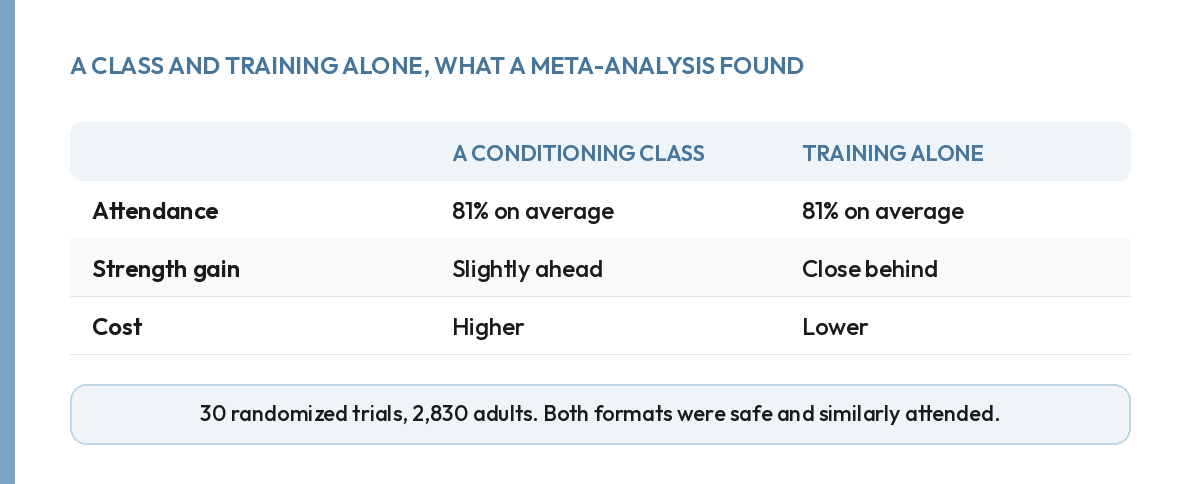
Close to the same, on average. A systematic review and meta-analysis of 30 randomized controlled trials covering 2,830 adults compared supervised training, the class model, against unsupervised training, going it alone. Both groups averaged 81 percent attendance across the trials. Supervised training came out slightly ahead on strength measures such as knee extension strength, though the effect size was small, and the advantage on functional tests like sit-to-stand did not hold up once the researchers tested it for robustness.
Source: a meta-analysis of supervised versus unsupervised exercise, Sports Medicine, 2024.
That is not a strong enough gap to build a decision around fitness alone. If the class format wins for you, it is winning on something else.
What a conditioning class gives you that training alone does not.
An instructor sets the pace, the intervals and the intensity, which removes a decision most people make badly when left to themselves: how hard is hard enough. A booked class time also works like an appointment, and appointments get kept more often than open-ended intentions.
There is a real psychological driver behind why this works for some people and not others. A systematic review of 21 studies on group fitness classes found that perceived capability, essentially whether someone believes they belong in the room, was the strongest predictor of whether they kept coming back. One contrast in that review showed an attendance gap of up to 28 percentage points between people who felt capable in the class setting and people who did not.
Source: a systematic review of psychosocial predictors of group fitness adherence, International Journal of Environmental Research and Public Health, 2025.
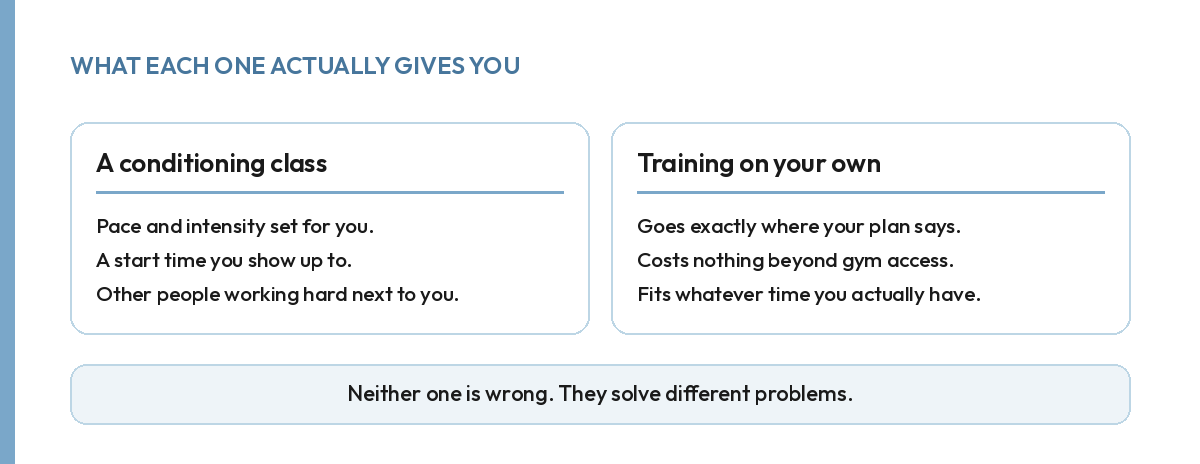
So a class helps most when the barrier is confidence, motivation or knowing how hard to push. It helps less when someone already knows what they are doing and just needs the time in a schedule that a fixed class cannot always offer.
Where training on your own wins.
Cost is the obvious one. A class carries a per-session or membership price that solo training on existing gym access does not.
Flexibility is the other. A class happens at 6pm on Tuesday whether that suits your week or not. Training alone happens whenever you actually have forty minutes, which matters more than it sounds like once real life starts interfering with a fixed schedule.
The gap the research leaves you with is small enough that this is really a practical decision, not a physiological one. If a class time is the reason you get out the door, that time is doing real work. If a class time is the reason you keep skipping because your schedule cannot hold it, the class is costing you sessions rather than buying them.
Getting the conditioning benefit either way.
Whichever format you pick, the same basics still apply. Warm up and mobility done in the right order matters just as much before a class as it does before a solo session, and a class's built-in warm-up segment is not always long enough on its own. If you are building your own cardio session from scratch, progressive overload applies to conditioning work too: the intervals or pace that felt hard three weeks ago should not still be the ceiling now.
Structure is the part that is easy to lose when nobody is calling out the next interval for you. Inside The Health Project, your training log holds your cardio sessions next to your strength work, so a solo conditioning session still gets recorded and compared against last week instead of disappearing the moment class isn't there to track it for you.
If you want the accountability of a class without the fixed schedule, that is closer to what my coaching provides: a plan and someone checking in, on your own time.
FAQ.
Is a cardio conditioning class better than training on your own?
Not overall. A meta-analysis of 30 trials found near identical attendance between supervised, class-style training and unsupervised training, with the class format only slightly ahead on strength outcomes.
Do you get fitter faster in a class?
Not by much. The instructor sets your pace and pushes intensity you might not choose on your own, but the research shows the gap in actual outcomes is small.
Why do people stick with classes when they hated the gym alone?
Mostly self-efficacy and belonging. A review of 21 studies found attendance differed by as much as 28 percentage points between people who felt capable in a class and people who did not, which has more to do with confidence and fit than the workout itself.
Can training on your own be just as effective as a class?
Yes, if you actually show up. The research shows similar attendance rates for both formats. The class buys you a start time and a pace you cannot argue with. Training alone asks you to supply both yourself.