Warm Up and Mobility: What to Do Before You Lift
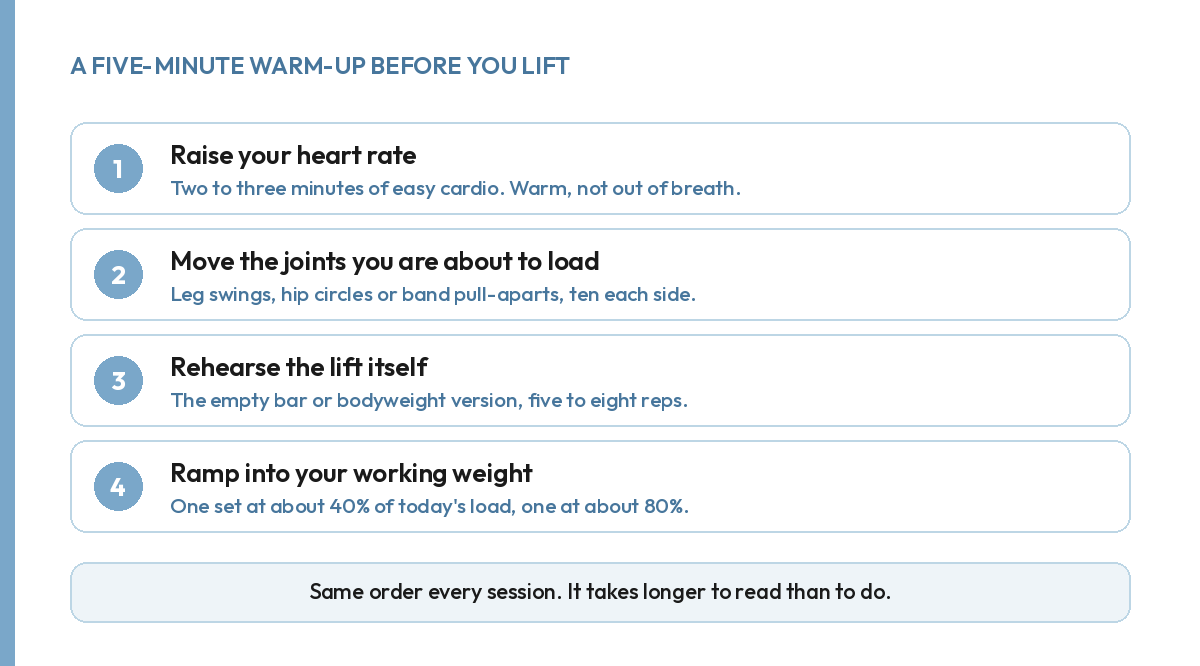
TL;DR. Warm up and mobility before you lift means four things, in order: raise your heart rate, move the joints you are about to load, rehearse the lift itself with no weight, then ramp into your working weight with one set at about 40% and one at about 80%. Skip long static stretching right before a heavy set, since holding a stretch past about a minute can temporarily reduce how much force that muscle can produce. The whole thing takes about five minutes and the ramp-up sets alone measurably change how your first working set feels.
Warm up and mobility, in the right order.
Most people either skip this entirely or do the wrong version of it: a handful of static stretches, held for thirty seconds each, done cold before touching a weight. That is close to the opposite of what the research actually supports.
The order that holds up is raise, move, rehearse, ramp. Each step earns the next one.
Raise. Two to three minutes of easy cardio, a bike, a row, or a fast walk. Warm, not out of breath. This is what actually raises muscle temperature, and it is the part a few stretches on a cold muscle skip entirely.
Move. Joint mobility for whatever you are about to load. Leg swings and hip circles before squats or deadlifts, arm circles and band pull-aparts before pressing. Ten reps a side is enough.
Rehearse. The lift itself, empty bar or bodyweight, five to eight reps. This is where your body relearns the exact pattern it is about to load, not a substitute movement.
Ramp. Working sets that build toward your actual weight, covered below.
Should you stretch before you lift?
Dynamic movement, yes. Long static stretching right before a heavy set, no, or at least not the way most people were taught to do it.
A systematic review of static stretching intensity across 18 studies found that higher-intensity, longer-duration stretching was more likely to produce a short-term drop in strength than lighter, shorter stretching. Of the four studies in that review that measured strength directly, two found that more intense stretching caused a bigger acute strength decrease than lighter stretching.
Source: a systematic review of static stretching intensity on range of motion and strength, Journal of Sport and Health Science, 2023.
Major sports science bodies have moved the same direction: current guidance from groups including the American College of Sports Medicine favors dynamic movement over static stretching as the default warm-up for strength and power work, while stopping short of banning static stretching from a session altogether. The practical version: save the long, deep stretches for after your lift, or for a separate mobility session, and use movement rather than held stretches to get ready for a heavy set.
The warm-up sets that actually change your first working set.
This is the part with the clearest evidence, and the part people skip fastest when they are short on time.
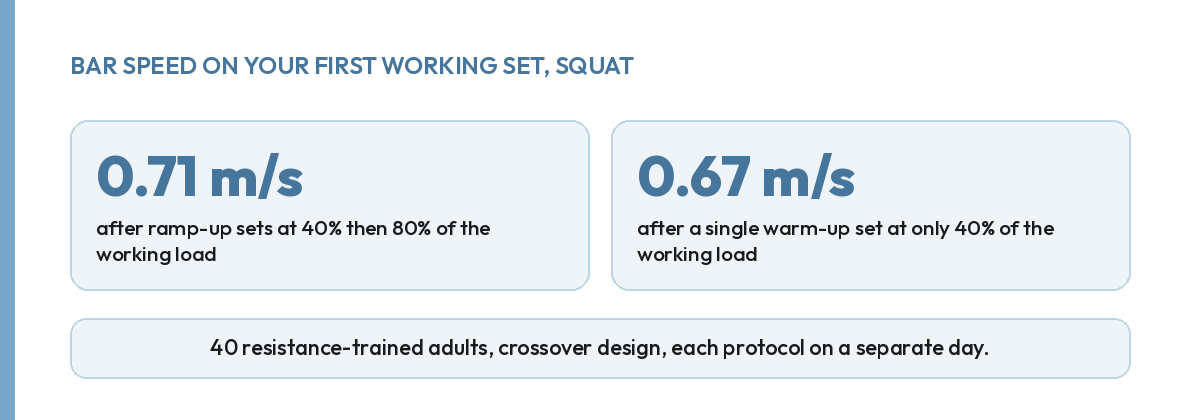
A study of forty resistance-trained adults compared three warm-up protocols before squats and bench press: one light set at 40% of the working load, one heavier set at 80%, or a ramp through both. For squats, warming up through 80% of the load produced meaningfully faster bar speed on the second working set than warming up with only a light 40% set, a difference the researchers found statistically significant.
Source: a study on specific warm-up before bench press and squat, International Journal of Environmental Research and Public Health, 2020.
The practical version of that finding: two ramp-up sets, not zero and not five. One around 40% of what you are about to lift, one around 80%, each for a handful of reps, before the set that actually counts. It costs about ninety seconds and it is the single change most likely to make your first real set feel like the second one instead of the first.
Why this is worth five minutes you do not feel like spending.
Warming up is one of the few things in training with genuinely strong evidence behind it at the population level. A meta-analysis of fifteen studies covering more than 21,000 children and adolescent athletes found that structured warm-up programmes cut sports injury rates by roughly a third compared with a normal warm-up, an effect that held up even after adjusting for publication bias.
Source: a meta-analysis of warm-up programmes and sports injury, International Journal of Environmental Research and Public Health, 2022.
That study is about team sport athletes, not gym lifters specifically, and the injuries it tracks are not identical to a strained shoulder on bench day. But the direction is consistent with everything else here: a body that has been raised, moved through its working range and rehearsed the pattern handles a heavy load better than one going in cold, and the studies that measure it keep landing in the same place.
Warm up and mobility on a time limit.
If you genuinely have three minutes, not five, cut the rehearsal step and keep raise, move, and at least one ramp-up set. Skipping the ramp-up sets entirely is the option that costs you the most, since that is the part with the clearest effect on the set that actually matters.
If a specific joint is consistently tight or sore before it warms up, that is worth its own longer mobility work outside the lifting session rather than stretching it hard right before you load it. Trying to fix a chronic tightness in the ninety seconds before a heavy set is asking the warm-up to do a different job than it is built for.
Building it into your sessions.
The order above is the same every session, whatever you are lifting that day, which is what makes it fast once it is a habit rather than a decision. Progressive overload is the reason your working weight keeps changing, and a consistent ramp-up is what lets you feel that change accurately instead of guessing from a cold first rep. On the days recovery is the limiting factor rather than the warm-up, how many rest days you actually need covers the other half of that balance.
And if soreness the next day has you wondering whether a warm-up would have made a difference, the difference between soreness and an injury is worth reading before you decide to skip a session over it.
Inside The Health Project, your training log holds your last session's weights, so ramping into today's set means reading a real number instead of guessing what you lifted last time.
FAQ.
Should you stretch before you lift?
Dynamic movement, yes. Long static stretching right before your set, no. Static stretching held for more than a minute can temporarily reduce maximal strength, so save it for after training or a separate session.
How long should a warm-up before lifting take?
About five minutes: a couple of minutes to raise your heart rate, then joint movement and a rehearsal of the lift itself. Add your ramp-up sets on top of that, which count as part of the session.
Do warm-up sets actually make you stronger on your first working set?
Yes. In one study, ramping up through 40% then 80% of the working load produced faster bar speed on the first two working sets than jumping straight in from a single light set.
Is mobility work the same thing as stretching?
No. Stretching lengthens a muscle while you hold still. Mobility is moving a joint through the range you are about to ask it to work in, which is closer to what the lift itself demands.