The Progressive Overload Workout: How to Add Load Every Week
TL;DR. A progressive overload workout means asking your body to do slightly more than last time, on purpose, every week. It is the reason training works at all. You can add load four ways: more weight, more reps, more sets, or better control, and adding weight is only the most obvious one. The hard part is not the principle. It is knowing exactly what you did last time.
What progressive overload means.
Your body adapts to what you ask of it. Ask the same thing every week and it has no reason to change.
Progressive overload is the practice of making the demand slightly harder over time. It is not a programme or a method by itself. It is the thing every programme, however it is dressed up, is trying to deliver.
Without it, a workout stays a workout. You show up, you move the same weight for the same reps, and your body settles at whatever level got it there. With it, a workout becomes training. Each session asks a little more than the last one did, and your body has a reason to keep adapting.
The four ways to add load.
More weight. The obvious one. Add the smallest increment your gym has.
More reps. Same weight, one more rep than last time. This is usually where progress lives once the weight stops moving easily.
More sets. Adding a set adds weekly volume. A systematic review grouped weekly volume into low, under 12 sets per muscle group, moderate, 12 to 20, and high, over 20. Adding sets is how you climb those bands.
Source: Baz-Valle and colleagues, a systematic review of resistance training volume.
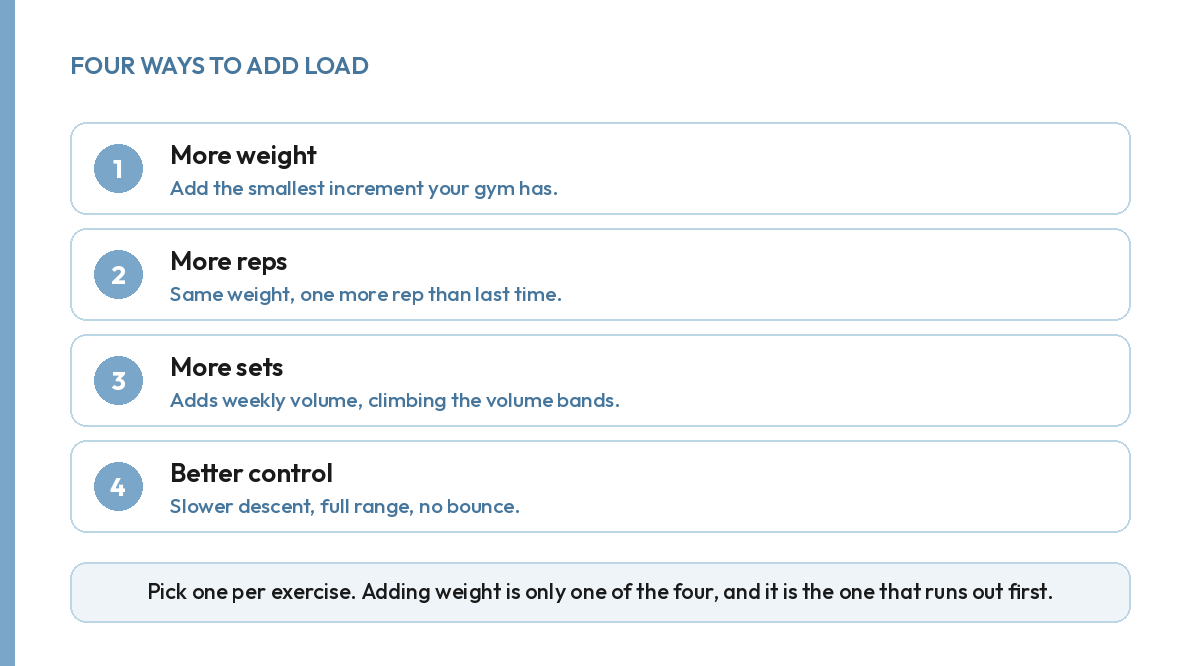
Better control. A slower descent, a full range of motion, no bounce at the bottom. The weight on the bar is the same and the set is still harder than it was.
Most people only ever reach for the first one. The other three keep a progressive overload workout moving long after the weight on the bar has stalled.
Building a progressive overload workout, week to week.
Pick one thing to progress per exercise. Not all four at once, and not on every exercise in the same session.
A simple rule that works for a long time. Stay at the same weight until you hit the top of your rep range on every set. Then add the smallest weight increment available and start again at the bottom of the range.
Worked example, three sets of 8 to 12 on a row:
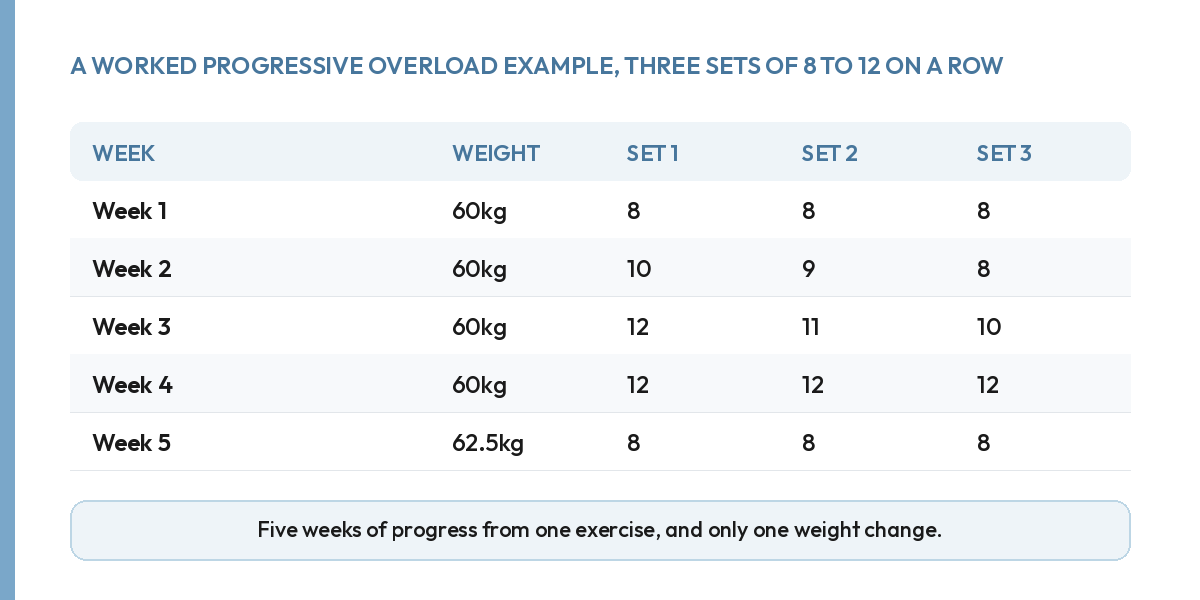
That is five weeks of progress from one exercise, and only one weight change. Nothing about it is dramatic, and that is the point. A progressive overload workout is built from small, repeatable steps, not from adding weight every single session.
The same logic scales down. If your gym has no plates smaller than 2.5kg, spend two or three extra weeks in the rep range before the weight moves. The direction matters more than the speed.
Why does progressive overload stop working?
Because it cannot continue forever in a straight line. Nobody adds weight every week indefinitely, and expecting to is how people conclude a programme has stopped working when the actual issue is smaller.
When progress stalls for two or three weeks in a row, the answer is usually one of three things. You are under-recovered, and need a lighter week, which is what a deload week in a programme is for. How many rest days that actually takes depends on how much you are lifting, not a fixed number. You have outgrown the current volume, and need another set. Or you have been training the same movement for so long that a variation, a different grip, a different angle, would give you somewhere new to grow.
What this looks like without a barbell.
None of this needs a gym full of plates. Bodyweight training progresses the same four ways, with the emphasis shifted.
More reps is usually the first lever: one more push up than last week. More sets comes next. Better control, a slower lowering phase, a longer pause at the bottom, adds difficulty without adding anything at all. And when a movement genuinely runs out of room, more weight becomes a harder variation instead. A push up moves to a decline push up, a bodyweight squat moves to a single leg version.
The bookkeeping is identical either way. What changes is only which lever you are pulling.
The part that actually fails.
The principle is easy. The bookkeeping is what breaks.
To beat last week you have to know what last week was, on every exercise, every set. Written on paper it survives about three weeks. Held in your head it survives about one session, and by the third exercise most people are already guessing. Logging it properly is what keeps that number accurate in the first place.
This is what we built The Health Project for. Every set is logged with its weight and reps, and it reads your last session and suggests the next step. You are not trying to remember, you are just reading, and a progressive overload workout stops depending on your memory.
Any logging app can hold the numbers. If you are weighing yours against the free gym apps most people start with, here is what actually decides which one is worth keeping.
If the split itself, not just the tracking, is the part you want help with, sets and reps written out for a full week shows the same weight and rep logic applied across a whole training week. And if progressing safely matters more than progressing fast, a starting week built around two full body sessions uses the same idea at a gentler pace.
If you would rather have someone build the plan and adjust it as you progress, that is what my coaching is for.
FAQ.
How much weight should you add?
The smallest increment available, usually 2.5kg on a barbell or one plate on a machine. Small jumps are easier to keep making, and they add up over months.
Can you use progressive overload with bodyweight exercises?
Yes. Add reps, add sets, slow the tempo, or move to a harder variation of the same movement.
How often should you add weight?
Whenever you hit the top of your rep range on all your sets. For some exercises that is weekly, for others it is monthly.
Does progressive overload work forever?
No. Progress slows as you get more trained, and everyone needs easier weeks built into the plan.
What happens if I skip a week?
Pick up roughly where you left off rather than starting over. One missed week does not undo months of progress, and a log is there so you do not have to guess what where you left off was.