Grip Strength and Cognitive Function
TL;DR. Grip strength and cognitive function are linked. In a UK Biobank study of 476,559 people, a stronger grip was associated with better reasoning, number memory and prospective memory, faster reaction time, and fewer visual memory errors, all statistically significant. A separate study of more than 40,000 people found stronger grip linked to more grey matter in brain regions tied to memory, and that grip strength measured today predicted cognition roughly nine years later more strongly than the reverse. None of this means a weak grip causes a worse memory. It means the two tend to move together, and grip is the easier one to measure and to train.
What research on grip strength and cognitive function found.
Grip strength is usually measured with a hand dynamometer, a small device you squeeze once with each hand while seated. In a UK Biobank study of 476,559 people, researchers compared maximal grip strength against five cognitive tests: reaction time, reasoning, number memory, visuospatial memory and prospective memory. After adjusting for age, sex, bodyweight and education, a stronger grip was tied to better performance on every one of them, each result statistically significant at P < .001.
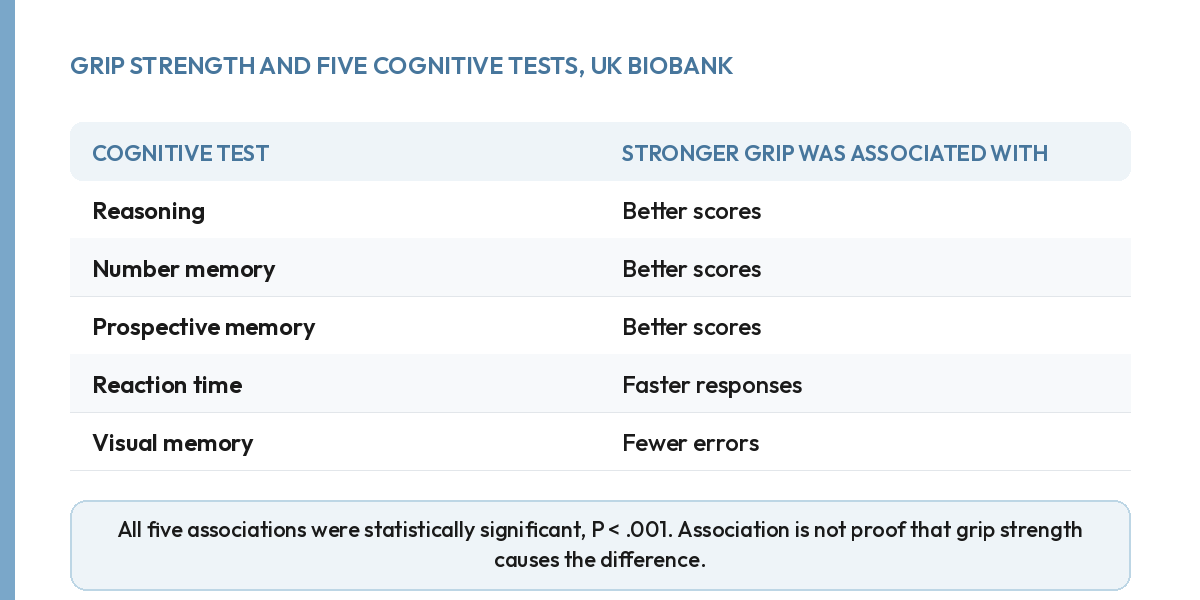
Source: Firth and colleagues, Frontiers in Psychiatry via PubMed Central, grip strength and cognitive performance in the general population.
The grip strength chart, by age and sex.
These are pooled averages from twelve British studies, 49,964 people between ages 4 and 90. Grip strength rises through your twenties, holds through your thirties, then declines gradually from midlife on.
| Age | Men | Women |
|---|---|---|
| 30 | 51.6 kg (± 9.6) | 31.4 kg (± 6.0) |
| 50 | 47.6 kg (± 10.1) | 28.7 kg (± 6.4) |
| 70 | 39.1 kg (± 8.1) | 23.5 kg (± 5.7) |
| 80 | 32.2 kg (± 7.3) | 19.1 kg (± 5.1) |
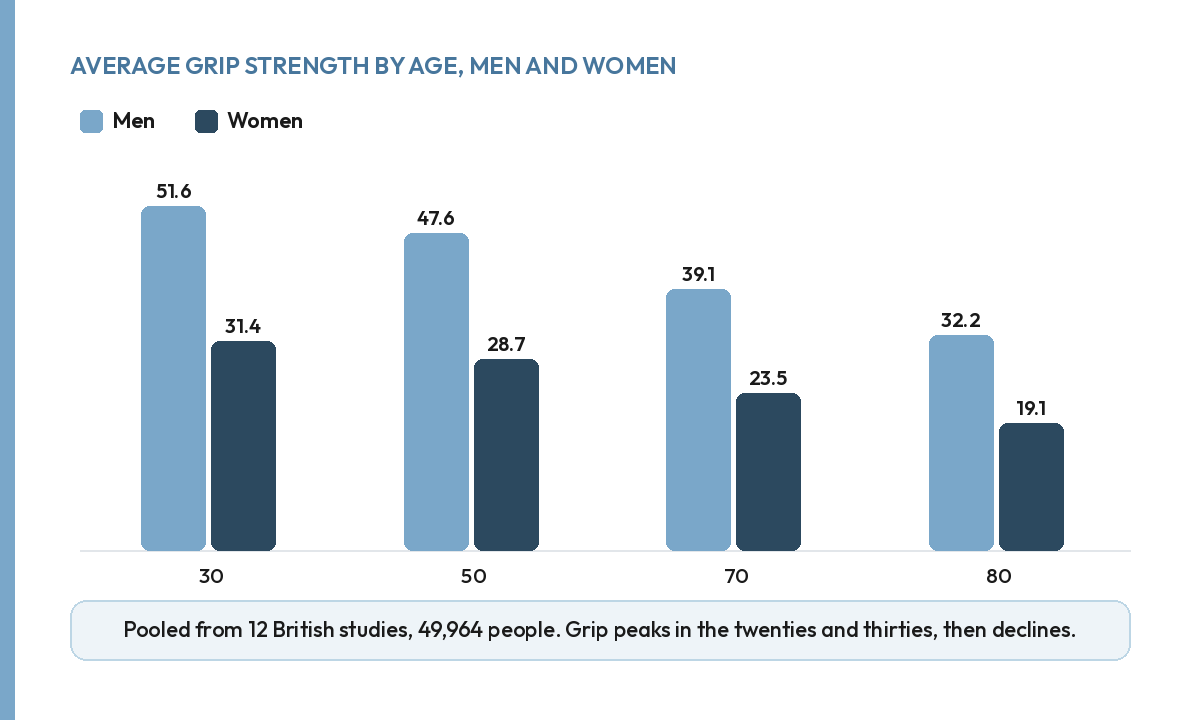
Source: Dodds and colleagues, PLOS ONE via PubMed Central, grip strength across the life course, normative data from twelve British studies. Men reached a peak median grip of 51 kg between ages 29 and 39. Women peaked at 31 kg between ages 26 and 42.
Why do grip strength and brain health move together?
One likely reason is that grip strength is a decent proxy for overall physical condition, and physical condition affects the brain through several routes at once: blood flow, inflammation and how much someone moves day to day. A study of more than 40,000 UK Biobank participants tested this more directly, using brain imaging rather than only behaviour.
Stronger grip was associated with greater grey matter volume in several regions, including the hippocampus and thalamus, both involved in memory. The study also looked at direction over time. Grip strength measured at the start predicted cognitive performance roughly nine years later more strongly than the reverse, cognition at the start predicting later grip. That does not prove grip strength causes better cognition. It does suggest grip is not just a passive marker riding along behind something else.
Source: Zhao and colleagues, BMC Medicine via PubMed Central, grip strength, brain structure and mental health in over 40,000 participants.
What this does not tell you.
Association is not causation. Every number above comes from people measured at one point or followed over years, not from a controlled trial where grip strength was raised on purpose to see if cognition changed. The UK Biobank authors themselves say the causal direction and the mechanism behind it still need to be worked out.
A single reading tells you very little about yourself. These are population averages across tens of thousands of people. Where you personally land on a given day depends on sleep, how recently you trained, and simple measurement noise. One number is not a result worth reacting to.
Nothing here is a screening test. A grip strength number is not a memory test and does not diagnose anything. If you have a real concern about your memory or thinking, that is a conversation for your doctor, not a number from a dynamometer.
How grip strength is actually tested.
A hand dynamometer. The standard tool in the research above. You squeeze once per hand while seated with your elbow at your side, and the device reads the force in kilograms.
A dead hang. Hold a pull-up bar with both hands and time how long you can hang before your grip gives out. Rougher than a dynamometer, but it needs no equipment and still tracks change over time.
Farmer's carries. Walk a fixed distance holding a heavy weight in each hand. Less precise than either of the above, but it doubles as training.
For tracking your own trend, precision matters less than consistency. Use the same method and the same rough time of day each time you check.
Training grip strength is straightforward.
Grip responds to the same principle as any other muscle: load it, let it recover, load it again. Dead hangs, farmer's carries, and simply not using wrist straps on your heavier lifts are enough for most people. None of this requires a plan built around grip alone. It comes along for the ride with general strength training.
We built The Health Project to hold exactly the kind of number a dynamometer gives you. Grip strength is a health marker you can log by hand, and you see its trend over time next to your training and your sleep. It connects with your Apple Health, Google Fit, Garmin, Fitbit, Oura and Whoop for the markers those devices track, and anything else can be entered by hand or uploaded from a lab report.
If VO2 max is the marker for your cardio side, grip strength is closer to a marker for everything else: how much muscle you are carrying and how well it responds to demand. Together with what exercise does for brain fog, they cover different routes to the same outcome. If building the muscle side of that picture is next, see building muscle mass.
We show you the trend. We do not tell you what your result means. If something looks off, that is a conversation for your doctor.
FAQ.
Does weak grip strength mean cognitive decline?
No. The research shows an association across large groups, not a diagnosis for one person. A single weak reading says nothing on its own.
Can you improve your grip strength?
Yes. It responds to resistance training the same way any other muscle group does, including simple dead hangs and carries.
What is a normal grip strength for my age?
The chart above gives averages by age and sex from a pooled British sample. Men peak around 51 kg in their thirties, women around 31 kg, both declining gradually after.
How is grip strength actually measured?
With a hand dynamometer, a small spring or hydraulic device you squeeze once with each hand. The research above used a Jamar hydraulic dynamometer.