Building Muscle Mass: What Actually Works
Building muscle mass comes down to three things, and the research on all three is consistent. Enough training volume, around 12 to 20 hard sets per muscle group per week for most people. Enough protein, with gains levelling off around 1.6 grams per kilogram of body weight per day. And enough time, measured in months rather than weeks.
TL;DR. Load matters less than most people think. Consistency matters more.
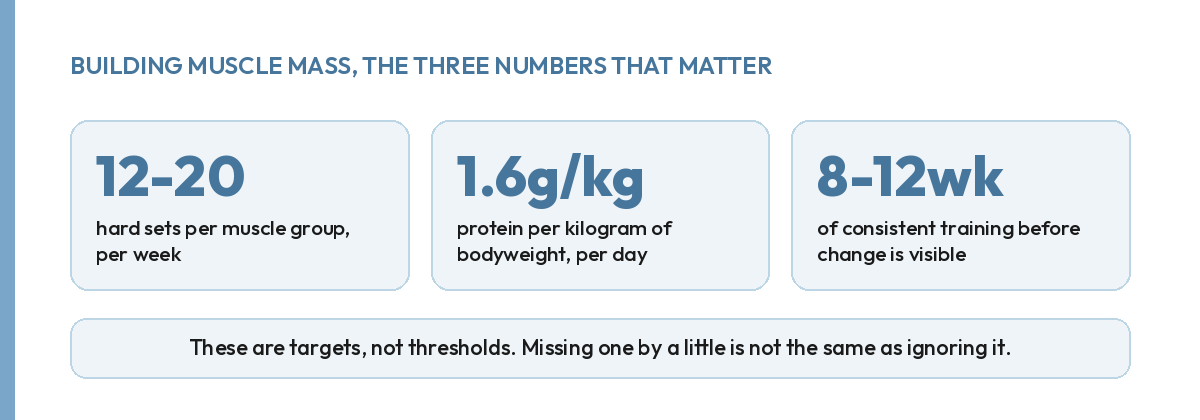
The three things that actually matter.
Everything else is detail.
- Hard sets, repeated weekly, with the demand slowly rising
- Enough protein and enough total food
- Enough sleep to recover from the first two
How much training does building muscle mass take?
The useful measure is hard sets per muscle group per week.
A systematic review grouped weekly volume into low, under 12 sets per muscle group, moderate, 12 to 20 sets, and high, over 20 sets. For trained people chasing size, the moderate band is the sensible target.
Source: Baz-Valle and colleagues, a systematic review of resistance training volume.
Start lower than you think. Volume is a lever you pull when progress stalls, and if you begin at 20 sets you have nowhere to go. Sets and reps example walks through what a full week of that volume actually looks like, set by set.
Volume only works if it keeps rising. A week that repeats last week's numbers is maintenance, not progress. The progressive overload workout covers the four ways to add demand each week without needing a heavier bar every single time.
Does the weight have to be heavy?
For muscle size, no.
A meta-analysis comparing low load and high load training found similar muscle growth between them when sets were taken close to failure, though strength gains still favoured the heavier loads.
Source: Lopez and colleagues, low load versus high load resistance training.
What this means in practice. Effort near the end of the set matters more than the number on the bar. A set of 15 taken close to failure is not a wasted set.
How much protein does building muscle mass need?
More is not endlessly better.
A meta-analysis of protein supplementation and resistance training found that intakes beyond about 1.62 grams per kilogram of body weight per day produced no further gains in fat free mass.
Source: Morton and colleagues, a meta-analysis of protein supplementation and resistance training.
For an 80kg person that is roughly 130 grams a day. Spread across your meals, not piled into one, since a single large dose late at night does not make up for a day of missed protein.
The part that trips people up is not the target, it is knowing whether they actually hit it. Most people who think they eat enough protein have never logged a full week and checked. How to track calories eaten walks through a method that takes minutes a day and gives you the real number, protein included, rather than a guess based on how the day felt.
A practical way to spread 130 grams across a day without weighing every gram: put a protein source at each meal first, then build the rest of the plate around it. Breakfast, lunch, dinner and one snack, each with 25 to 35 grams, gets most people to target without a single supplement.
How long does it take to build muscle?
Longer than the internet suggests, and the first visible changes usually take a couple of months of consistent training.
Strength moves first, and much of that early strength is your nervous system learning the movement rather than new muscle. Size follows.
The honest framing. Judge a training block by months, and judge it on your logbook rather than the mirror. The mirror is affected by lighting, food and water, and your logbook is not.
What does recovery have to do with building muscle mass?
Training breaks the tissue down. Sleep and rest days are where it gets rebuilt, which is why the same weekly sets produce more muscle in someone sleeping well than in someone who is not.
Sleep is the easiest of the three inputs to neglect, because a missed night does not show up the next day the way a missed meal does. It shows up two or three weeks later, as a plateau nobody can explain. Rest days gym covers how many rest days your specific training volume actually needs, and how to tell a planned rest day from quietly falling off.
A week with 15 hard sets and eight hours of sleep most nights will out-build a week with 20 hard sets and six.
What most people get wrong.
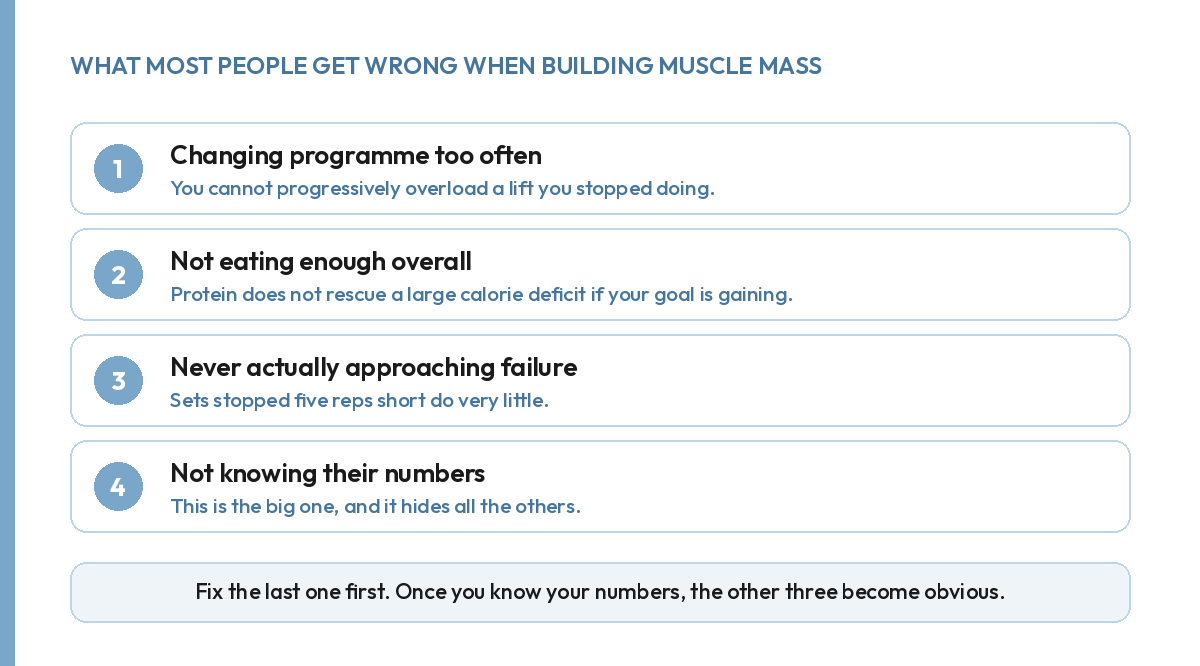
Changing programme too often. You cannot progressively overload a lift you stopped doing. Give a programme at least six to eight weeks before deciding it is not working.
Not eating enough overall. Protein does not rescue a large calorie deficit if your goal is gaining. If the scale is not moving up slowly over a month, the food is the first thing to check, not the training.
Never actually approaching failure. Sets stopped five reps short do very little. Two or three reps left in the tank at the end of a set is close enough for almost everyone.
Not knowing their numbers. This is the big one, and it hides all the others. Without a log, "I trained hard this week" and "I trained the same as last week" look identical, and only one of them builds muscle.
A worked week, put together.
None of this needs to be complicated. A week built around the numbers above looks roughly like this for someone training four days:
Monday and Thursday, upper body, 12 to 16 hard sets split across four or five exercises, each set close to failure. Tuesday and Friday, lower body, the same structure. Every session, try to beat last week's log by one rep, one set, or a small amount of weight, using whichever of the four progression options is available that day. Every day, hit your protein target across three or four meals. Every night, protect the same sleep window you would protect for a work deadline.
Nothing in that week is exotic, and that is the point. The three numbers do the work. Showing up for months is what turns them into visible muscle.
The part that decides it.
Muscle is built by repeating a small, boring thing correctly for months. The people who succeed are almost never the ones training hardest. They are the ones who know what they lifted last time.
This is what we built The Health Project for. You log every set, and it reads your last session and suggests the next step. Your protein and your sleep sit next to your training, so when progress stalls you can see which of the three is missing.
FAQ.
How much protein do you need to build muscle?
The research points to gains levelling off around 1.6 grams per kilogram of body weight per day.
Can you build muscle and lose fat at the same time?
Yes, most reliably in people newer to training or carrying more body fat. It is slower than doing either alone.
How many days a week should you train to build muscle?
Three to five for most people, arranged so each muscle group gets its weekly sets across more than one session.
Do you need supplements to build muscle?
No. Total protein across the day matters, and whether it comes from food or powder does not.