Why Gym Motivation Memes Do Not Fix Week Three
TL;DR. Gym motivation memes give you a feeling for a few minutes and ask nothing of you in return. That is exactly why they stop working right around the point most people quit. What holds up instead is structure: a scheduled session, a number you track, and a plan that still runs on the day you feel nothing at all.
What gym motivation memes actually are.
A gym motivation meme is entertainment wearing the costume of a plan. It gives you a short lift, the same way a good song does, and then it is gone. It does not tell you what to do today, it does not know whether you did it yesterday, and it has no opinion about tomorrow.
That would be fine if the feeling were the goal. It is not. The goal is still training in six weeks, and a feeling that lasts ninety seconds was never built to carry you there.
Why the early weeks are where it breaks.
There is no single day where everyone quits, but the data on who keeps training and who does not points squarely at the start. A 2026 cohort study of thousands of app-tracked lifters found that how many days someone actually trained in their first 28 days was the single strongest predictor of whether they were still training months later, stronger than anything they reported about how motivated they felt. Half of beginners had stopped meeting their own training target by week 19, and the steepest part of that decline fell between weeks 10 and 15.
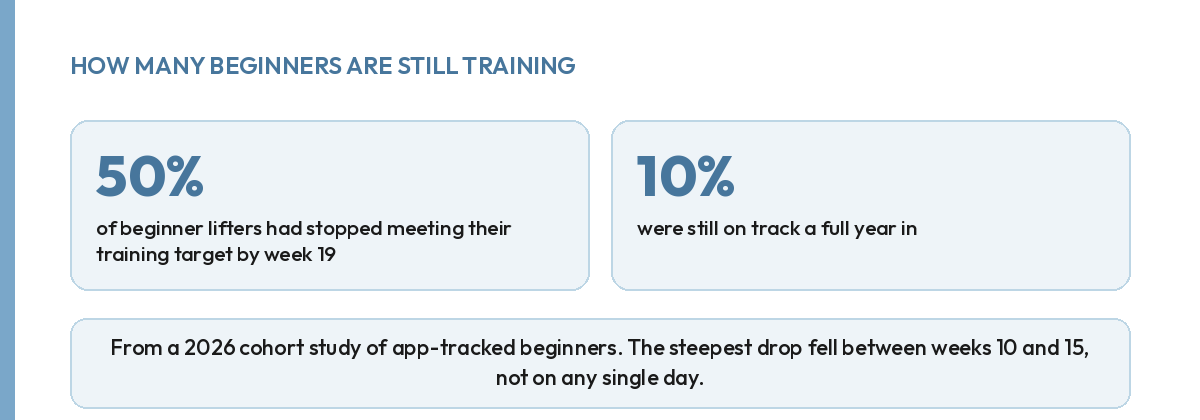
Week three sits inside exactly the window that study flags as decisive, the first month, well before the visible drop-off shows up in the numbers. Whatever gets you through it is doing more work than it looks like at the time.
Source: predictors of long-term resistance exercise adherence, a 2026 cohort study of mobile app users.
What actually holds up instead?
The research on exercise motivation draws a sharp line between two kinds. One is externally driven: pressure, guilt, a quote that tells you to be disciplined. The other is autonomous: you understand why the plan matters and you have some say in it. A systematic review of the exercise psychology literature found autonomous motivation consistently predicted who kept training months and years later, while externally driven motivation showed no benefit or an active downside, and pointed to externally prescribed training, the kind handed to you with no input, as one likely reason dropout is so high in fitness settings generally.
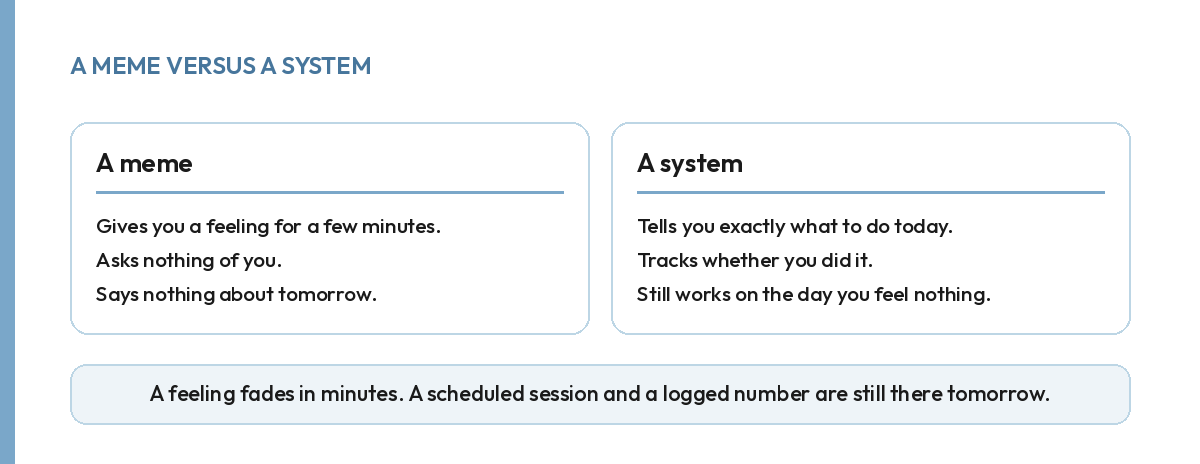
A meme is externally driven by design. Somebody else made it, for everybody, about nothing in particular that applies to your week. A system you built or chose, with sessions on your own calendar and numbers you can see moving, is the other kind. That difference, not the size of the feeling either one gives you, is what the research ties to actually sticking with it.
Source: exercise, physical activity, and self-determination theory, a systematic review.
What to do in week three specifically.
Schedule your next three sessions before the week starts, on your calendar, at times you have actually kept before. Deciding in the moment is the exact decision motivation is worst at making. A session already on the calendar only asks you to show up. A session you have to decide on fresh every morning asks you to win an argument with yourself first, and week three is exactly when you start losing that argument more often than not.
Track one number. Sessions completed, or total weight moved, or minutes trained. It does not need to be complex. It needs to exist, so a bad week shows up as a smaller number rather than a private feeling you can argue yourself out of. A number is also harder to reinterpret after the fact than a feeling is. Three sessions logged is three sessions logged, whether or not you felt strong doing them.
Lower the bar on the day you do not want to go. A short session that happens beats a full session you plan and skip. The goal in week three is staying in the habit, not hitting a personal best. Fifteen minutes on the calendar you actually do beats an hour you plan and cancel, because the fifteen minutes keeps the pattern alive and the cancelled hour breaks it.
None of this requires more motivation than you have right now. That is the point. A system built to run on a normal, unmotivated Tuesday is the one that is still running in month three, long after the memes you saved last week have scrolled out of memory.
How your own numbers make this easier to see.
A meme cannot see your week. Your own training log can. Watching progressive overload build session to session turns a vague sense of "I have not been consistent" into an actual count you can act on, and a habit tracker built into the same app you log your sessions in means the streak and the workout live in one place instead of two.
Programmed structure, rather than a fresh burst of motivation, is also most of what separates a deload week that keeps you going from a full week off that quietly becomes two. If you would rather have a coach build the schedule and check in on it with you, rather than build the structure alone, that is what my coaching is for.
FAQ.
Do motivational quotes and memes ever help?
They can lift your mood for a few minutes. They do not build the structure that gets you through a week you do not feel like training.
Is week three really when people quit?
The exact day varies. The research points to the first month as the highest leverage window, and to a steep drop across weeks ten to fifteen.
What actually predicts whether someone keeps going?
How consistently they train in their first four weeks, more than anything else measured, including how motivated they say they feel.
What should I do instead of looking for more motivation?
Schedule the next three sessions before you need motivation to show up, and track one number so you can see it working.