Deload Week Gym Training vs a Rest Week
TL;DR. A deload week gym plan means training with less: lighter loads, fewer sets, or both, for one week. A rest week means not training at all. They solve different problems. A deload keeps the habit and the movement pattern in place while fatigue drains away, which suits most people. A full week off suits illness, injury, and the point where training has stopped being something you want to do. Neither one is a setback.
The difference in one line.
A deload week. You still go, with roughly half the volume or noticeably lighter loads on the bar.
A rest week. You do not train at all.
Both reduce fatigue. Only one keeps the habit intact, and for most people the habit is the fragile part. Missing a full week makes the next week easier to miss too.
Us versus them, side by side.
| Deload week | Rest week | |
|---|---|---|
| You still go | Yes | No |
| Fatigue drops | Yes | Yes, faster |
| Habit stays intact | Yes | At risk |
| Skill and technique | Maintained | Slightly rusty |
| Best for | Accumulated fatigue | Illness, injury, burnout |
| Risk | Doing too much anyway | Not coming back |
Signs you need a deload week gym reset.
The signals build over weeks, not days.
- Weights that moved easily a month ago feel heavy now.
- Your sleep has been getting worse for a week or more.
- Your resting heart rate has drifted up and stayed there.
- Sessions feel like something to survive rather than something you want to
do.
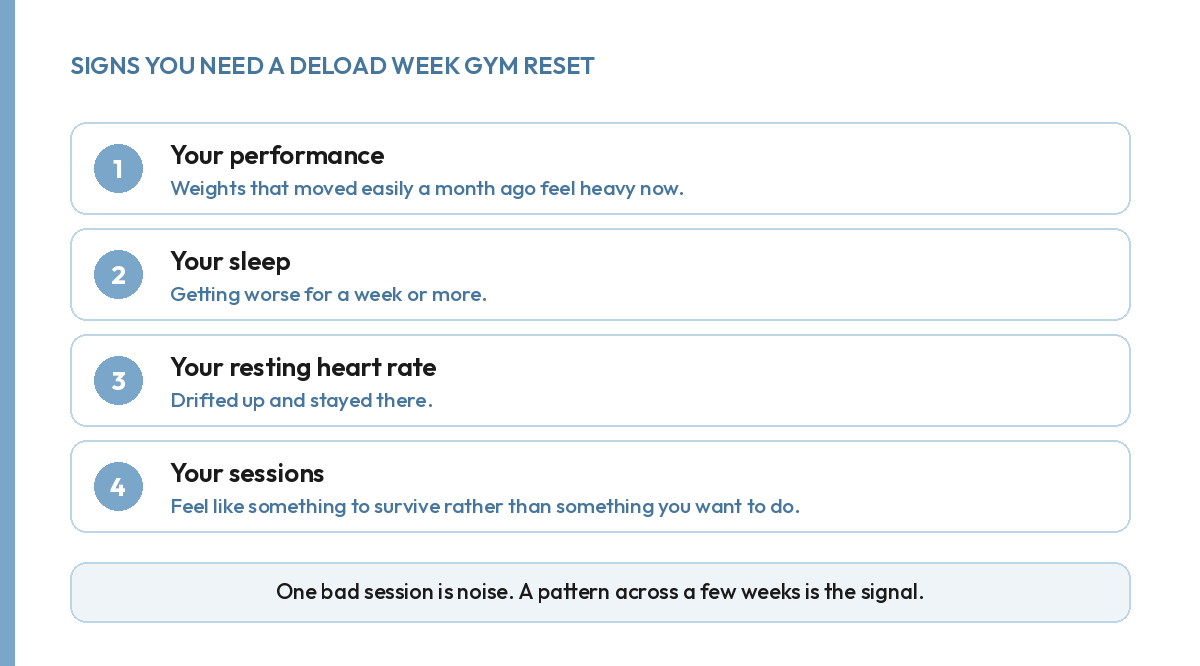
One bad session is noise. Three bad weeks is a pattern. Persistent underperformance despite normal rest is the sign worth acting on, rather than training through it.
Source: Kreher and Schwartz, overtraining syndrome, a practical guide.
How to run a deload week.
Pick one lever, not both, unless you are very run down.
Cut the sets. Same weights, roughly half the sets. This is the version most people should use, because it keeps the weight on the bar familiar and only shortens the session.
Cut the load. Same sets, around 60 percent of your usual weights. Use this version when your joints feel beaten up rather than just tired, because a lighter weight is easier on tendons than a lighter set count is.
Keep the exercises the same and keep the sessions on the same days. You are reducing the work, not rebuilding the week. Swapping exercises during a deload adds a new stimulus at exactly the point where the goal is less stimulus, not more.
Volume matters here because that is what you are lowering. Weekly volume is usually grouped as low, under 12 sets per muscle group, moderate, 12 to 20, and high, over 20. A deload usually means dropping a full band, so a week sitting in the high band comes down to moderate, and a week already in the low band barely needs to move at all.
Source: Baz-Valle and colleagues, a systematic review of resistance training volume.
A worked example, cutting sets.
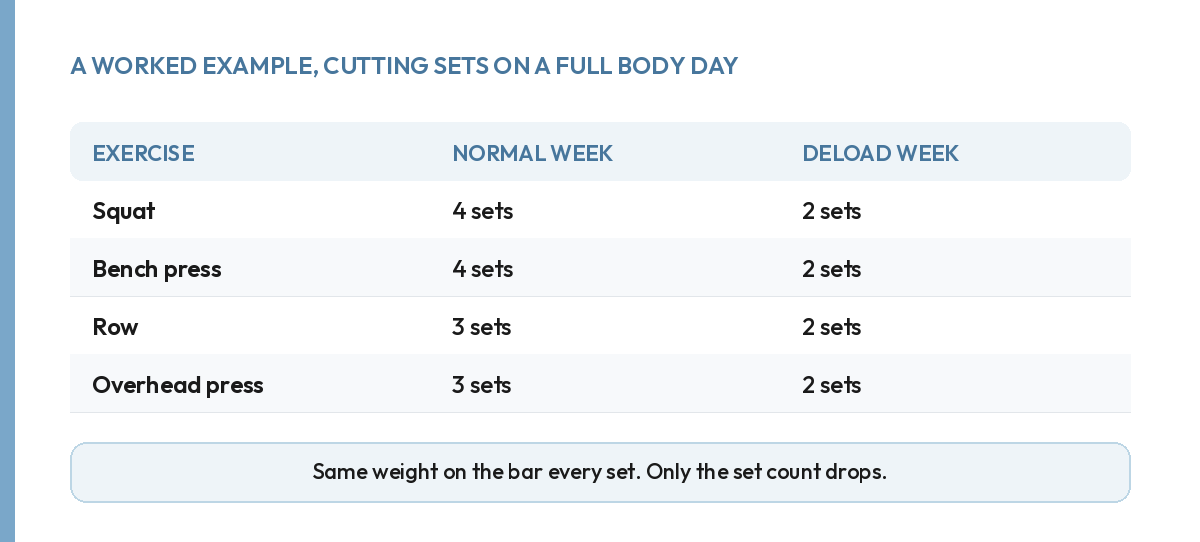
Same weight on the bar, same days in the gym, half the sets on the main lifts. Nothing about the exercise selection or the weekly schedule changes, only how much of it you do that week. That is the whole method: one lever, held steady for seven days, then back to normal.
When a full week off is the right call.
- You are ill. Training through an infection is not toughness, and it slows
the illness down rather than the fatigue.
- You are injured, and the movement hurts in a way that is not ordinary
muscle soreness.
- You have lost the desire to go, and it has lasted weeks rather than one
bad Monday.
The risk with a full week off is real. One week becomes three, because nothing forces you back once the routine has already broken. If you take one, put the return date in your calendar before the week starts, and treat that date the same way you would treat a booked session.
Which one should you pick?
If your training is fine and your body is tired, deload.
If your training is fine and your head is tired, take the week off.
If you cannot tell, deload. It is the lower risk option, because it keeps you going to the gym, and going is most of what a habit actually is.
How your own numbers make this easier to see.
Almost nobody plans a lighter week, because the need for one builds too slowly to notice from inside it. You do not feel a 5 percent decline. You feel fine, then one day you feel finished.
This is what we built The Health Project for. Your sessions, your sleep and your recovery markers sit together, so a slow drift shows up as a line rather than a feeling. Programmed lighter weeks are part of the coaching programme, the same way planned rest days are, so a deload gets scheduled in rather than noticed after three bad weeks. The app shows you the trend. It does not tell you what a single reading means about your health, that stays a conversation for your own doctor.
If you are already tracking progressive overload week to week, a deload is the other half of the same pattern: the weeks you add, and the weeks you deliberately do not. Your sleep trend is often the earliest signal that one is due, sometimes before your lifts show it at all.
If you would rather have someone build the deloads into your programme and tell you when one is due, that is what my coaching is for.
FAQ.
How often should you deload?
Many programmes schedule one every four to eight weeks. Going by the signals above works just as well.
Will you lose muscle during a deload week?
No. A week of reduced training does not cost you muscle.
Should beginners deload?
Rarely. Beginners recover quickly and usually are not generating enough fatigue to need one.
Is a deload the same as a rest day?
No. A rest day is one day inside a normal week. A deload is a whole week of reduced training.