How Many Sets in a Rep? A Guide by Goal
TL;DR. The honest answer to how many sets in a rep range you need depends entirely on what you are training for. Strength wants low reps and heavy weight. Muscle size tolerates a much wider range, as long as the set is taken close to failure. General fitness can use whatever range you can control well and enjoy doing. There is no single correct number that applies to all three.
How many sets in a rep range should you actually do?
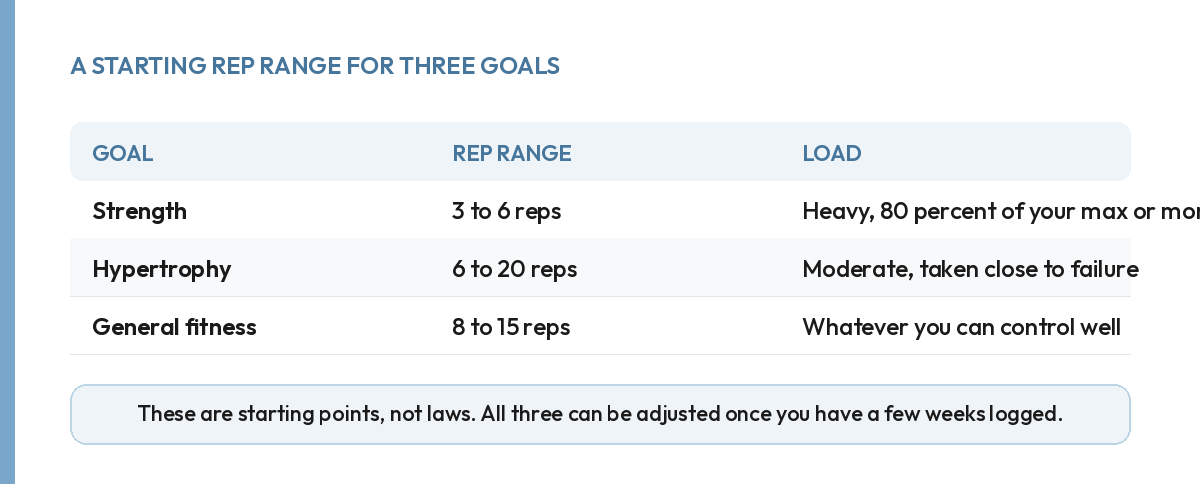
Start with your goal, not a number you read somewhere. Strength training wants heavy weight and low reps. Building muscle size tolerates a much wider window. General fitness has the most freedom of the three, because the goal is consistency rather than maximizing one specific adaptation.
Most of the confusion around this question comes from people copying a rep range built for someone else's goal. A powerlifter's 3 to 6 reps is not wrong for you, it is just answering a different question than the one you are actually asking if your goal is size or general health. The number itself is not the source of truth. The goal it is supposed to serve is.
Reps matter more for strength than you might think.
A systematic review comparing training loads found moderate and high loads produced meaningfully larger strength gains than low loads. One meta-analysis it drew on found roughly 35.4 percent strength gains from high load training against 28.0 percent from low load training over a comparable period.
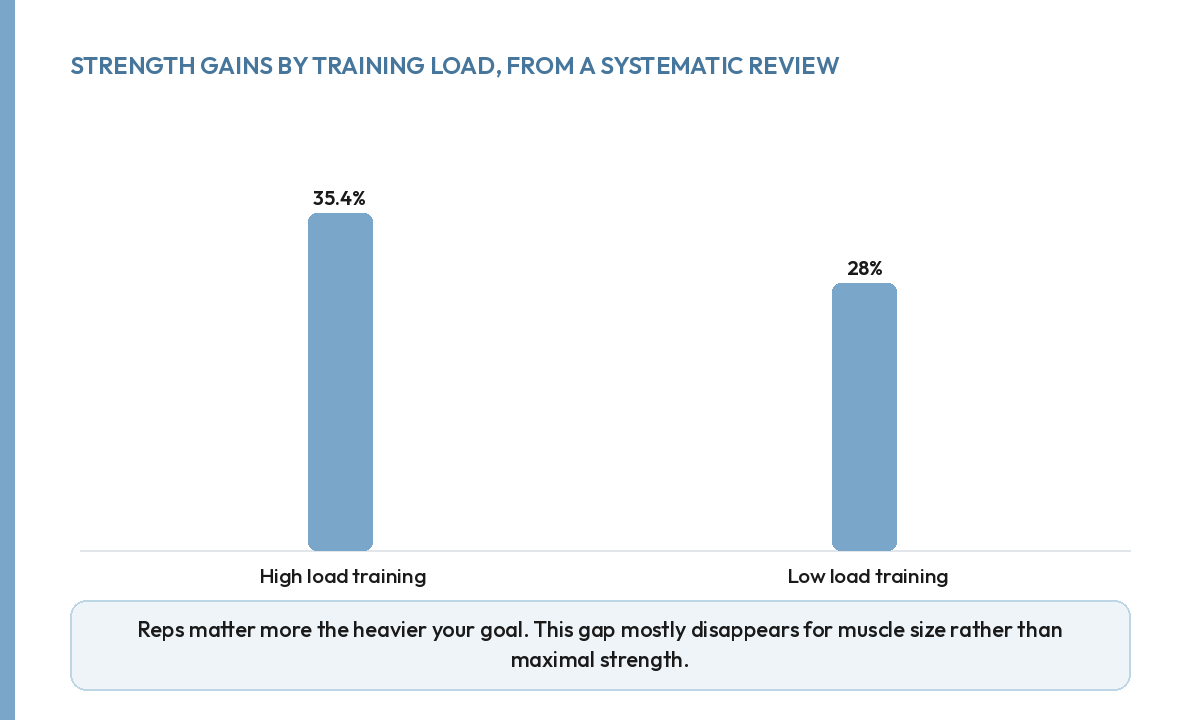
If your actual goal is a bigger number on a specific lift, that gap is real and worth respecting. Low reps at a heavy weight, close to your current max, is doing something a lighter set of twenty is not. Part of the reason is skill: a heavy triple practices the exact movement pattern and bar speed a max attempt requires, in a way a set of high rep, lighter work does not. Strength is partly a skill you rehearse, not only a muscle you grow, and low reps at a real weight are the rehearsal.
There is a floor here too. Untrained lifters can add some strength from almost any rep range early on, simply from getting more efficient at the movement. That effect fades quickly, and once it does, the load you are lifting starts to matter far more than it did in your first few months.
Source: resistance training load and its effect on strength and hypertrophy, a systematic review.
Reps matter less for muscle size, if you push close to failure.
The same review found the opposite pattern for muscle growth. When sets were taken to muscular failure, load mattered far less, and a wide range from roughly 30 to 90 percent of a lifter's max produced similar hypertrophy. The one caveat: very light loads, under about 20 percent of max, stopped working, so there is a floor even though the ceiling is wide.
Practically, that means a set of eight and a set of eighteen can build a similar amount of muscle, provided both are pushed close to the point where another clean rep is not available. The rep number is a much smaller lever for size than it is for strength.
This is genuinely good news if heavy weight is uncomfortable for a joint, or unavailable because you train with limited equipment. A higher rep set, taken seriously close to failure, is not a compromise for muscle growth. It is a legitimate option with its own real evidence behind it, not a fallback for people who cannot do the heavier version.
What this means for choosing your sets.
Once your rep range is set by your goal, the number of sets is what actually drives progress inside that range, especially for muscle size. Two to four working sets per exercise is a reasonable starting point for most lifters, then adjust against your weekly total per muscle group rather than any single session. The rep range answers what each set should feel like. The set count answers how much of that stimulus you are actually giving a muscle across the week, and it is the number worth raising first once a range feels comfortable.
If you want a full worked week already built around this, with sets counted out day by day, sets and reps: a worked example does exactly that. This post is about choosing the range in the first place. That one is about what to do once you have.
How your own numbers make this easier to see.
Choosing a rep range on paper is the easy part. Tracking whether a set at that range is actually close to failure, and whether you are hitting your weekly sets per muscle group, is where most people lose the thread. This is what we built The Health Project for. Log your sets and reps down to the working set, and progressive overload reads your history to suggest the next step, so the range you chose keeps being applied correctly instead of drifting week to week.
If you would rather have a coach set the rep ranges for your specific goal and adjust them as you progress, that is what my coaching is for.
FAQ.
How many reps build the most strength?
Lower reps at a heavier load, roughly 3 to 6 reps at 80 percent of your max or more, produced larger strength gains in a systematic review.
How many reps build the most muscle?
A wide range works, roughly 6 to 20 reps or even higher, as long as the set is taken close to failure.
Does rep range matter if I take every set to failure?
Less than most people think for muscle size. It matters far more for maximal strength.
How many sets should I do per exercise?
Two to four working sets per exercise is a reasonable starting point, adjusted against your weekly total per muscle group.