Sets and Reps Example: A Worked Week You Can Copy
TL;DR. This sets and reps example walks through what a set and a rep actually are, how many the research supports, and a full week broken down muscle group by muscle group. Weekly work groups into low, under 12 sets per muscle group per week, moderate, 12 to 20 sets, and high, over 20 sets. Most people training for size do well somewhere in the moderate band. Load matters less than people assume. Light and heavy loads produce similar muscle growth when sets are taken close to failure, though heavy loads build more strength.
What a set and a rep actually are.
A rep is one full repetition. Down and up on a squat is one rep.
A set is a group of reps performed without stopping. Eight squats, then rest, is one set of eight.
Training is usually written as sets by reps. Three by eight means three sets of eight reps. A full workout is written as a list of these, one line per exercise. Bench press, 4 by 6 tells you the exercise, the number of sets, and the number of reps in each one, in that order.
The rest between sets is part of the plan too, even though it rarely gets written down. A heavy set of six needs longer to recover from than a light set of fifteen, which is one reason two lifters doing the same sets and reps on paper can be training very differently in the gym.
How many sets per week.
The useful unit is not sets per session. It is sets per muscle group per week, because most people train a muscle more than once in a week.
A systematic review of resistance training volume grouped weekly work into three bands. Low volume is under 12 weekly sets per muscle group. Moderate is 12 to 20 weekly sets. High is over 20.
Source: Baz-Valle and colleagues, a systematic review of resistance training volume.
If you are starting out, the lower end of moderate is plenty. Adding volume is something you do when progress stalls, not something you begin with.
Sets are only one of the three inputs that decide whether this turns into muscle. Building muscle mass covers the other two, protein and time, and what most people get wrong about both.
Does the weight need to be heavy?
Not for muscle size. It does for strength.
A meta-analysis comparing low load and high load resistance training found similar muscle growth between them, when sets were taken close to failure. Strength gains favoured the heavier loads.
Source: Lopez and colleagues, low load versus high load resistance training.
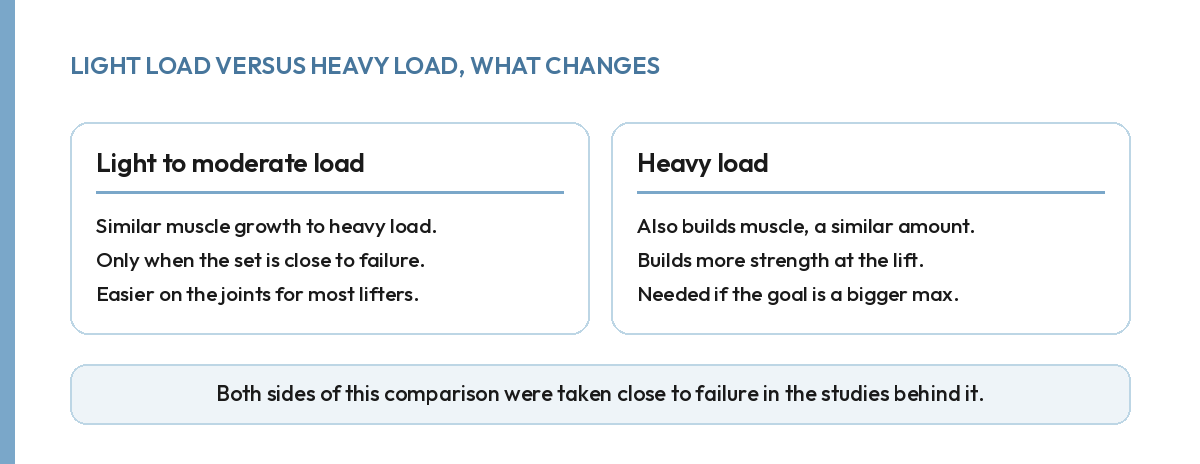
The practical version. If you want to be bigger, a range of loads works, so pick what your joints tolerate. If you want to be stronger at a lift, you have to train that lift heavy.
Close to failure is doing most of the work in both directions of that comparison. A light set stopped five reps short of failure trains very differently to the same light set taken to one rep short. The load is a second-order choice. How close to your limit the set finishes is the first one.
If you are still deciding which rep range to build this week around in the first place, how many sets in a rep range to use by goal breaks that choice down by strength, size and general fitness before you get to the set counts below.
A full sets and reps example for one week.
This is one example, not a prescription. It splits the week into an upper body day and a lower body day, then repeats both, so each muscle group gets trained twice.
Monday, upper body.
- Bench press, 4 sets of 6
- Row, 4 sets of 8
- Overhead press, 3 sets of 8
- Lat pulldown, 3 sets of 10
Tuesday, lower body.
- Squat, 4 sets of 6
- Romanian deadlift, 3 sets of 8
- Leg press, 3 sets of 10
- Calf raise, 3 sets of 12
Thursday and Friday. Repeat both sessions, with different exercises if you prefer.
Add the sets up by muscle group and the week looks like this. Chest: 8 sets, from bench press twice. Back: 14, from row and lat pulldown twice each. Shoulders: 6, from overhead press twice. Quads: 14, from squat and leg press twice each. Hamstrings and glutes: 6, from the Romanian deadlift twice. Calves: 6, from the calf raise twice.
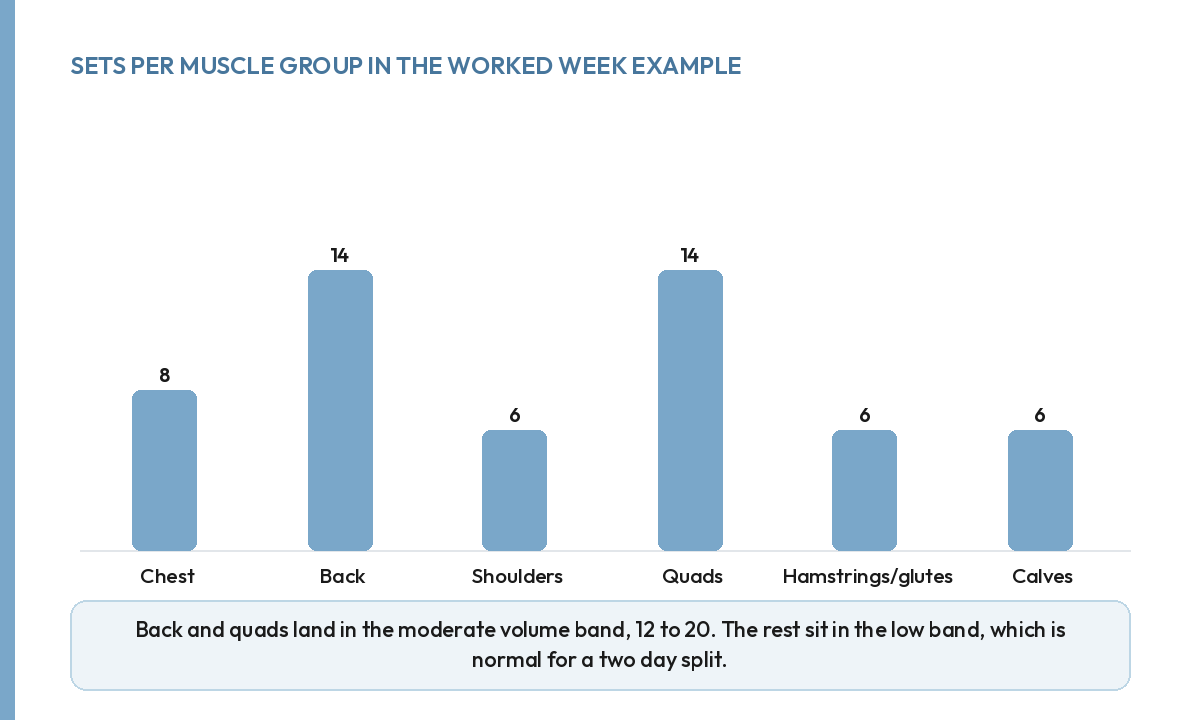
Back and quads land inside the moderate band, 12 to 20 weekly sets, which is where the research points for someone past their first few months. Chest, shoulders, hamstrings and calves sit in the low band here, and that is normal for a two day split rather than a mistake. A third session, or a second exercise for those muscles, is how you would push them into the moderate band too.
How to actually keep count.
The count only works if you record it. Almost nobody can tell you how many sets their chest got last week, which is why so many programmes drift into doing the same three exercises at the same weight for a year.
Keeping count by memory fails in a specific way. It is easy to remember that you trained chest twice this week. It is much harder to remember that one of those sessions only used one chest exercise for three sets, while the other used two for eight, so the honest weekly number is nowhere near what it felt like at the time.
A written log fixes this without asking you to do arithmetic mid-workout. Write the exercise, the sets, the reps and the weight as you go, and the weekly total per muscle group is just addition, done once a week rather than guessed at.
The split above is one way to arrange the week. If you want a version built around two full body sessions instead, this starting week for women over 50 uses the same set and rep logic applied to fewer sessions.
This is what we built The Health Project for. You log every set with its weight and reps, and it reads your last session and suggests the next step. Your history is there when you want to check what you actually did, by exercise or by muscle group, instead of trusting a mental total that drifts over a busy month.
If you would rather have someone build the split and adjust it as you progress, that is what my coaching is for.
FAQ.
How many reps should you do?
Anything from about 5 to 30 can build muscle if the set is taken close to failure. Lower reps with heavier loads build more strength.
Is three sets of ten a good starting point?
Yes. It is a reasonable default, and across two sessions a week it puts you in the low to moderate volume band.
How long should you rest between sets?
Long enough to complete the next set with good form. For heavy compound lifts that is usually two to three minutes.
Do warm up sets count?
No. Count the working sets, the ones taken close to failure. Warm up and mobility covers what those earlier sets should actually look like.