Should You Lose Fat or Build Muscle First?
TL;DR. Lose fat or build muscle first depends mostly on how lean you are right now. Research on body composition change shows that the leaner someone starts, the more of a calorie surplus goes toward muscle rather than fat, and the fatter someone starts, the more of that same surplus goes toward fat. That single fact is most of the decision: build first if you are already reasonably lean, lose first if you are carrying more fat than you're comfortable training through for months.
Lose fat or build muscle first: the short answer.
If you had to pick one rule, it is this. The leaner you already are, the more a muscle-building phase pays off. The more fat you are carrying, the more a fat-loss phase pays off first. Neither path is wrong, and neither is permanent. Most people who take this seriously alternate between the two over a year or more, building for a stretch, then leaning out, then building again.
What actually breaks this decision is trying to do a maximum version of both at the same time: a large surplus and a large deficit are opposites, and you cannot run both. A smaller, deliberate version of both together is a separate approach, and it works best for beginners specifically, which the next section explains.
Why body fat changes the math.
This is not a guess. A well known finding in body composition research is that when someone eats in a surplus, the share of that surplus that becomes fat-free mass, rather than fat mass, depends heavily on their starting body fat. A review of the underlying studies found that people with a higher starting fat mass gained a larger proportion of fat mass for the same weight gain, while leaner people gained proportionally more fat-free mass. Source: Body fat and fat-free mass inter-relationships: Forbes's theory revisited.
In plain terms: the same surplus does not do the same job for two different people. For someone already lean, more of it turns into the muscle they are training for. For someone carrying more fat, more of it turns into fat they did not want. That is the actual argument for losing fat first when you have a meaningful amount to lose, and it has nothing to do with looks or motivation. It is what the extra calories turn into.
The case for building muscle first.
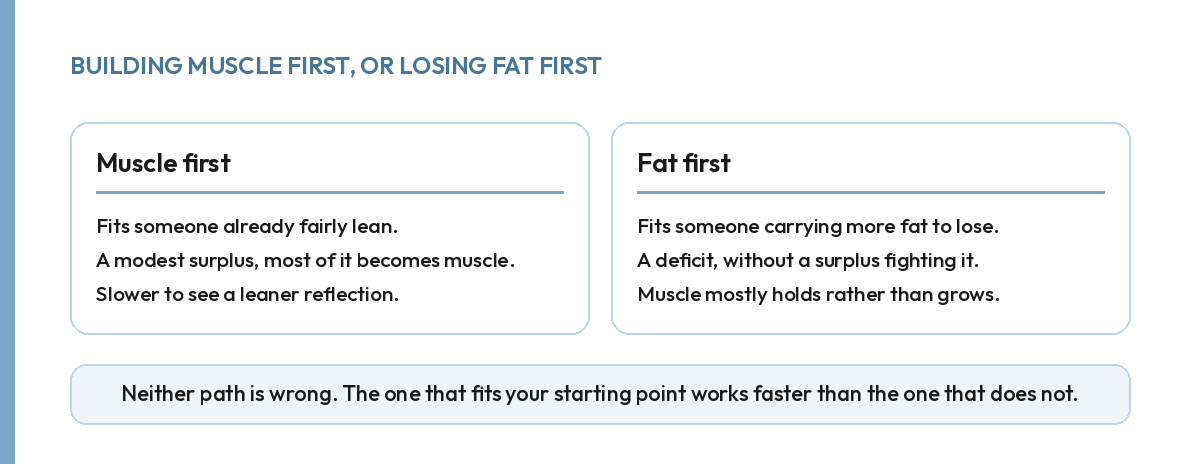
Building muscle first makes the most sense when you are already fairly lean, or when strength and performance matter more to you right now than how lean you look. A modest surplus, paired with a full training programme that trains every major muscle group through a real range of weekly volume, puts most of the extra calories toward muscle rather than fat when your starting point supports it.
It is also the more patient path. A surplus builds strength and size over months, and the leaner look most people associate with "results" usually shows up later, once a fat-loss phase follows. If you want that leaner look sooner, this is the wrong phase to start with.
The case for losing fat first.
Losing fat first makes sense when you are carrying more fat than you want to train through for months, or when a doctor or coach has flagged your weight as worth addressing on its own. A deficit removes the surplus that would otherwise turn a larger share of your extra calories into fat, and it lets your strength training do a narrower job: holding the muscle you have rather than trying to grow it and shrink your waist at once.
This path also tends to feel better sooner for a lot of people, since a shrinking waist and a lighter scale are visible faster than added muscle is. The cost is that strength gains slow down during a deficit, even with training and protein dialed in.
Is there a body fat percentage where the decision is obvious?
Not a single number that applies to everyone, and any article that hands you one exact cutoff is oversimplifying research that does not give one. What the research does support is the direction: the leaner you are, the more a surplus favours muscle, and that relationship is gradual rather than a hard line at any specific percentage. If you are unsure which side of that gradient you are on, err toward losing fat first. A modest deficit costs you little if you turn out to have been lean enough to build instead, while a needless surplus at a higher body fat mostly adds fat you will have to remove later anyway.
How to decide for your situation.
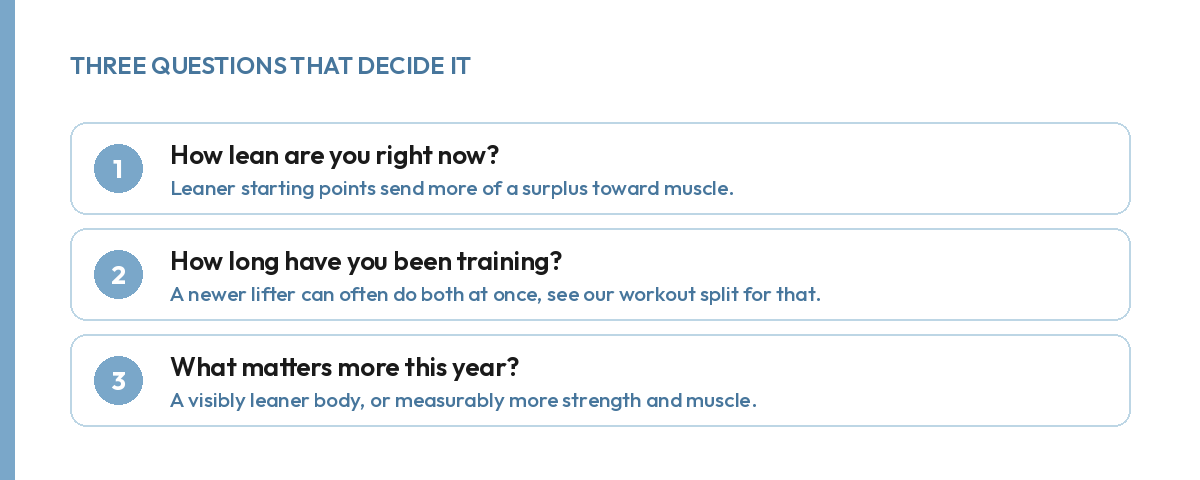
Work through three questions in order. First, how lean are you right now, by feel and by how your clothes fit rather than a precise number. Second, how long have you been training seriously: a newer lifter has more room to do a smaller version of both at once than someone who has trained hard for years. Third, what matters more to you over the next few months, a visibly leaner body or measurably more strength.
If you are new to structured training and reasonably active already, doing both at a smaller scale, sometimes called body recomposition, is a legitimate third option rather than a compromise. Our guide to building muscle mass covers what training volume and protein that actually takes, whichever phase you choose.
Tracking the decision as you go.
Whichever you pick, the same numbers tell you whether it is working. Inside The Health Project, your training logs every session so you can see strength trending up or holding steady, and your nutrition targets are set for a surplus or a deficit and adjust as your weight, training and recovery change. Our explainer on what calorie balance actually means covers how those targets are calculated either way.
We show you the trend. We do not tell you what your result means. If something looks off, that is a conversation for your doctor.
FAQ.
Is there a single right answer to lose fat or build muscle first?
No. It depends on your current body fat, your training history, and which outcome you care about seeing sooner.
Can a beginner just do both at once instead of choosing?
Yes, in many cases. New and returning trainees often see both muscle gain and fat loss from the same plan, which is a separate approach from choosing one first.
Does losing fat first mean I will lose muscle too?
Some muscle loss is possible in any deficit, but keeping protein high and strength training through the cut limits it to a small amount for most people.
How long should a muscle-building phase or a fat-loss phase last?
Most people run each phase for roughly three to six months before checking in on progress and deciding whether to continue or switch.