Maintaining After Weight Loss: How to Hold It
TL;DR. Maintaining after weight loss comes down to a short list of habits, not willpower. In the National Weight Control Registry, a long-running study of people who lost significant weight and kept it off, 87 percent were still down at least 10 percent of their weight years later. The people who managed it weighed in often, stayed active most days, and had a plan for eating driven by stress rather than hunger. Some slow regain over the years is normal even among successful maintainers. The goal is a range you can hold, not a number you defend forever.
What separates people who hold the loss.
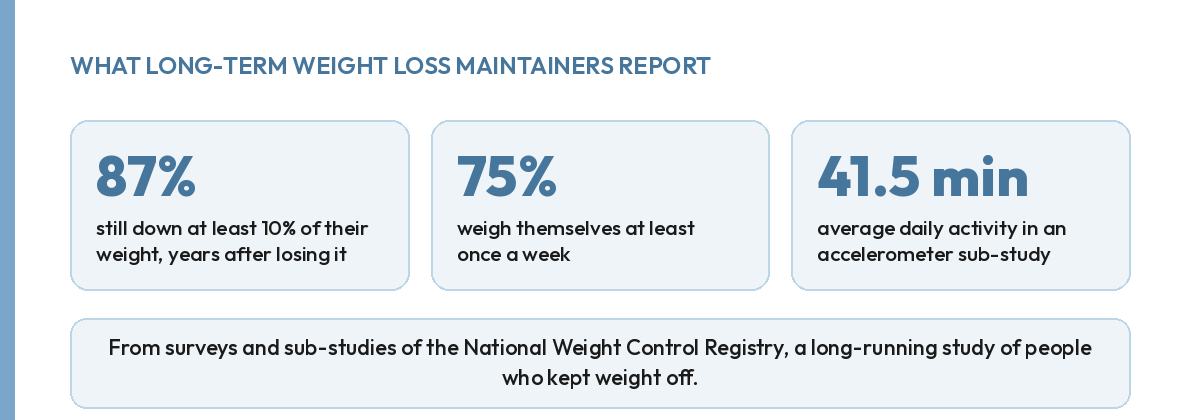
The National Weight Control Registry has tracked thousands of adults who lost at least 30 pounds and kept it off for at least a year. In a survey of registry members, over 87 percent were still maintaining a loss of at least 10 percent of their peak body weight. That is not people who never regained anything. It is people who stayed well ahead of where they started.
Source: Patel and colleagues, Obesity Science and Practice via PubMed Central, health-tracking app use among National Weight Control Registry members.
Weigh in on a schedule, not just when you feel like it.
Among the same group, 75 percent weigh themselves at least once a week, and 38 percent weigh in daily. Regular weigh-ins are not about chasing a number every day. They are an early warning system. A pound or two of drift is easy to catch and correct in the same week it happens. Five or ten pounds of drift, noticed months later, is a much harder problem to solve.
If daily weighing feels like too much, weekly is still enough to catch a trend before it becomes a pattern. What matters is that you actually look, on a schedule, rather than avoiding the scale until clothes stop fitting.
Maintaining after weight loss takes more activity than losing it did.
This is the part most people underestimate. In an accelerometer sub-study of the registry, successful maintainers averaged 41.5 minutes a day of moderate to vigorous activity. Even at that level, close to a third of them still fell short of the standard public health guideline of 150 minutes a week.
Source: Ogden and colleagues, Obesity via PubMed Central, how NWCR members differ in the physical activity behind their success. The practical read: the activity level that got weight off is often the floor, not the ceiling, for the activity level that keeps it off. Whatever routine you built while losing weight is worth protecting once you reach maintenance, not scaling back the moment the number on the scale settles.
What actually causes weight regain?
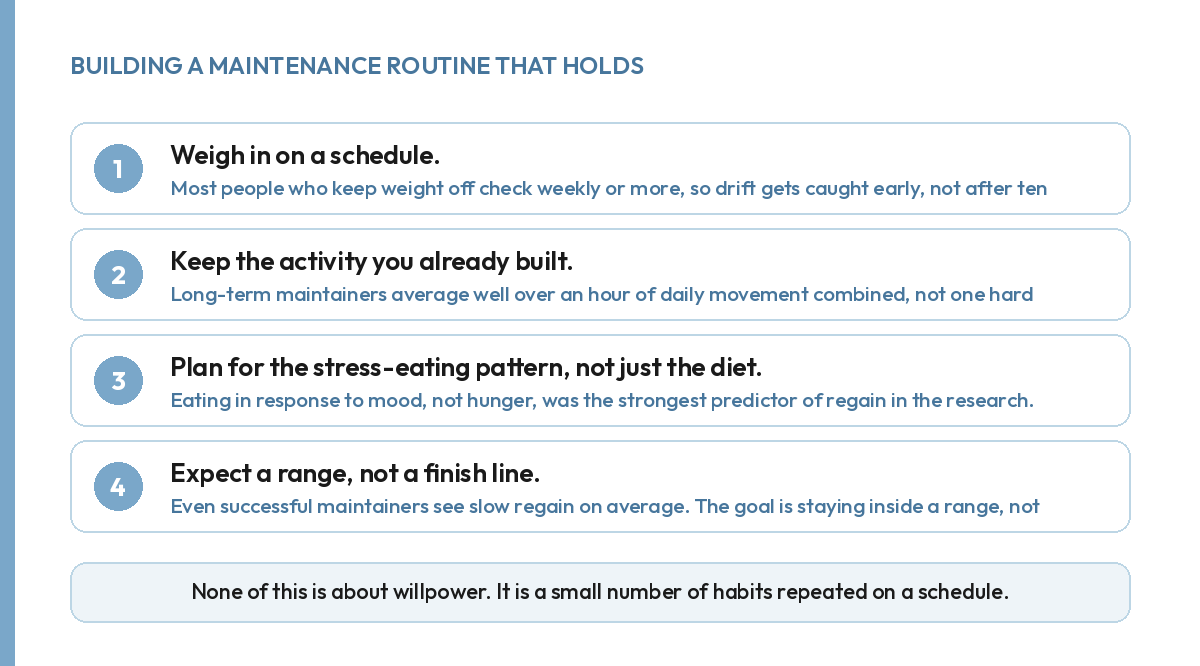
In a separate five-year follow-up of registry members, the strongest predictor of regain was not a specific food or macro split. It was a pattern researchers call internal disinhibition, eating in response to stress, boredom or emotion rather than hunger. Participants who had lost about 30 percent of their body weight and held it for five years on average still regained roughly 1.6 kg a year over the follow-up period, and the people who scored highest on emotional eating regained the most.
Source: Elfhag and colleagues via PubMed Central, internal disinhibition and five-year weight regain in the registry.
This is worth planning for directly. A hard week at work or a rough patch at home is a predictable event, not a surprise, so it is worth deciding in advance what you will do instead of eating through it. Waiting until the moment it happens rarely works.
Expect a range, not a finish line.
Even inside the most successful group in the research, slow average regain over years is normal. That is not a personal failure and it is not a sign the approach stopped working. Trying to hold one exact number forever sets up a fight you cannot fully win. Holding a range, and catching drift with regular weigh-ins before it becomes a real trend, is a target you actually can sustain.
What The Health Project does for this part.
We built The Health Project to make the habits above easier to actually keep. Weight and training log together next to your nutrition, so a weigh-in takes seconds and the trend is right there instead of buried in a notebook. If stress eating is part of your own pattern, the weekly check-in is built to catch a rough week, energy and stress included, before it turns into a rough month. Progressive overload in your training keeps your activity numbers visible too, so the routine that got you here does not quietly fade once the scale looks good.
Weight and body composition are one part of the picture. If building the muscle side back up is next, see building muscle mass. If the honest question is whether to prioritize losing more fat or building more muscle from here, lose fat or build muscle first walks through how to decide.
We show you the trend. We do not tell you what to do about it. If regain feels bigger than the small drift discussed here, that is a conversation for your doctor or a coach, not a number on its own.
FAQ.
How often should I weigh myself when maintaining weight loss?
At least weekly. Among long-term maintainers in the National Weight Control Registry, 75 percent weigh in at least once a week and 38 percent weigh in daily.
How much exercise do I need to maintain weight loss?
More than most people expect. Long-term maintainers averaged 41.5 minutes a day of activity in one sub-study, and even then, three in ten fell short of the standard 150-minutes-a-week guideline.
Is some weight regain normal after losing weight?
Yes. Even people who keep most of their loss off for years show slow average regain. The realistic goal is staying inside a range, not holding one exact number forever.
What actually causes people to regain weight?
In long-term follow-up of successful losers, eating in response to stress or emotion, not hunger, was the strongest predictor of regain, more than any single diet detail.