Marketing Your Coaching Business
TL;DR. Marketing your coaching business starts with the cheapest, highest trust source first: referrals from current clients, asked for directly, not hinted at. Content that shows how you actually coach comes next. Paid outreach is the most expensive and lowest trust source. It is usually where new coaches start, because it feels the most like "doing marketing."
Where new coaching clients actually come from.
Most new coaches reach for ads or social posting first, because that is what marketing looks like from the outside. The channel that actually fills a roster for most coaches is quieter than that.
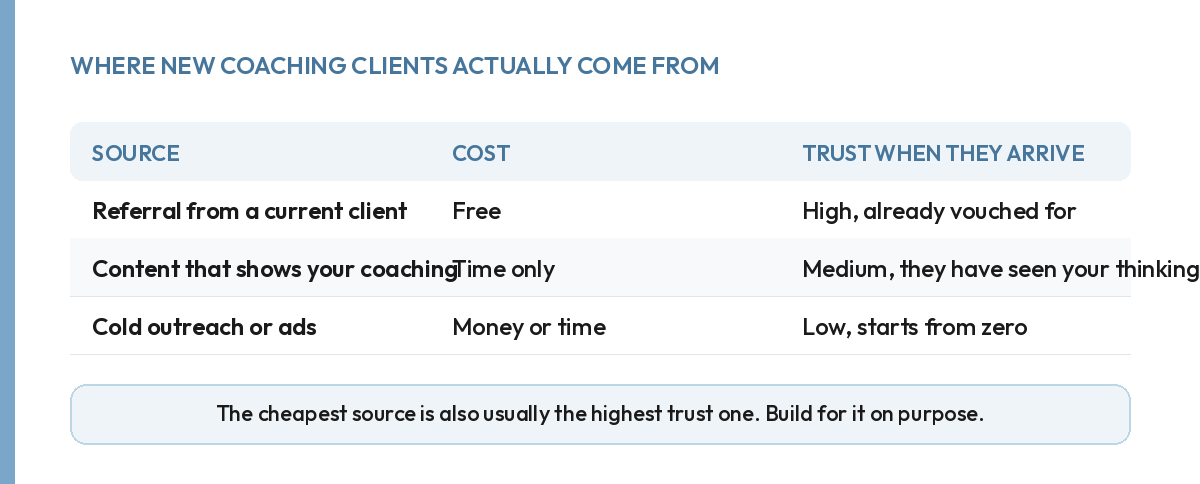
A referral from a current client costs nothing and arrives with trust already built in. Content that shows your actual coaching, not just that you exist, costs time and builds trust slowly. Ads and cold outreach cost money or time, and they start every stranger from zero trust. That is why they convert at a fraction of the rate the other two do, even when the budget behind them is far larger.
None of this means ads never work. They are the expensive way to buy trust that referrals and content earn for free. Most new coaches reach for the expensive option first, simply because it looks the most like "doing marketing."
Ask for referrals directly. Most coaches never do.
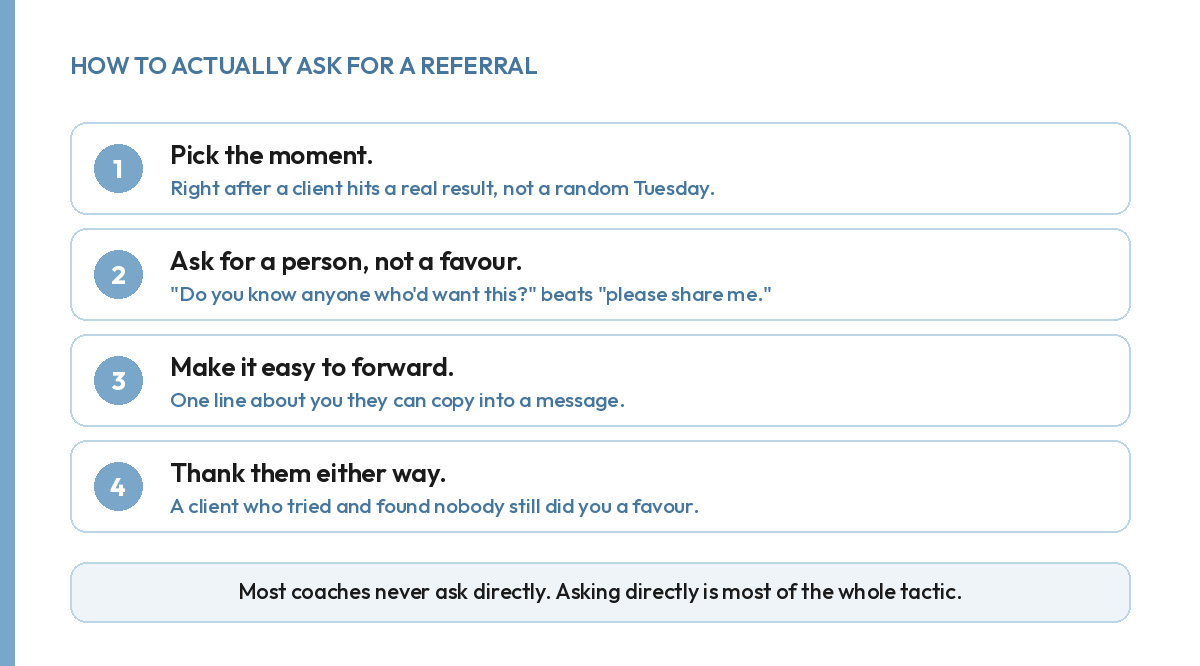
Waiting for a happy client to think of mentioning you is not a referral strategy, it is hoping. Ask right after a genuine result, while the client still feels it. Ask for a person specifically, "do you know anyone who would want this," rather than a general "please share me." A specific ask is easier to act on than a vague one. Give them one line about what you do that they can copy straight into a message, so the ask costs them thirty seconds instead of ten minutes of writing.
Share proof, honestly.
A specific result, described in the client's own words, does more than any generic testimonial. "I stopped losing motivation by week three" tells a stranger something real. "Great coach, highly recommend" tells them nothing they could not read on any page. Always get clear permission before sharing a client's story or photo, and never present one client's result as what anyone else should expect. A result is a result for that person, not a promise for the next one.
Content that shows how you coach, not just that you exist.
A post about your own training tells a stranger you exist. A post that walks through how you would actually handle a client's stalled week tells them how you think. That is what they are really trying to judge before they hire anyone. The same specificity that makes a client's own goal stick is what makes your content worth reading: concrete over vague, every time.
Niche down before you try to reach everyone.
"I help people get fit" describes almost every coach and convinces almost nobody. "I help new parents rebuild strength in the first year back training" describes one person's exact situation, and that person will recognise themselves in it immediately. A narrow, specific description costs you nothing and works harder than a broad one. The goal of marketing is not reaching the most people. It is being unmistakably right for the person actually reading it.
This also makes referrals easier to give. A vague "great coach" is hard for a client to pass on, because they do not know who to pass it to. A specific niche gives them an obvious person to think of the moment someone in their life fits it.
Other practitioners are a referral source coaches underuse.
Physiotherapists, dietitians and doctors all see people who could use ongoing coaching once the immediate problem is handled. Most of them have nobody specific to send that person to. A short, genuine introduction, what you do, who it is for, and why you are asking, is enough to start. It can turn into a standing referral relationship that keeps sending clients long after the first conversation. This works because it is the same principle as a client referral: trust that already exists, handed to you rather than built from nothing.
Make it easy to book the first conversation.
Once someone is curious, do not make finding out how to start harder than it needs to be. The right tools remove friction here too. A clear way to book a first call, and a simple way to see what working with you involves, both matter more than another post about your own routine. A prospect who has to hunt for how to contact you will often just not bother. Coaches running clients on our platform give a prospect that single clear place to look before they ever book a call.
So what is marketing your coaching business actually about?
Earning trust in the cheapest way available before you pay to buy it from strangers. Referrals first, honest proof next, useful content after that, and paid reach only once the free channels are genuinely maxed out, not skipped because they feel slower. Slower and free beats fast and expensive for almost every coach starting out, and it keeps working long after the ad budget for the month has run out.
FAQ.
What is the best way to market a coaching business with no budget?
Referrals and content, both of which cost time rather than money. Ask current clients directly, and share how you actually coach rather than just that you exist.
Should I use before-and-after photos to market my coaching?
Only with a client's clear permission, and never presented as a guaranteed outcome for someone else. One person's result is one person's result.
How do I get my first coaching clients without ads?
Referral from your own network, and from anyone you have already coached informally. Ask directly rather than waiting for someone to offer.
Do testimonials actually help sell coaching?
Yes, specific ones do. A vague quote helps little. A client describing exactly what changed and why helps a stranger picture their own result, which is the entire job a testimonial is there to do.