Goal Setting Apps for Health and Fitness
TL;DR. A goal on its own does almost nothing. What changes behaviour is a goal attached to a specific action, tracked often enough to see, and reviewed when it slips. A goal setting app that does this well is rare, and most goal setting apps handle the first part and stop there. Give the whole thing much longer than you expect, because habit formation in one review took a median of 59 to 66 days, with individuals ranging from 4 to 335.
Why most goals fail before the app is even opened.
Most health goals are outcomes, not actions. Lose 10kg. Get fit. Sleep better.
You cannot do an outcome. You can only do the actions that produce it, which means an outcome goal gives you nothing to perform today. That is the gap almost every abandoned goal falls into.
The fix is to pair every outcome with the action that drives it.
- Lose 10kg becomes log every meal and lift three times a week
- Get fit becomes three sessions a week, same days
- Sleep better becomes in bed by 11 on weeknights
The outcome is how you know it worked. The action is what you actually do.
What a goal setting app needs to do.
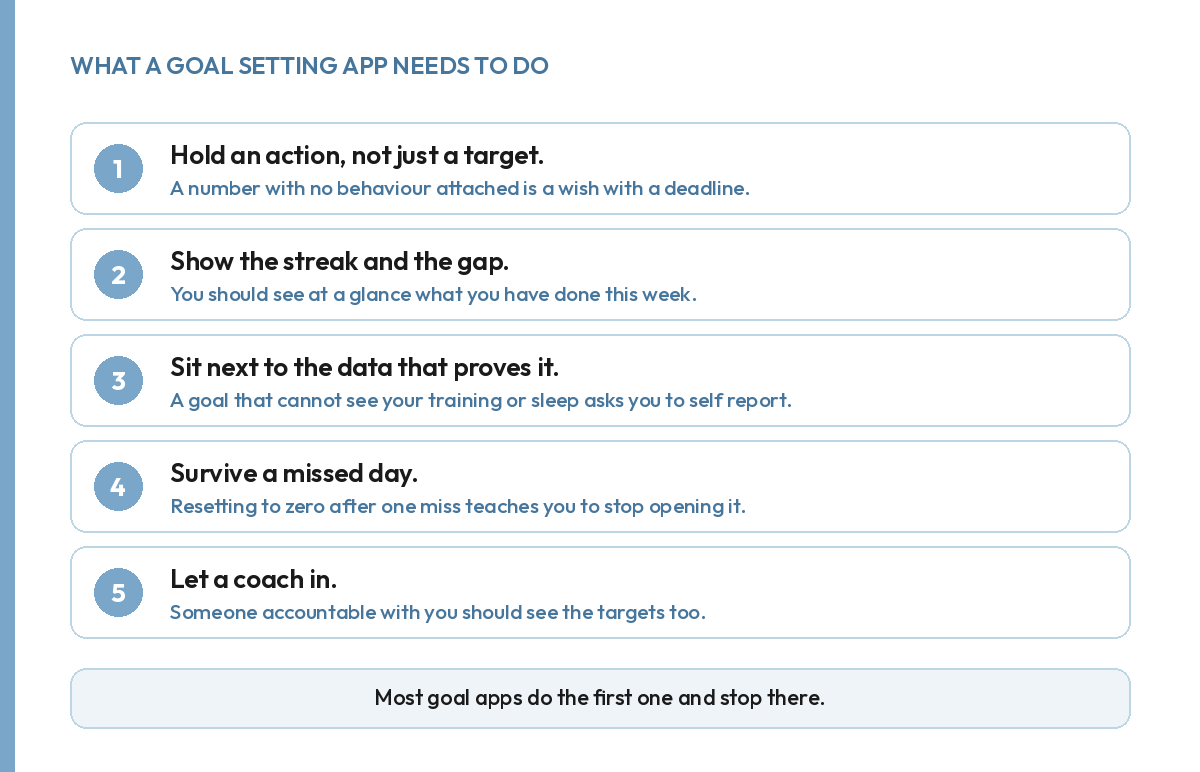
Hold an action, not just a target. A number with no behaviour attached is a wish with a deadline.
Show the streak and the gap. You should see at a glance what you have done this week and what is missing.
Sit next to the data that proves it. A goal app that cannot see your training or your sleep is asking you to self report, and self reporting drifts.
Survive a missed day. Apps that reset your progress to zero after one miss teach you to stop opening them, which is the opposite of what you needed.
Let a coach in. If someone else is accountable with you, they should be able to set and see the targets too.
Put together, this is a short list, but most apps only ever build the first one and call it done. Here is the whole set side by side.
Why the streak matters more than the target.
A target sits in the future. A streak sits in the present, and the present is where behaviour actually happens. The days you show up in a row are the thing your brain can act on today, while a distant number does nothing until the day you reach it, or the day you give up on it.
This is also why a missed day has to be survivable. A run of three weeks followed by one skipped day is still a run of three good weeks. An app that wipes that back to zero is measuring the wrong thing, and it is teaching you that one bad day erases every good one, which is not true of an actual body.
Give it much longer than you think.
A systematic review and meta-analysis of habit formation reported median times to habit formation of 59 to 66 days, with means of 106 to 154 days, and individual variation from 4 to 335 days.
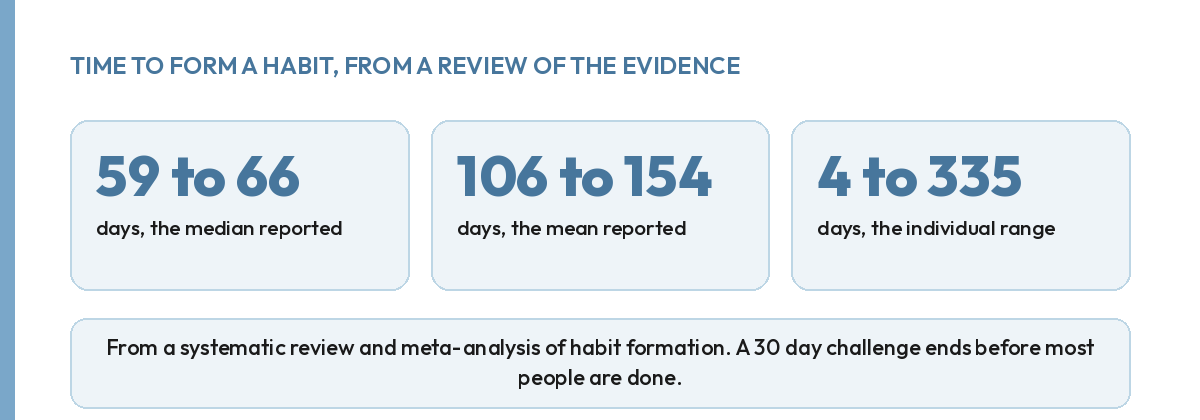
Source: a systematic review and meta-analysis on time to form a habit.
Most goal apps are built around 30 day challenges. The median is roughly double that, and the spread runs to nearly a year. A 30 day frame teaches you that you failed, at exactly the point most people are still normal. If your app resets a challenge counter at day 30, treat that as a marketing decision, not a deadline your body agreed to.
The kinds of app available.
General habit trackers. Flexible, and blind to your actual health data. You tick a box saying you trained, and nothing checks. Useful for a habit that has nothing to do with training, nutrition or sleep, and weak for one that does.
Single purpose apps. A step goal in your watch, a calorie goal in your food app. Each works on its own, and none of them see each other, so a goal that depends on more than one area, like sleep affecting your training, never shows up. Our own breakdown of gym apps that track training covers what this category does well and where it stops.
Health platforms with targets built in. The goal sits on top of the data that proves it, so ticking a box is not required. If your training was logged and your sleep was synced, the goal already knows whether you hit it. We compared the wider field of health tracker apps if you want to see how this group differs from a single purpose tool.
The Health Project, which we make, is in the third group. Targets are set by you or by your coach, across training, nutrition and sleep, with your actual history underneath them rather than a checkbox.
Whose goal is it?
Worth asking honestly. Goals someone else set for you, or that you set to satisfy someone else, have a short life.
The ones that last are usually smaller and duller than the ones people announce. Three sessions a week, most weeks, for a year, beats any transformation challenge.
If what you actually need is a person expecting you rather than an app reminding you, that is what my coaching is.
FAQ.
What is the best goal setting app for fitness?
One where the goal sits on top of your real training and sleep data, so progress is measured rather than self reported.
How long does it take to build a fitness habit?
Median times in the research run from about 59 to 66 days, with wide individual variation.
Should you set daily or weekly goals?
Weekly, for training. Daily targets turn one missed day into a failure.
Why do 30 day challenges not stick?
Because the median time to form a habit is roughly twice that, so the challenge ends before the habit exists.