Personal Training Software: What to Look For
TL;DR. Personal training software exists to stop client management living in spreadsheets and chat threads. The main platforms handle programme delivery and client messaging well. Where they usually stop is the client's own health data, their sleep, their nutrition and their markers, which stays scattered across the apps they already use. One honest note, we build a platform in this category.
What the software is actually replacing.
For most coaches it replaces four things at once.
- Programmes written in a spreadsheet and sent as a file
- Check ins living in chat, mixed in with everything else
- Progress photos and numbers in a phone album
- Invoices in a different tool entirely
Any platform worth paying for has to be better than that combination, not better than one part of it. The combination is also why the switch takes longer than people expect. Moving the programmes across is quick. Moving the habit of checking one place instead of four is the part that actually saves you time, and it only happens once your clients stop pinging you on the side.
What to judge a platform on.
How fast you can build and reuse a programme. You will write the same block many times. Templates and duplication decide how many clients you can hold. If you are still typing out sets and reps from memory for every client, the software has not actually changed your week.
What the client's app is like. They use it far more than you do, and their adherence is your retention. A confusing app costs you the client's trust before it costs you anything else.
Whether check ins are structured. Free text check ins become work. Structured ones become data you can look back through without rereading a month of messages to find the week something changed.
What it can see. Most platforms see the training they delivered. Fewer see the client's sleep, nutrition and markers, which is usually where the actual reason for a stall is sitting. A client who trains hard but sleeps five hours a night looks, from the training log alone, like a client who just is not progressing.
What it costs per client. Pricing in this category is usually tiered by active client count, so the sums change as you grow. Run the maths at the roster size you expect in a year, not the one you have today.
The main platforms.
ABC Trainerize describes itself as personal training software for delivering customised fitness programmes, tracking client progress and growing a fitness business. Long established and broad.
TrueCoach describes itself as a platform built for personal trainers, coaches and gym owners, aimed at saving time and growing the business. Known for a straightforward coach experience.
The Health Project, which we make, lets coaches run their clients on the platform, with the client's training logged down to the set, their meals logged from a photo or the food library, their sleep pulled in from a watch or ring, and a weekly check in that covers energy and stress as well as weight. It is the training and everything around it, in the one client view.
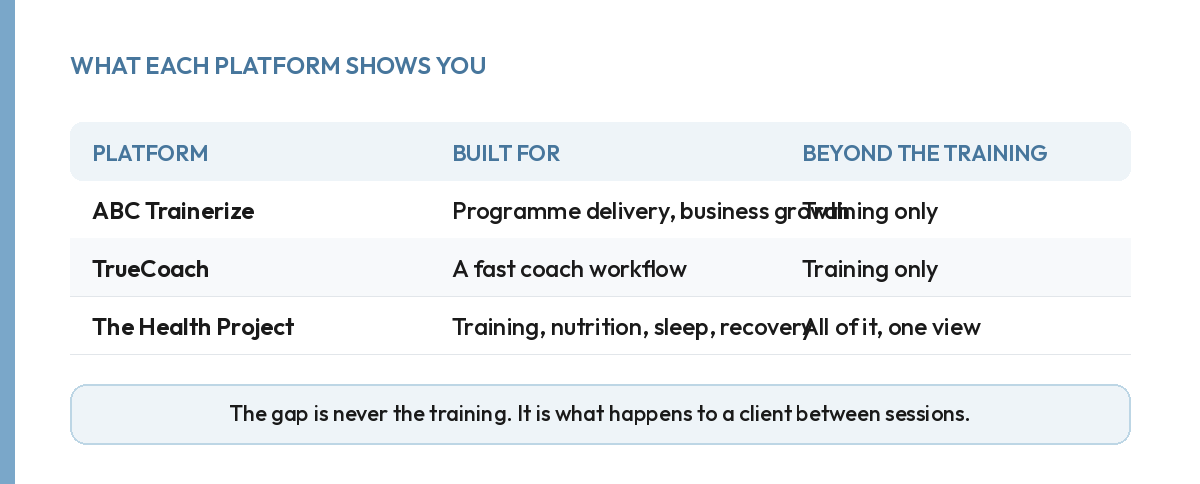
Check current pricing on each platform's own site. It is tiered and it changes.
Where most platforms stop.
They see what they delivered.
A client stalls. The programme looks fine, adherence looks fine, and the reason is that they have slept badly for five weeks or have been eating three hundred calories under what they told you. Software that only holds the training cannot show you that, so you find it out in conversation, if at all, usually well after the client has already gotten frustrated and started to disengage.
That gap is the entire argument for holding the client's whole picture rather than just their sessions. It is also why we built our own platform the way we did: training, nutrition and sleep sitting next to each other rather than in three different apps you have to check separately.
How fast can you actually build a programme in it.
This is the criterion coaches underrate until they are three months in. A platform that makes you rebuild similar blocks from scratch every time is a platform that caps your roster, because the admin per client never falls. See a worked week you can copy for what a properly structured programme actually looks like once it is written down. If your current process cannot produce that in a few minutes per client, the software is not the bottleneck yet, the workflow is.
How to trial a platform before you buy it.
A demo account tells you almost nothing, because a demo has no real client behind it. Trial it against your actual work instead.
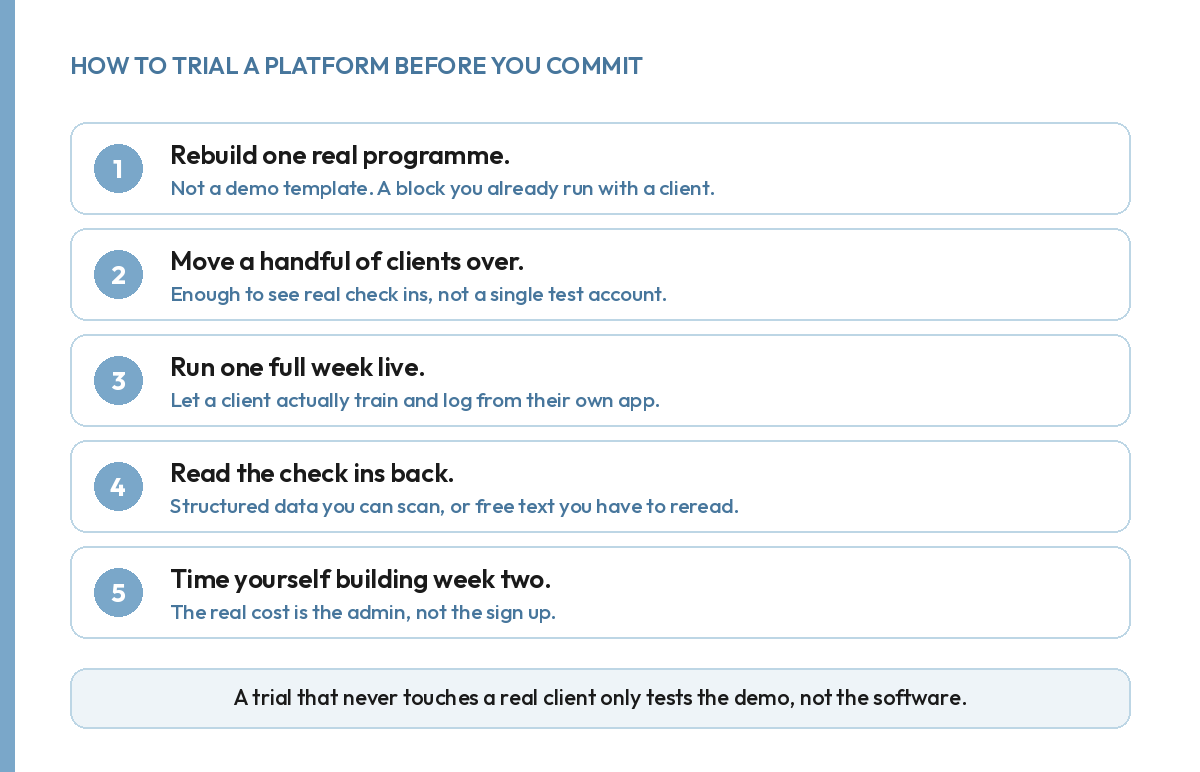
Rebuild one real programme, move a handful of actual clients over, and run one full week live before you decide anything. Ask the clients directly what the app was like to use, since their answer is worth more than any feature list. Check ins are the other thing to watch closely: a structured weekly check in, the kind built around weight, energy, sleep and stress rather than a blank text box, is what turns a season of coaching into something you can actually set and track goals against rather than a pile of messages you would have to reread to reconstruct.
Do you need personal training software at all?
If you have three clients, probably not. A spreadsheet and a phone work.
The moment it stops working is usually around the point where you cannot remember what each client did last week without looking. From there, every additional client costs more admin than the last one, and that admin is exactly the cost personal training software exists to remove. It does not remove the coaching itself. It removes the parts of the week that were never coaching in the first place.
FAQ.
What is the best personal training software?
It depends on whether you are optimising for programme delivery, business management, or seeing the client's whole health picture.
How much does personal training software cost?
Most platforms price by number of active clients. Check the current tiers on their own sites.
Can you run online coaching without software?
Yes, up to a small number of clients. It stops scaling when admin grows faster than your roster.
What do clients actually want from the app?
Clarity on what to do today, somewhere easy to log it, and a coach who visibly saw it.