Recovery Watches: How to Use the Numbers Properly
TL;DR. Recovery watches turn heart rate variability, resting heart rate and sleep into a single score. It is an estimate of your physiological state, not a verdict on your day. Use the trend across weeks, not this morning's figure, and never let a score talk you out of a session you feel fine for. One honest note, we make an app that holds this data alongside your training.
What a recovery score is made of.
Almost every device builds its score from the same handful of inputs.
- Heart rate variability, usually measured overnight. This is the gap
between one heartbeat and the next, and it moves with how loaded your nervous system is, not just how tired your legs feel.
- Resting heart rate, also overnight. A number that sits higher than your
own average for a few days in a row is a more honest signal than one bad night.
- Sleep, its duration and its estimated quality. Most watches infer stages
from movement and heart rate rather than measuring brain activity directly, so treat the stage breakdown as a rough sketch, not a lab result. For more on what these numbers actually capture, see sleep trackers app.
- Recent training load, on some devices. A hard week shows up in the score
even before you feel it in a session.
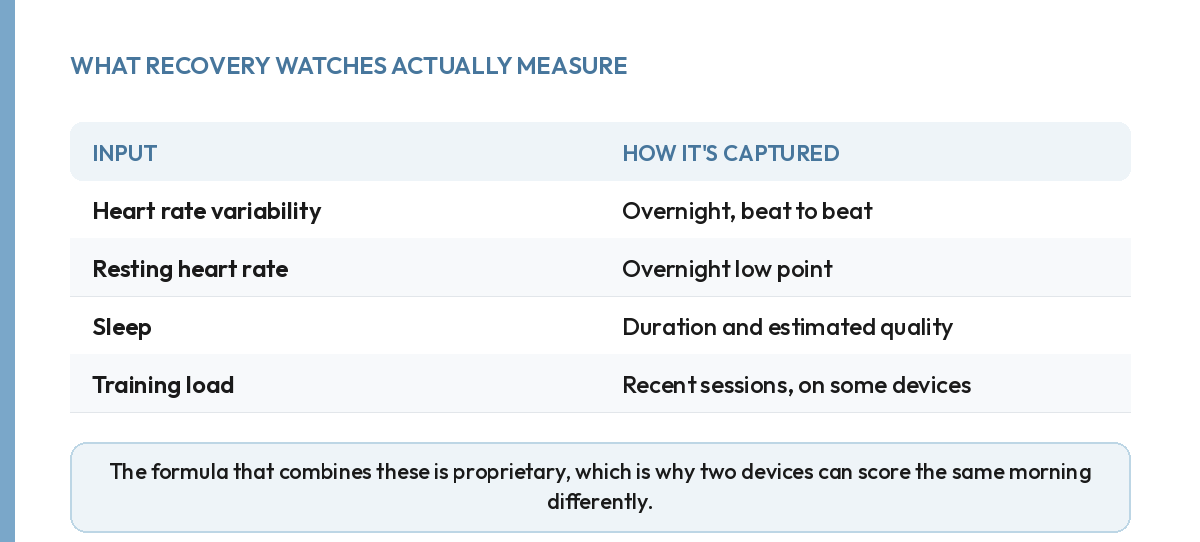
Those get combined by a formula the manufacturer does not publish, and the result comes back as a number or a colour. Different devices give the same person different scores on the same morning, which tells you these are proprietary estimates rather than a measurement of anything.
Six ways to use one properly.
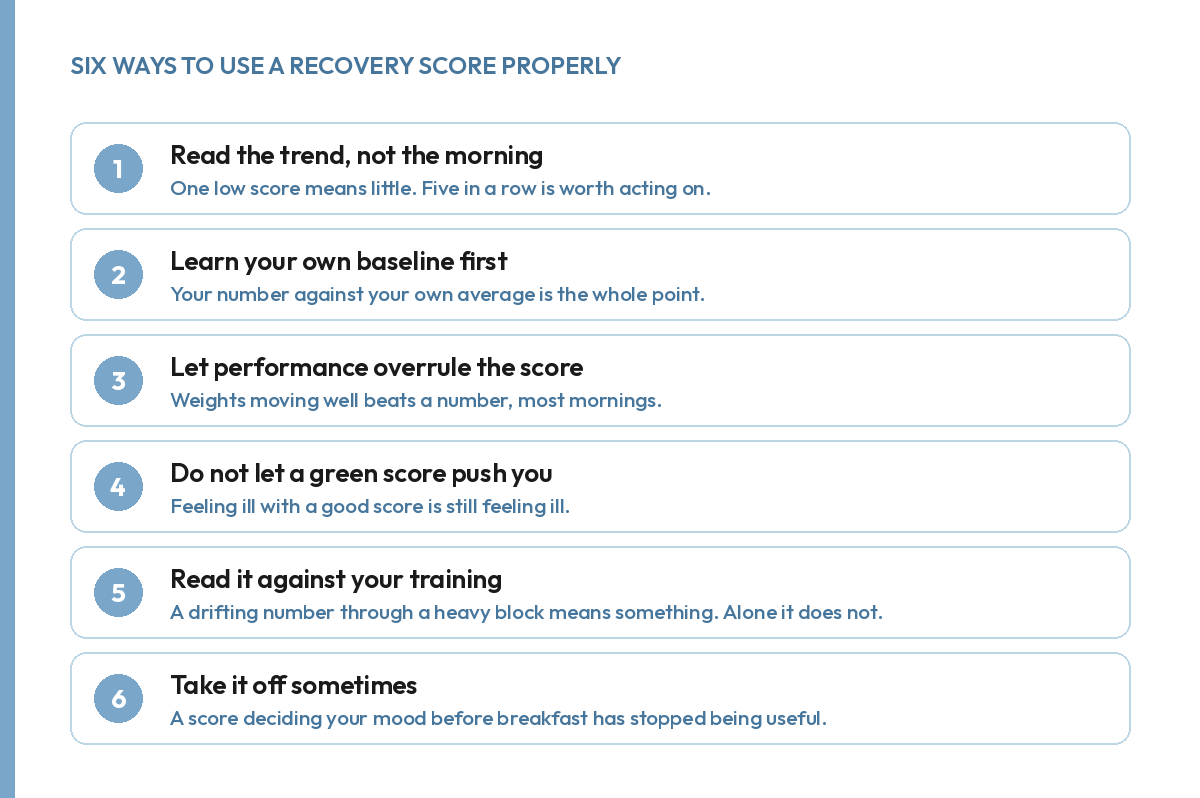
1. Read the trend, not the morning.
A single low score means very little. Five low mornings in a row is a signal worth acting on. One bad number after a late flight or a stressful day at work is noise, not a pattern.
2. Learn your own baseline before judging anything.
HRV differs enormously between people. Your number compared to someone else's is meaningless. Your number compared to your own average is the whole point, and that baseline takes a few weeks of consistent wear to settle.
3. Let performance overrule the score.
If you feel good and the weights move well, the session is fine, whatever the app said. Recovery scores do not know you slept badly because of a newborn rather than a virus, and they cannot tell the two apart.
4. Do not let a green score push you into a session you should skip.
The failure runs in both directions. Feeling ill with a good score is still feeling ill. A watch has no way to see a sore throat or a stomach that is off.
5. Look at it against your training, not on its own.
A drifting resting heart rate through a heavy block is useful information. The same drift with no context is just a number. Log your sessions somewhere so the two lines sit next to each other.
6. Take it off sometimes.
If a score is deciding your mood before breakfast, the device has stopped being useful. That is a real pattern and it is worth naming, and it is a good reason to go a week without checking it at all.
How to choose a recovery watch.
There is no single best device, but there are a few things worth prioritising over brand name.
- Comfort overnight matters more than anything else. A watch you take off
because it is uncomfortable in bed gives you no overnight data at all.
- Battery life that survives sleep tracking. A device charged only during
the day misses exactly the readings a recovery score depends on.
- Sync with the rest of your health data. A score sitting alone in one app,
disconnected from your training and nutrition, is harder to act on than one sitting next to them. See health tracker apps for how to think about that fit.
- Consistency of wear, not the brand's marketing. The device that stays on
your wrist every night beats the one with the better name that sits in a drawer after a month.
What the numbers are good for.
Spotting the slow drift you cannot feel. Fatigue accumulates gradually enough that nobody notices it from inside, which is exactly the case where a recorded trend beats a feeling. The same logic applies to fitness gains: a slow-building change like VO2 max moves over months, not days, which is why VO2 max by age is worth reading alongside this.
Persistent underperformance despite rest is worth taking seriously rather than pushing through.
Source: Kreher and Schwartz, overtraining syndrome, a practical guide.
Which recovery watches are worth wearing?
Any of them, honestly, as long as you wear it consistently. Consistency of measurement matters more than which brand did the measuring, because you are comparing you to you. Chasing a specific brand for a marginally different algorithm is time better spent on sleep and training consistency, which move the underlying numbers far more than the device does.
What matters more than the hardware is whether the numbers end up anywhere you can read them against your training.
This is what we built The Health Project for. Your recovery markers, your sleep and your sessions sit together, and it connects with your Apple Health, Google Fit, Garmin, Fitbit, Oura and Whoop.
We show you the trend. We do not tell you what it means about your health. If something looks wrong, that is a conversation for your doctor.
FAQ.
Are recovery scores accurate?
They are consistent estimates rather than measurements. Useful against your own baseline, not comparable between people or devices.
Should you skip training on a low recovery score?
Not automatically. Let how you feel and how the weights move have the final say.
What is a good HRV?
There is no universal good number. What matters is your own trend.
Do you need a dedicated recovery device?
No. Most modern watches provide the same underlying inputs.
Can a recovery watch tell you if you are overtraining?
No. It can flag a pattern worth paying attention to, persistent underperformance despite rest, but reading that pattern is a job for a coach or a doctor, not the device.