Coaching Tools Online: What's Worth Paying For

TL;DR. Coaching tools online is not one purchase, it is six categories: client platform, payments, booking, video calls, contracts and intake forms. Each replaces a manual process that quietly costs you time. Pay for the client platform and payments first. The rest can wait until the admin they remove is actually hurting you.
Six categories, one tool each.
New coaches often ask which app to get, as if coaching software is a single purchase. It is closer to six smaller decisions, and most of them are cheap relative to the time they save.
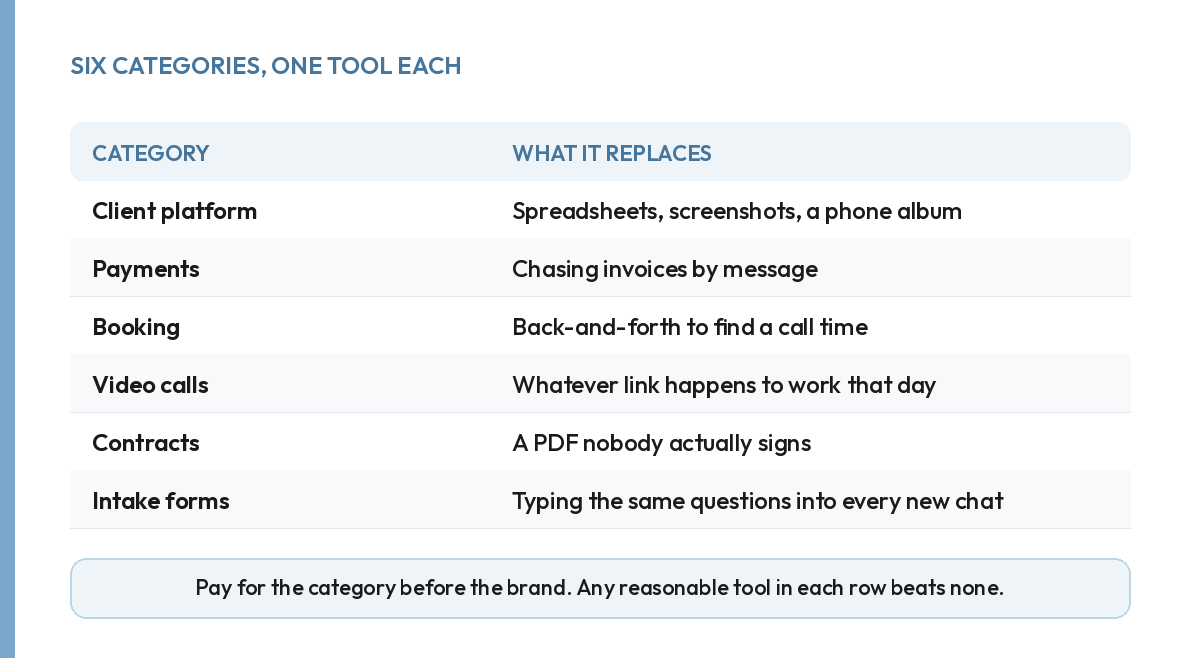
Client platform. What to actually check in one before you commit, and how three real platforms compare head to head once you have a shortlist. This is the category that matters most, because it holds the programme, the check-in and the message all the way through your relationship with every client.
Payments. A tool that bills automatically each month beats a message reminding a client their invoice is due. Late payments are rarely deliberate, they are usually just forgotten, and a forgotten payment costs you an awkward conversation you would rather not have.
Booking. A link a client picks a time from removes an entire back-and- forth thread per call. Skip this while you have three clients. Add it the moment scheduling calls starts eating a real chunk of your week.
Video calls. Almost any reliable option works. The requirement is consistency, the same link every time, not features. A client who cannot find the call link is a client who missed the call through no fault of their coaching.
Contracts. A short agreement covering what you deliver, what you do not, refunds, and cancellation. It protects you if a client disputes a charge, and it sets the same expectation for every client rather than a different verbal understanding with each one. A template you reuse for every sign-up, adjusted for name and price, takes an afternoon to write once and then costs you nothing per client after that.
Intake forms. The same structured thinking that makes a check-in useful makes an intake form useful. Ask the same questions of every new client once, in writing, instead of reconstructing their history from a scattered first conversation.
Where to spend first.
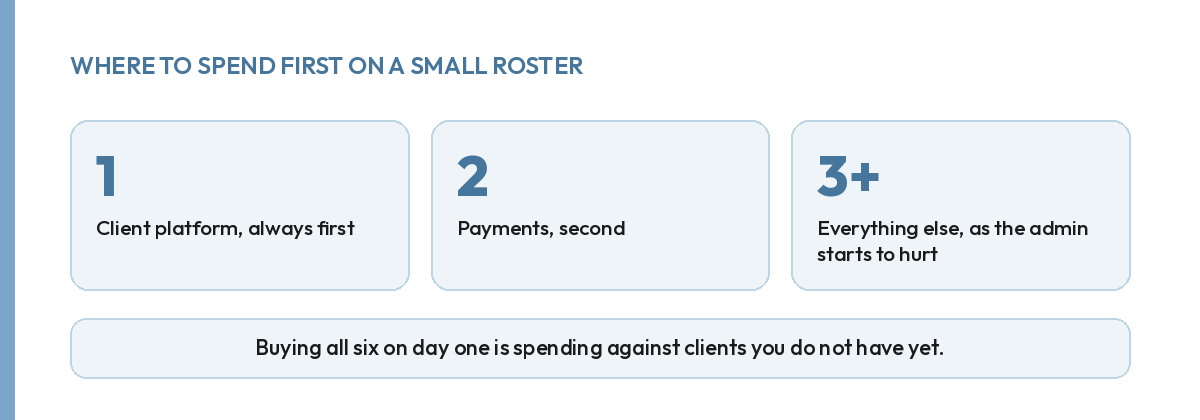
Buying all six on day one is spending against a roster you do not have yet. Start with the client platform, because it touches every single client every week. Add payments next, because chasing money by hand does not scale past a handful of people. Everything else earns its keep once the specific admin it removes is actually costing you real time, not before.
What a client platform has to cover before the other five matter.
The client platform sits ahead of the other five categories because it is the only one your client sees every single day, not just at sign-up or at renewal. Get this one wrong and no amount of polish on the payments page or the booking link will save the relationship. The client's actual daily experience is the programme and the check-in, not the parts of the business behind the scenes.
This is also the category coaches most often underbuy. A spreadsheet plus a chat app looks free, and it is, right up until the tenth client arrives. Every check-in then takes twice as long to read, because none of it is structured the same way twice. The cost was never the client platform's subscription fee. It was always the hours a coach spends reconstructing structure that a proper tool would have held for free.
What each category actually costs you if you skip it.
Skipping payments automation costs you an awkward message once a month per client, multiplied by however many clients forget to pay on time. Skipping booking costs you a scheduling thread every time a call needs finding. Skipping a contract costs you nothing, until the one time a client disputes a charge and you have no written agreement to point to. None of these failures happen on day one. They accumulate quietly, roster growth turning a minor annoyance into a real weekly cost, which is exactly why they are easy to keep putting off.
What can genuinely wait.
Booking, dedicated video software and a polished intake form all matter eventually and none of them matter on day one. A calendar link you build for free, a video call on whatever you already use, and a copy-paste set of questions are all fine substitutes while your roster is small. Upgrade each one when the manual version starts taking longer than the paid one would.
There is no fixed roster size where this switch has to happen. It happens whenever you notice yourself doing the same manual step for the fourth or fifth time in a week and thinking a tool would have handled it in seconds.
So are coaching tools online actually worth paying for?
For the first two categories, almost always. A client platform and a payments tool pay for themselves within a client or two, in time alone. For the rest, buy them when the manual version starts costing you more than the subscription would, not before, and not because a list like this one told you to.
Buy in that order, and each tool earns its subscription back long before it feels like an expense.
This is the category we built our own coach platform to fill. Messaging, programming and check-ins live in one place for every client you run, instead of split across a spreadsheet, a chat app and a separate booking link.
FAQ.
What coaching tool should I buy first?
A client platform for programming, check-ins and messaging. Everything else on this list matters less until that one is solid.
Do I need a separate booking tool as a coach?
Once you are trading messages back and forth to find a call time more than a few times a week, yes. Before that, it can wait.
Can I run a coaching business on free tools only?
For a first handful of clients, mostly. The free versions of most categories stop being enough right around the point your roster does.
Do I need a contract with online clients?
Yes, even a short one. It sets expectations on both sides and protects you if a client disputes a charge or a result.