Deload Week Running: How to Structure One

TL;DR. A deload week running plan means less mileage for one week, not none. Cut your volume by roughly a third to a half, keep your frequency and your easy pace the same, and go back to normal the week after. It is not a rest week and it is not a taper. It is a scheduled dip in load that lets accumulated fatigue drain away before it turns into an injury or a bad patch you cannot train through.
What deload week running means.
Lifters cut sets or weight for a deload. Runners cut distance. The principle is identical: the same routine, at a noticeably lower volume, for one week. You still run most of the days you normally would. You just run less on each of them.
This is different from a full week off, which stops training rather than reducing it, and different from a taper, which is a short, race-specific cut aimed at one event rather than a recurring reset. A full guide to picking between a deload and a rest week covers the general version of that choice, mostly written for the gym. Running has its own version of the same decision, and its own version of the signs that it is due.
Signs your training is asking for one.
The signals build over one to two weeks rather than showing up overnight.
- Your usual easy pace takes noticeably more effort to hold.
- A run you would normally finish comfortably starts fading well before the
end.
- Your motivation and mood dip together, on days training would normally
lift both.
- A small ache lingers into a second week rather than settling in a day or
two.
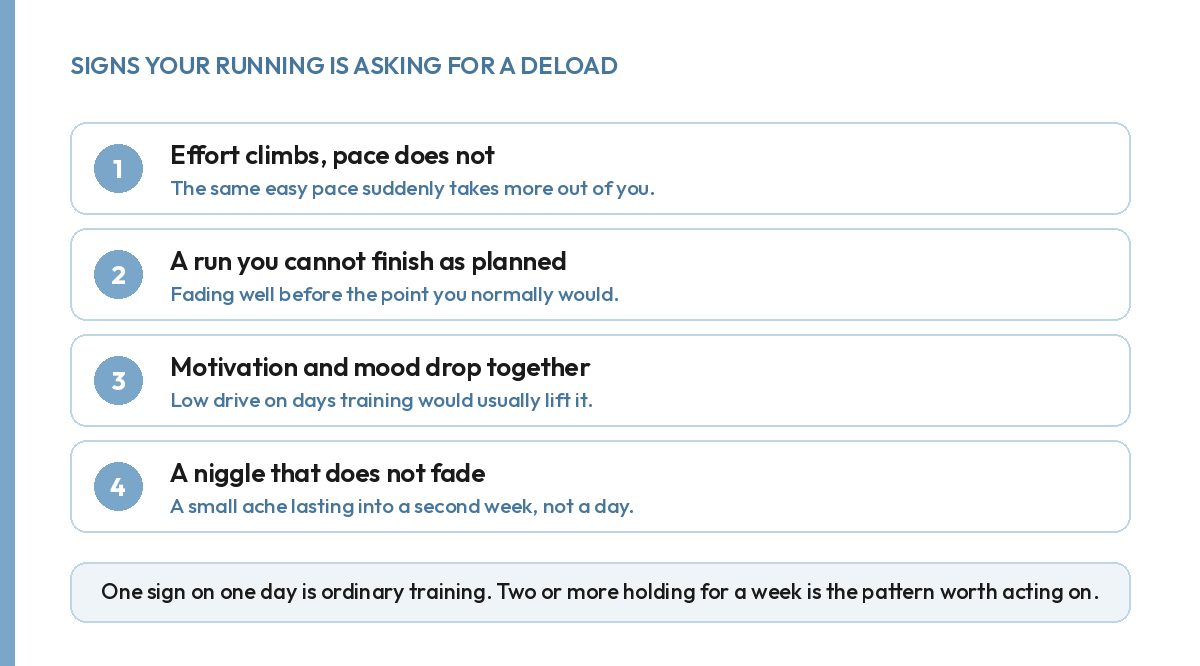
Rising effort for the same pace, and a drop in drive on days that would normally lift it, are two of the more consistent early markers of overreaching in the sports science literature, more so than a single morning resting heart rate reading, which the same research found inconsistent as a standalone signal. Functional overreaching, the ordinary kind that a deload is built to answer, recovers in days to weeks. Left untreated it can slide into a state that takes months to come back from.
Source: Kreher and Schwartz, overtraining syndrome, a practical guide.
How much should you cut your mileage?
There is no precise, evidence backed percentage. A systematic review of running injury research found the popular rule of keeping weekly increases under 10 percent is not actually supported by the studies behind it, and the data on training load changes and injury risk was mixed across the board, some studies finding a link to rapid jumps in distance and others finding none.
That cuts both ways for a deload. Nobody can hand you a guaranteed-safe number, and you should be equally sceptical of anyone who claims to. What works in practice for most runners is a cut of roughly a third to a half of your normal weekly distance, kept at the same easy effort you would normally run at. Go further if the signs above have been building for more than a week. A smaller cut is enough if you caught it early.
Source: training parameters and running injury risk, a systematic review.
A worked example, four weeks.
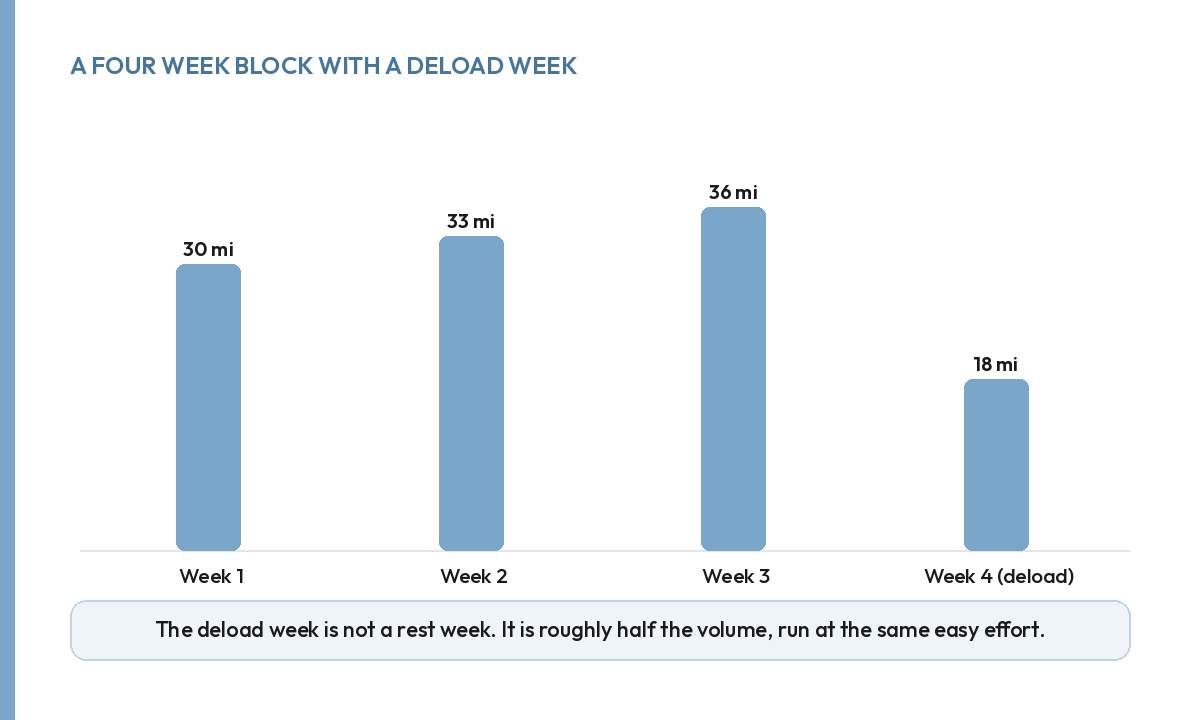
Three weeks of normal, slowly rising volume, then a week at roughly half the third week's distance. The pattern of the week does not change: the same days, the same routes, the same easy pace. Only the distance on each of them comes down. The week after, mileage goes back to where the block left off rather than starting over from week one.
What stays the same.
Keep your running days the same. Frequency protects the habit and the movement pattern far more than total mileage does, and a runner who stops entirely for a week often finds the second week harder to start than the first.
Keep your pace the same on your easy days too. A deload lowers volume, not intensity. If you normally run a short session with some pace work in it, either drop it for the week or shorten it, rather than turning every run into a hard effort at a lower volume, which defeats the point.
Do not swap in new routes, new shoes, or a different surface during a deload. You are removing load, not adding a new variable at the exact point you are trying to settle one down.
How your own numbers make this easier to see.
Almost nobody plans a lighter week on purpose, because the need for one builds slowly and is easy to miss from the inside. You feel fine, then a few sessions in a row feel like something to survive.
This is what we built The Health Project for. Your training, your sleep and your recovery markers sit together, so a slow drift shows up as a line rather than a feeling you have to notice on your own. Progressive overload and a deload are the two halves of the same pattern: the weeks you build on, and the weeks you deliberately do not. Programmed lighter weeks are part of the coaching programme, the same way planned rest days are, so a deload gets scheduled in rather than noticed three weeks late. The app shows you the trend in your training load, your sleep and your resting markers. It does not tell you what a single reading means about your health, that stays a conversation for your own doctor.
If you would rather have someone build the deloads into your training and tell you when one is due, that is what my coaching is for.
FAQ.
How much should you cut your mileage during a deload week?
There is no single safe number backed by the evidence. Treat 30 to 50 percent below your normal week as a starting range, then adjust to how you feel.
How often should runners deload?
Every four to eight weeks suits most schedules. Take one sooner if the signs above show up early.
Will a deload week hurt your fitness?
No. One lighter week does not cost you fitness. Skipping deloads and getting hurt costs far more of it.
Is a deload week the same as a taper?
No. A taper is a short cut in volume before a single race. A deload is a recurring reset built into normal training, race or no race.