Rest Days Gym Schedule: How Many You Actually Need

TL;DR. A rest days gym schedule is not a fixed number, it is a match between how much you train and how much you recover. Most people lifting three to five times a week need at least one full day off, more if their weekly volume is high or their sleep is poor. Soreness is a poor guide to how recovered you are. Better signals are your strength on the bar, your sleep and your resting heart rate. A rest day is planned. Falling off is not, and the difference is whether you know when you are going back.
What actually happens on a rest day.
Training is the stimulus. The adaptation happens afterwards, while you sleep and eat.
Skipping recovery does not make you fitter faster. It makes the next session worse, and a run of worse sessions is how people end up stuck at the same weights for months.
This is the part that is easy to say and hard to feel, because nothing visibly happens on a rest day. No new personal best, no sweat, no session to log. The work is happening anyway, in muscle repair, in the nervous system resetting, in glycogen being restocked. A rest day is not time off from progress. It is the part of training where progress is actually made.
Building a rest days gym schedule that actually works.
There is no single number, because it depends on how much work you are doing.
The useful question is weekly. A systematic review grouped training volume into low, under 12 sets per muscle group per week, moderate, 12 to 20, and high, over 20 sets. Higher volume needs more recovery, not the same recovery.
Source: Baz-Valle and colleagues, a systematic review of resistance training volume.
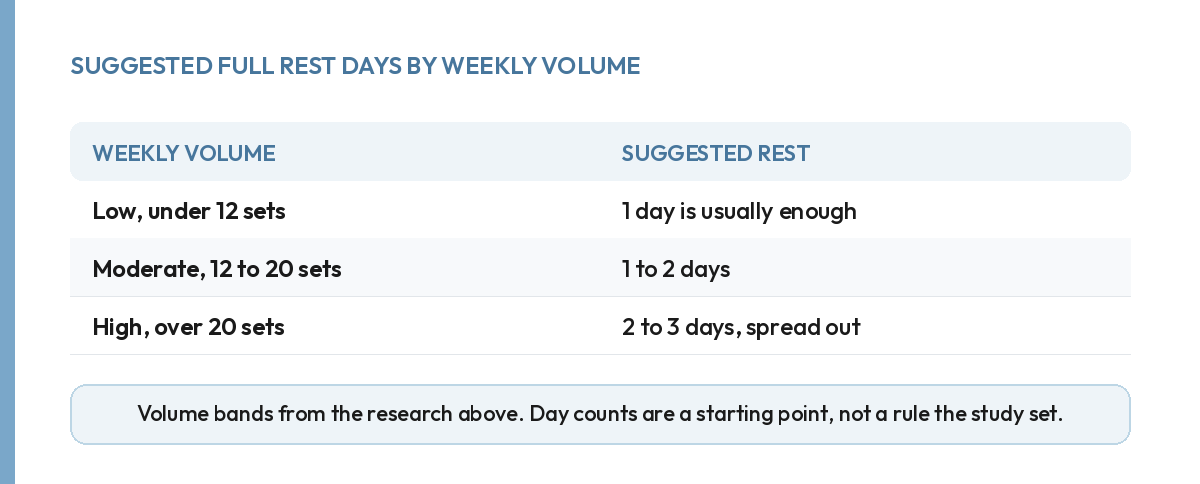
Treat those day counts as a starting point, not a rule the research itself sets. The study measured sets, not rest days. The mapping above is ours, built to be adjusted against how you actually feel and perform.
A practical starting point for most people. Train three to five days a week, and take at least one full day off training. If you are training five or six days, split the muscle groups so no muscle is worked hard on consecutive days. Someone following the progressive overload approach of adding a set most weeks will eventually need to move from the low band to the moderate one, and their rest days should move with it.
Soreness is not the signal.
Soreness tells you a muscle did something unfamiliar. It does not tell you whether you recovered.
You can be extremely sore and perfectly ready to train, usually after trying a new exercise. You can also be completely pain free and thoroughly under-recovered, which is the more dangerous of the two.
Better signals, in order of usefulness:
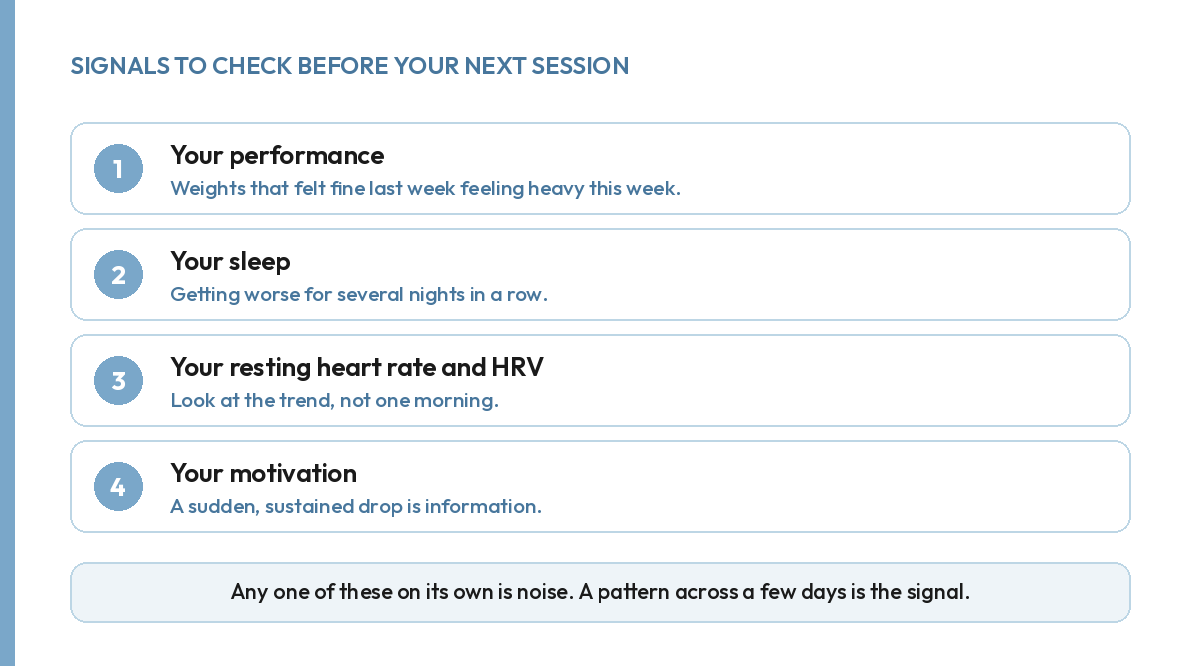
- Your performance. Weights that felt fine last week feeling heavy this
week.
- Your sleep. Getting worse for several nights in a row.
- Your resting heart rate and HRV. A trend, not a single morning.
- Your motivation. A sudden and sustained drop is information.
Persistent underperformance despite rest is worth taking seriously rather than training through.
Source: Kreher and Schwartz, overtraining syndrome, a practical guide.
What to do on a rest day.
Move, gently. A walk, easy cycling, some mobility work. Blood flow helps and none of this interferes with recovery.
Eat normally. Protein needs do not drop on a rest day. Recovery is when the building happens.
Sleep. This is the one that actually matters and the one most people trade away first. If you track your nights against a target, a bad run of sleep is visible before it turns into a bad week of training rather than after. That is what sleep tracking is for.
Do not train the same muscle hard. That is not a rest day with extras. That is a training day.
What a rest days gym schedule looks like at different training frequencies.
Three days a week, full body each time, needs the least planning. Any two non-consecutive rest days work, and most people naturally land on something like train, rest, train, rest, train, rest, rest.
Four or five days a week is where the split matters. Push the same muscle group on back to back days and the second session is training on top of an unfinished repair job, not a fresh one. Spreading upper and lower body, or pushing and pulling, across the week gives every muscle group its rest even on a day you are still in the gym. Sets and reps written out for a full week shows one way to lay that split out.
Six days a week leaves almost no full rest day, so the rest has to happen inside the split instead. This works for a well-recovered, experienced lifter and works badly for anyone newer to training, whose weekly volume tolerance is lower to begin with. Recovery needs also shift with age and training history, which is why a gentler two day a week starting point looks different from a six day a week schedule built for someone years into training.
How do you know if you need a rest day or a rest week?
If one or two days off fixes it, it was a rest day.
If you take two days off and the weights still feel heavy, you have accumulated more fatigue than a weekend clears. That is what a planned lighter week, a deload week, is for.
What your rest days can tell you over time.
Rest is the only part of training that leaves no record. Sessions get logged and rest days do not, so nobody can look back and see whether the good months had more of them.
This is what we built The Health Project for. Your training, your sleep and your recovery markers sit in one place: resting heart rate, HRV and training load alongside the sessions you actually did. Programmed easier weeks are part of the coaching programme too, so a deload is planned in rather than noticed after the fact. The app shows you the trend. It does not tell you what a single reading means about your health. If something looks wrong, that is a conversation for your doctor.
If you would rather have someone build the schedule and adjust your rest days as you go, that is what my coaching is for.
FAQ.
Is it bad to work out every day?
No, if the hard work is spread so no muscle group is trained hard on back to back days. It becomes a problem when every session is maximal.
Should you take a rest day if you are not sore?
Yes. Soreness is not the measure of whether you recovered.
How many rest days a week is best?
At least one full day for most people. More if your weekly volume is high or your sleep is poor.
Does walking count as rest?
Yes. Easy movement does not meaningfully interfere with recovery from lifting.