Exercise Mood Boost: What the Research Actually Shows
TL;DR. An exercise mood boost is real and measurable, not just a feeling people report. A meta-analysis of 11 randomized trials found exercise reduced depression symptoms with a standardised mean difference of 0.67 and anxiety symptoms with 0.29, both meaningful effects, with the biggest gains in people who had a diagnosed depression. On how much you need, one dose-response analysis found the best-modelled effects around 600 to 900 MET-minutes a week, a moderate, sustained amount rather than an extreme one, with benefit levelling off at very high weekly volumes.
Exercise mood boost: what actually happens, by the numbers.
"Exercise helps your mood" gets said so often it starts to sound like a platitude. The research behind it is more specific than that, and more interesting.
A systematic review and meta-analysis of 11 randomized controlled trials covering 1,009 participants found exercise interventions produced a standardised mean difference of 0.67 for depression symptoms and 0.29 for anxiety symptoms compared with control groups, both favouring exercise. Depression moved more than anxiety did. And within that group, people who had a diagnosed depression, not just everyday low mood, showed the largest response, with a standardised mean difference of 0.96.
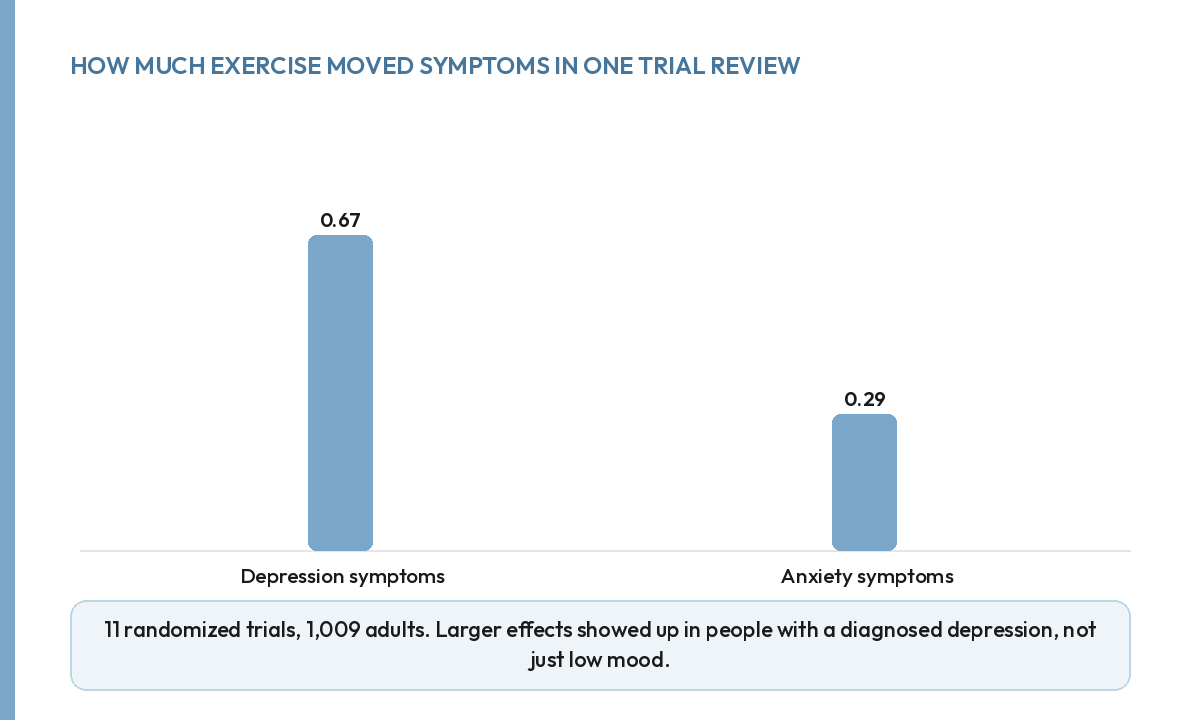
Interestingly, the same review found programmes shorter than 12 weeks worked at least as well for depression as longer ones. Mood is not a reward that only shows up after months of consistency. It moves earlier than that.
How much exercise do you need to feel it?
More than nothing, and less than you might assume.
A network meta-analysis of 23 randomized trials in 2,298 postmenopausal women modelled the relationship between weekly exercise dose and both anxiety and depression. The pattern was not a straight line: benefit improved as weekly volume rose from zero, peaked in a moderate range, and did not keep climbing at very high doses. The best-modelled effects sat around 600 to 900 MET-minutes a week for anxiety, with a similar pattern for depression.
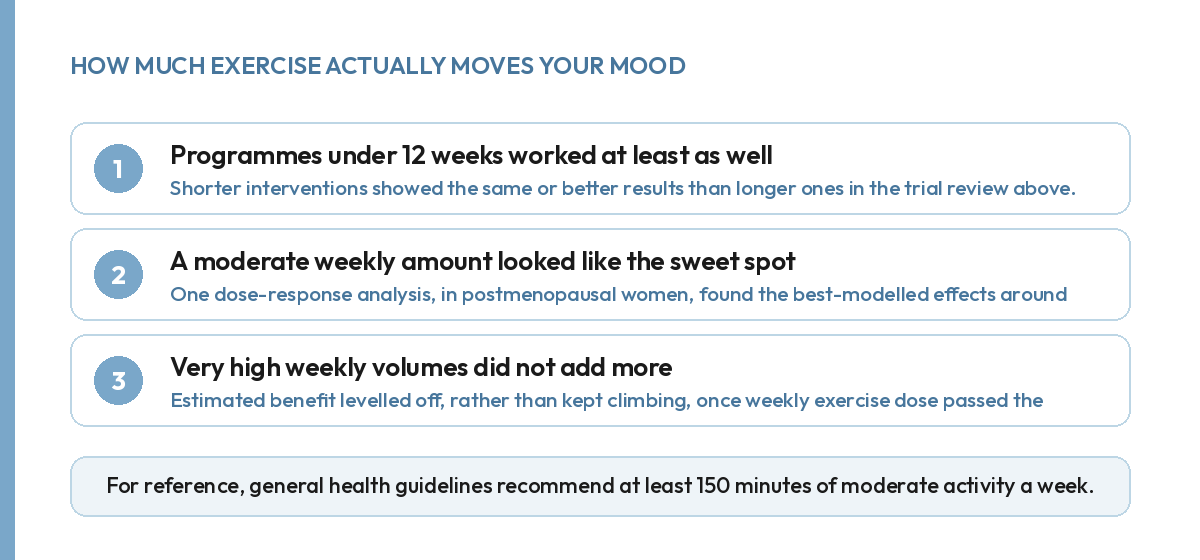
Source: a network meta-analysis of exercise dose-response for anxiety and depression in postmenopausal women.
For reference, general health guidelines put a floor at 150 minutes of moderate activity a week. The dose-response research above suggests that floor is a reasonable place to start for mood too, and that chasing far more volume than that is not where the extra benefit lives.
That same review also compared exercise types. Mind-body training, yoga, tai chi, pilates and qigong, ranked ahead of aerobic training on both outcomes in this specific population, which is worth knowing if structured cardio has never been the format that stuck for you.
Why exercise moves mood at all.
The honest answer is that researchers are still working out the exact mechanism, and it is very likely more than one thing at once: changes in brain chemistry, better sleep, a sense of accomplishment, and simply having a fixed point in the day. What the trials above show is the outcome, not a single tidy explanation for it, and that is enough to act on without waiting for the mechanism to be settled.
This is also why so many different formats show up with a real effect in the research: walking, cycling, resistance training, yoga. None of them depends on one specific mechanism working alone, so a format you will actually keep doing tends to beat the format that scores best in a single study but never makes it past week two. The trials measuring these effects mostly ran structured programmes with a set frequency, not occasional exercise done whenever the mood struck, which is worth keeping in mind when the goal is a real effect rather than a placebo one.
Building it into a week that already feels full.
The dose-response finding above is good news for anyone who has written off exercise for mood because a serious training programme felt like too much to take on. A moderate, sustained weekly amount is the target, not a daily hour.
Getting back into training after any kind of break starts at roughly half of what you think you can do, for exactly this reason: the version that keeps happening beats the version that looks impressive for two weeks and then stops. If focus and mental clarity are what you are actually chasing alongside mood, exercise and brain fog covers that side of the same picture.
Consistency is also where most mood-related exercise plans quietly fail, not the workouts themselves. Setting a goal you will actually keep matters as much here as the exercise selection does.
This is what we built The Health Project for. Your sessions and your weekly check-in, a two minute reflection on energy, sleep, stress and wins, sit next to each other, so you can see whether a more active week actually tracked with a better one, rather than relying on memory to connect the two.
If persistent low mood or anxiety is what you are dealing with, exercise is a genuine, evidence-backed lever and not a replacement for talking to a professional about it.
FAQ.
Does exercise actually improve your mood, or is that overstated?
It holds up in trials. A meta-analysis of 11 randomized trials found a meaningful reduction in depression symptoms from exercise, with the largest effects in people with a diagnosed depression rather than everyday low mood.
How much exercise do you need for a mood benefit?
One dose-response analysis found the best-modelled effects around 600 to 900 MET-minutes a week, roughly a moderate, consistent weekly amount rather than an extreme one.
Do you need intense exercise to get a mood boost?
No. The research points toward consistency and a moderate weekly total mattering more than pushing intensity.
Can exercise replace therapy or medication for depression?
That is not what the evidence shows. Exercise has a real, measurable effect on mood, and it is not positioned in the research as a replacement for clinical treatment.