How to Get Back in the Gym
TL;DR. How to get back in the gym comes down to three rules. Go back at about half of what you think you can handle, twice a week, for three weeks. Previously trained muscle returns faster than it was built, and in one study a second block of training built more than the first. The barrier is almost never physical. It is that the first session feels like an admission of having stopped. Habits also take longer to rebuild than people expect, with median times in one review running from 59 to 66 days, so give it longer than a fortnight before you judge it.
Start with the part nobody says out loud.
Most people do not avoid the gym because it is hard. They avoid it because going back means admitting they stopped.
That feeling is not information about your fitness. It is not a reason to wait until January, or until you feel ready, or until you have lost some weight first. Nobody in there is keeping score on your absence. The people in there are thinking about their own set.
The only decision that matters this week is the day and time of the first session. Not the programme, not the split, not the shoes. Pick the day, then read on.
How to get back in the gym without a session that ends it.
The most common way a return fails is a first session that is far too hard. You walk in, you remember what you used to lift, and you try to prove something. Two days later you cannot walk properly, and the second session never happens.
So the plan for the first three weeks is deliberately light.
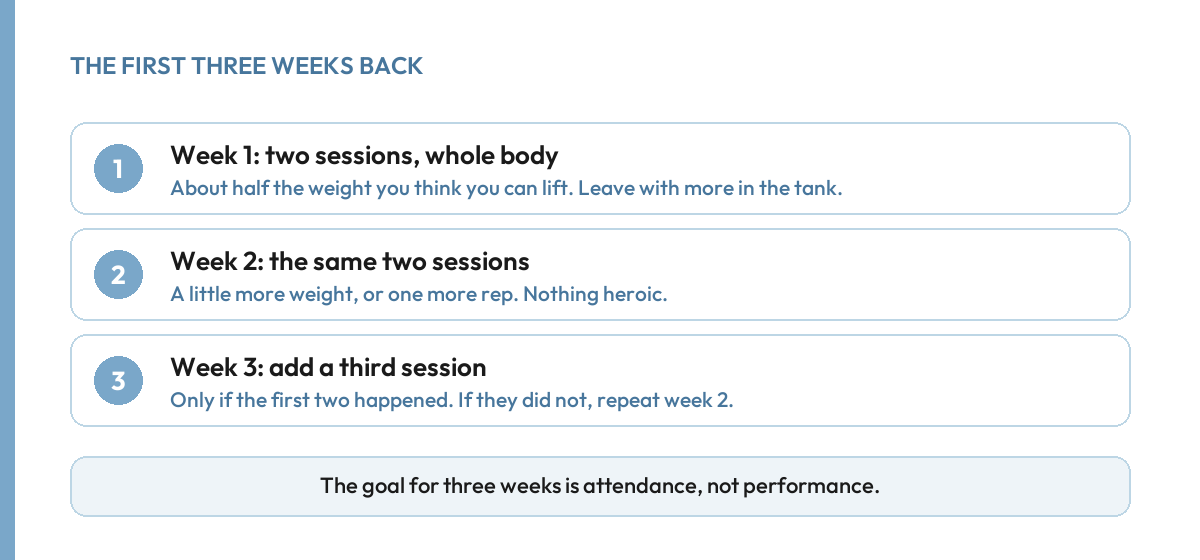
Week 1. Two sessions. Whole body. About half the weight you think you can lift, well inside your limit. Six to eight exercises, two or three working sets each, and you leave feeling like you could have done more. That feeling is the point. If you need a shape for the session, our guide to sets and reps has one you can copy as it stands.
Week 2. The same two sessions, slightly more weight or one more rep on each exercise. You are not chasing the number you remember. You are re-learning the movements and letting your joints and tendons catch up with your enthusiasm.
Week 3. Add a third session if the first two happened both weeks. If they did not, repeat week 2 rather than adding. A third session on top of a shaky two is how the whole thing collapses.
The goal for three weeks is attendance, not performance. After that, you have a base to build on, and the normal rules of progressive overload take over.
What comes back, and how fast.
Strength returns quickly, and much of the early return is your nervous system remembering movements it already knows. The bar feels foreign for a session or two and then it does not.
Previously trained muscle also rebuilds faster than it was originally built. In a study of eight men published in Scientific Reports, seven weeks of resistance training raised lean leg muscle by 6.5 percent. Seven weeks of stopping brought it back down toward where it started. Then seven weeks of training again took lean leg muscle to 12.4 percent above the starting point, which means the second block built more than the first. Strength followed the same shape: up 9.3 percent after the first block, back down during the break, then up 18 percent from the start after the second.
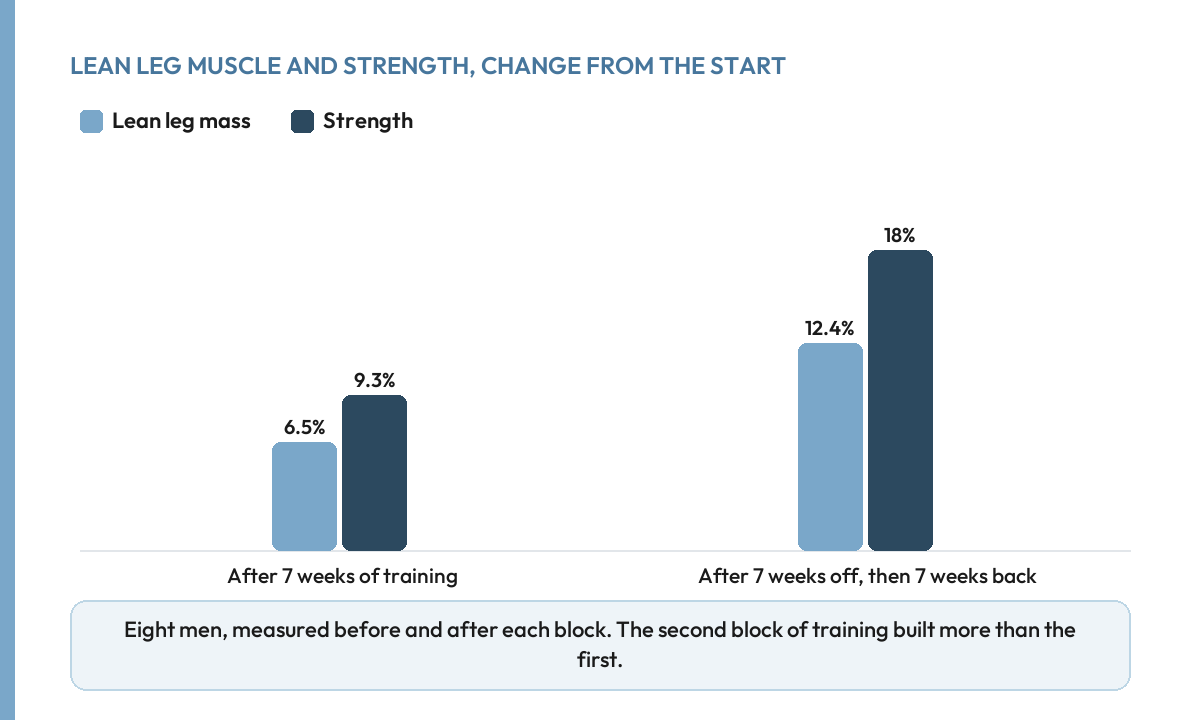
Source: a study on muscle memory after a break from training, Scientific Reports, 2018. Eight people is a small group, so treat the exact percentages as one result rather than a promise. The direction is the useful part: the months you put in before were not wasted, even if the last year was.
Expect your first sessions to feel disproportionately hard for how light they are. That fades within about two weeks.
Give it longer than you think.
The idea that a habit takes 21 days is not what the research shows. A systematic review and meta-analysis of 20 studies and 2,601 people reported median times to form a health habit of 59 to 66 days, with means of 106 to 154 days, and individual variation running from 4 to 335 days.
Source: a systematic review and meta-analysis on time to form a habit, Healthcare, 2024.
So a fortnight of effort that still feels like effort is not failure. It is week two of a process whose midpoint is around two months. The same review found that habits practised in the morning, and habits people chose for themselves rather than were assigned, tended to come out stronger. Both are worth knowing when you pick your slot.
Five things that make a return stick.
Book it like an appointment. A specific time on specific days, in your calendar, the same way you would book a dentist. "I'll go when I can" is a decision to not go.
Make the first session too easy. Deliberately. You should walk out wondering whether that counted. It counted.
Go at the same time. Habits attach to cues, and time of day is the strongest one available. Morning, if it fits your life, for the reason above.
Do not change your diet in the same week. Two hard changes at once and both usually fail. Get the sessions happening first. The food can wait three weeks.
Never miss twice. One missed session is life. Two in a row is how a break starts. If you miss Tuesday, Thursday is not optional.
What if you fall off again?
You will, at some point. Everyone does. A cold, a work trip, a bad month.
The difference between people who train for decades and people who restart every January is not willpower. It is how quickly they come back after a missed week. Treat it as a missed session, not a failed project, and go back on the next scheduled day at half the weight. The three week plan above works the second time too, and the third.
It also helps to know the difference between a break and a rest. Planned time off is part of training, not a lapse. Our post on rest days covers how much is normal, so a scheduled easy week does not get mistaken for the start of a slide.
The thing that made it stop last time.
Usually, invisibility. When you cannot see progress, missing a session costs nothing you can perceive, so eventually you miss all of them. The gym becomes a place you used to go, without a single day where you decided to quit.
This is what we built The Health Project for. Every session is logged down to the set, your history is there to look back on, and the app reads your last session and suggests the next step, so a run of weeks becomes something you can see rather than something you have to remember. There is a habit tracker for the days themselves, and you can plan your week in advance so the appointment above is already in front of you. See how the training side works.
And if what you actually need is somebody expecting you on Tuesday, that is what coaching is. Not a meal plan and not a counting requirement, just a person who knows you were due in and asks. See how coaching works.
FAQ.
How long does it take to get back in shape?
Faster than the first time. In one study, men who trained for seven weeks, stopped for seven and came back for seven ended up further ahead than the first block of training got them. Expect the first two weeks to feel harder than they should, then a steady return.
Should you start with cardio or weights?
Weights, if you have to choose. Strength is what you lost fastest and what returns fastest. Cardio can sit alongside from week two onward if you want it.
How many times a week should you go when starting again?
Two, for the first three weeks. Add a third only once those two are actually happening every week without you having to negotiate with yourself.
Will you lose everything if you stop for a year?
No. Strength and size drop, but they return considerably faster than they were built, and a longer break does not reset you to zero. It changes how light your first sessions should be, not whether they are worth doing.