How Long to See Results From Working Out Female Guide
TL;DR. How long to see results from working out female bodies specifically depends on what you are measuring. Strength improves first, often within a few weeks, and most of that early gain is your nervous system learning the movements rather than new muscle. Visible changes take longer, usually a couple of months of consistent training, and depend as much on nutrition as on the gym. Habits take longer than anyone expects. In one review, the median time to habit formation ranged from 59 to 66 days, with individuals ranging from 4 to 335 days.
What changes, and when.
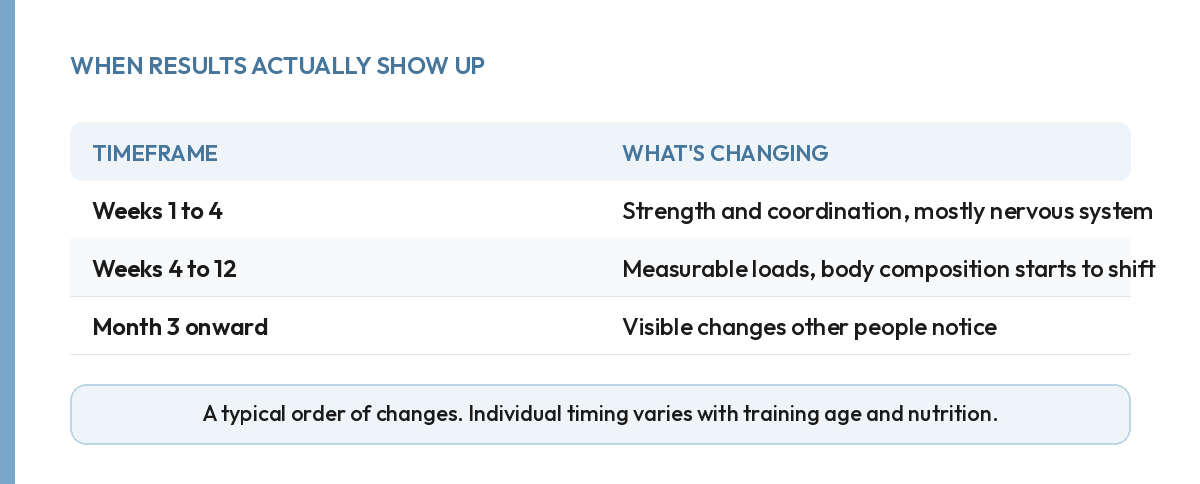
Weeks 1 to 4. Strength and coordination.
The weights move better and the movements feel less awkward. Very little of this is new muscle. Your nervous system is getting better at recruiting what you already have.
Weeks 4 to 12. Measurable changes.
Loads on your main lifts are clearly higher than when you started. Body composition begins to shift if nutrition supports it.
Month 3 onwards. Visible changes.
Changes other people notice. This is also where most people have already stopped.
How long to see results from working out female bodies, specifically.
The timeline above is not different for women. Nervous system adaptation, measurable strength gains and visible change all follow the same order regardless of sex. What differs is what the mirror and the scale show you along the way.
Water retention linked to the menstrual cycle can shift the scale, and how you look in the mirror, by a kilogram or more within a single week, for reasons that have nothing to do with training. Judging a training block by how you looked on any one day, at any point in the cycle, will always be misleading. Your logbook is not affected by any of this, which is exactly why it matters more here than anywhere else in this article.
Strength training does not make you bulky by accident. Visible muscle size takes deliberate, sustained training and eating to build, over months and years, not weeks. The strength gains that show up first are your nervous system getting efficient, not new tissue, and that is true whether you are 16 or 60.
Why the mirror is the wrong instrument.
Your reflection is affected by lighting, the time of day, how much you have eaten, how much water you are holding, and your mood. Those inputs move more day to day than actual body composition does over a month.
Your logbook is not affected by any of them. Twelve reps where you could do eight is a real change, and it happened whether or not you can see it.
Judge a training block on what you lifted and what you weighed on average, not on how you looked on one particular morning.
The number that surprises people.
Habits take much longer to form than the popular figure suggests.
A systematic review and meta-analysis of habit formation reported median times of 59 to 66 days, with means of 106 to 154 days, and individual variation from 4 to 335 days.
Source: a systematic review and meta-analysis on time to form a habit.
Read that range again. Some people take nearly a year. If going to the gym still feels like effort at week eight, nothing has gone wrong. You are inside the normal range.
What makes it faster.
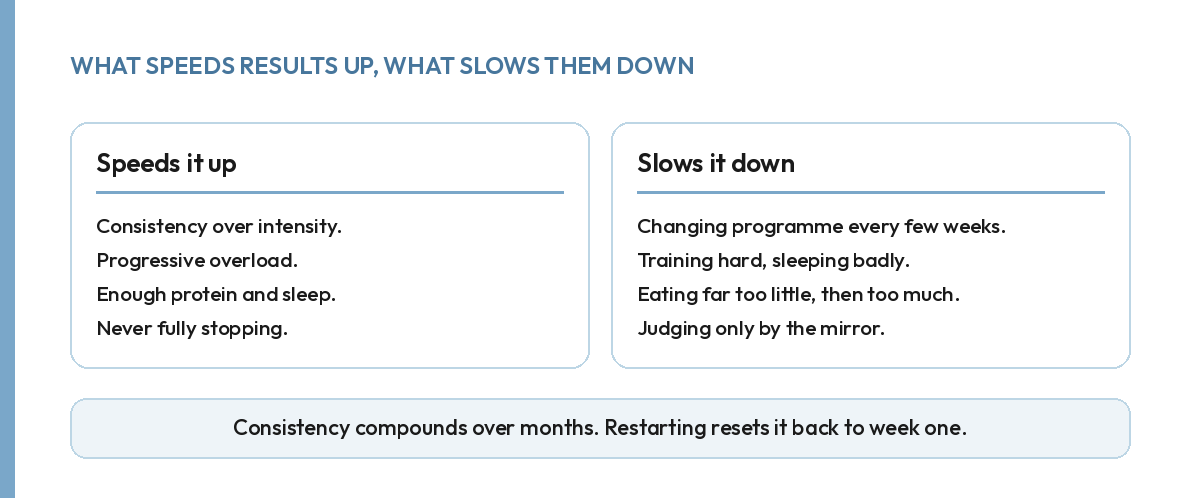
Consistency over intensity. Three sessions a week for six months beats six sessions a week for three.
Progression. The demand has to rise or your body has no reason to change. Progressive overload is simply doing that on purpose, one small step at a time, rather than hoping the same workout keeps working forever.
Enough protein and enough sleep. These are where results are actually built. Calorie balance decides body composition change more than any single workout does, which is why two people doing the same programme can see different results.
Not restarting. Every fresh start costs the momentum of the last one. The people who get results are rarely the most disciplined. They are the ones who never fully stopped.
What makes it slower.
- Changing programme every few weeks
- Training hard while sleeping badly
- Eating far too little, then far too much
- Measuring progress only by how you look
A worked example, week by week.
Week 1. Log every session: the exercises, the weight, the reps. This is the only week where the numbers will look unimpressive. That is expected, not a bad sign.
Week 4. The same lifts move with less effort, or for a rep or two more, than they did in week 1, even when nothing looks different in a photo. A training log that reads your last session and suggests the next step makes this comparison automatic instead of something you have to remember.
Week 8. A short weekly check-in, a two minute reflection on weight, energy, sleep, stress and wins, starts showing a trend rather than a single number. A trend line moving in the right direction is a result. A single day never is.
Week 12. Loads are meaningfully higher across your main lifts. If you are years past your first training block, a strength plan built for women over 50 still runs on this same timeline, it just starts from a different point.
This is a slower story than a before-and-after photo, and it is the one that is actually happening.
Why does progress feel invisible?
Because it arrives too slowly to perceive from inside it, and because the thing most people use to measure it is the least reliable instrument available.
A change of one or two percent a month is real, compounding, and completely invisible day to day. It only becomes visible when it is written down.
This is what we built The Health Project for. Your sessions, your weight trend and your sleep sit in one place over months, so you can see the line instead of trusting a feeling. If you want someone keeping you accountable to it, that is what my coaching is.
FAQ.
How long before you see results from working out?
Strength changes within a few weeks. Visible changes usually take a couple of months of consistent training.
Why do you look bigger when you start training?
Muscles hold more water and glycogen when trained regularly. It is not fat gain.
How long does it take to get in shape after a long break?
Faster than the first time. Previously trained muscle regains size and strength more quickly.
Is going to the gym twice a week enough?
Yes, for strength and health. Two well structured sessions you actually attend beat four you skip.
Does strength training make women bulky?
No. Visible muscle size takes deliberate, sustained training and eating over months and years, not weeks.
What should I track if the scale is not moving?
Your lifts, your reps, your sleep and your energy. Any one of those can be improving while the scale sits still.