The Best Strength Training for Women Over 50
TL;DR. Strength training for women over 50 is the direct answer to a decline that moves faster than muscle loss itself: strength. In longitudinal data on people around 75, women lose muscle mass at roughly 0.64 to 0.7 percent a year, while strength goes at 2.5 to 3 percent a year. It also has a positive effect on bone mineral density in postmenopausal women, though the size of that effect is moderate at best. Two to three sessions a week is enough to start.
What strength training for women over 50 changes.
Two things are happening and they move at different speeds.
Muscle mass declines slowly. In longitudinal studies of people around 75, women lost muscle at about 0.64 to 0.7 percent per year, men at 0.8 to 0.98.
Strength declines much faster. At the same age, women lost strength at about 2.5 to 3 percent per year, men at 3 to 4 percent.
Source: Wilkinson and colleagues, the age related loss of skeletal muscle mass and function.
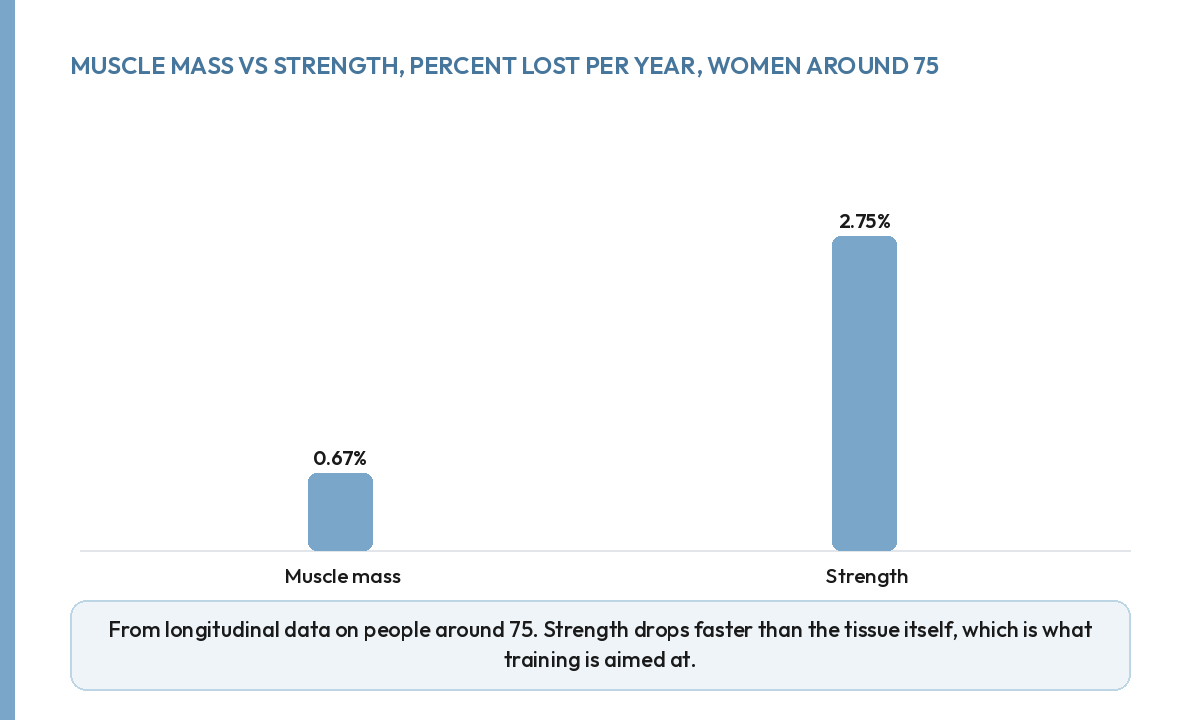
That gap is the important part. You are not simply losing tissue. You are losing the ability to use it, faster than you are losing it, and strength training is the one intervention aimed straight at that.
What about bone?
Exercise has a positive effect on bone mineral density in postmenopausal women. Being honest about the size of it, a systematic review found the effect sizes for lumbar spine and femoral neck to be moderate at best in mostly healthy groups.
Source: Kistler-Fischbacher and colleagues, exercise training and bone mineral density in postmenopausal women.
Moderate is still worth having, and it is more than nothing does. But it is not the transformation some marketing suggests, and you should know that going in.
This is general information about training, not medical advice. Bone health, medication and anything to do with menopause are conversations for your doctor.
What the training should look like.
Lift with real resistance. Light weights for high reps are pleasant and underpowered. The set should get genuinely hard.
Two to three sessions a week. Enough to progress, few enough to recover.
Full body, using compound movements. A squat or leg press, a hinge, a push, a pull, and something for the core.
Progress it. Add a rep, then another, then a little weight. Without that, it becomes exercise rather than training. How to add load week to week works the same way at any age.
A starting week.
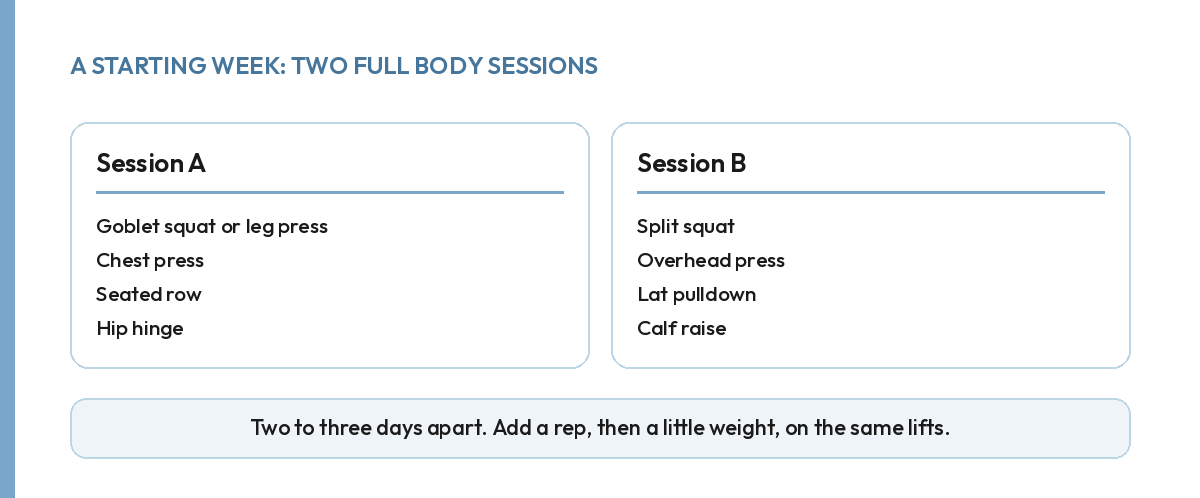
Two sessions, whole body, with two or three days between them.
Session A.
- Goblet squat or leg press, 3 sets of 8 to 12
- Chest press, 3 sets of 8 to 12
- Seated row, 3 sets of 8 to 12
- Hip hinge, 2 sets of 10
Session B.
- Split squat, 3 sets of 8 each side
- Overhead press, 3 sets of 8 to 12
- Lat pulldown, 3 sets of 8 to 12
- Calf raise, 2 sets of 12
Add walking on the other days. Nothing here requires a barbell.
If you want to see the same sets and reps logic applied to a four day split with higher weekly volume, this worked sets and reps example breaks it down set by set.
Working around joints, old injuries and starting from zero.
If a joint has a history, that movement pattern still has a version you can load. A sore knee often tolerates a leg press better than a barbell squat. A shoulder that objects to an overhead press can still row and press from the chest. Swap the exercise, not the intention behind it.
If you have never lifted anything, start with two sessions a week at a weight that feels almost too easy for the first two weeks. Your joints and connective tissue adapt slower than your muscles do, and the rush to add weight in month one is where most early strains come from. Slow is the fast way here.
Warm up with a few minutes of easy movement before the first working set, and treat the first set of each exercise as a lighter rehearsal for the working sets that follow it.
How long before you notice anything?
Strength moves first, often within a few weeks, because early gains come largely from your nervous system learning the movements.
Changes in muscle size take longer, and changes in bone take longer still and are measured in a scan rather than a mirror.
Judge it on your logbook. Being able to do 12 reps where you could do 8 is progress, whatever the scale says. A week where you felt flat and skipped a rep is not a failure either, it is a normal part of a plan that runs for years rather than weeks. A fuller week by week breakdown of what changes and when goes through the same timeline in more detail.
The part that decides whether this works.
None of the above matters if the sessions do not keep happening, and the thing that keeps them happening is being able to see them add up.
This is what we built The Health Project for. Every session is logged down to the set, weight and reps, it reads your last session and suggests the next step, and your training sits next to your sleep, your recovery and any markers you want to keep. Deload weeks are built into the coaching programme for the weeks your body asks for less.
Strength is not the only marker worth watching as you age. If you also track cardio fitness, see where average VO2 max lands by decade to judge yours in context.
If you want someone in it with you, that is what my coaching is.
FAQ.
Is it too late to start strength training at 60?
No. Resistance training improves strength at every age studied, including in much older adults.
How heavy should the weights be?
Heavy enough that the last two or three reps are genuinely hard, while your form holds.
Will strength training make you bulky?
No. Building large amounts of muscle is slow and difficult at any age.
How many times a week should a woman over 50 lift?
Two to three sessions a week is a sound starting point, with rest days between.