How to Build a Habit Tracker That Lasts
TL;DR. How to build a habit tracker that actually works comes down to two things: picking one behaviour and logging it in the same place every time. The research says a habit takes a median of 59 to 66 days to form, not the 21 days you have probably heard, and missing a single day matters far less than switching trackers or giving up on the whole thing.
Why "21 days" is the wrong number.
The 21 day figure traces back to a 1960 self-help book, Psycho-Cybernetics, in which a plastic surgeon named Maxwell Maltz observed that it took his patients about three weeks to get used to a new face after surgery. He never tested the idea, and he was not writing about habits at all. It has just been repeated so often that it now reads as science.
Source: Scientific American, how long does it really take to form a habit.
The real research measured actual people trying to build actual habits, not a surgeon's impression of his patients. A 2024 systematic review and meta-analysis pooled 20 studies and 2,601 participants who were building habits around eating, drinking, exercise and other everyday behaviours. The median time to reach 95 percent of full automaticity, the point where a behaviour has become close to effortless, was 59 to 66 days. Individual results ranged from 4 days to 335 days.
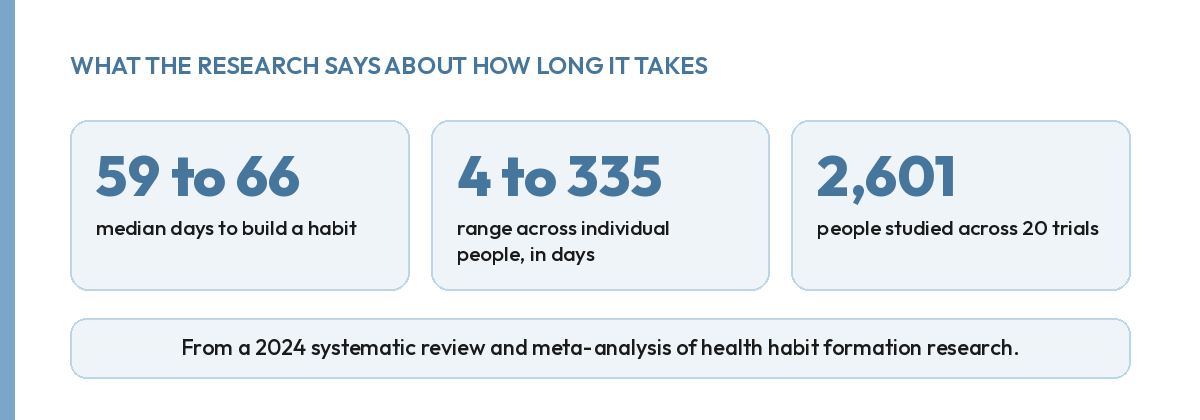
Source: Singh, Murphy, Maher and Smith, Healthcare, 2024, a systematic review and meta-analysis of health behaviour habit formation.
That spread matters more than the average. If you quit on day 25 because the habit still feels effortful, you are not failing. You are roughly on schedule for a fair number of people in that data.
Why tracking it works at all.
A habit tracker only does one job: it shows you whether you actually did the thing, instead of leaving that to memory. That sounds small, but it has been studied directly.
A systematic review of 22 studies on self-monitoring and weight loss found a consistent association between logging a behaviour and the outcome that behaviour was meant to produce. In one of the included studies, how often someone logged their food predicted 32 percent of the difference in how much weight they lost, a result the researchers reported as statistically significant. Across the review as a whole, more frequent self-monitoring was consistently linked to a better result, whether that meant food, exercise or a person's own weight.
Source: Burke, Wang and Sevick, Journal of the American Dietetic Association, 2011, self-monitoring in weight loss: a systematic review of the literature.
The mechanism is not mysterious. You cannot adjust what you cannot see. A tracker turns a vague sense of "I've been pretty good about this" into a row of actual days, which is the only thing you can act on.
How to build a habit tracker in five steps.
Most habit trackers fail for the same reason: they start too big. Here is the version that tends to survive past week two.
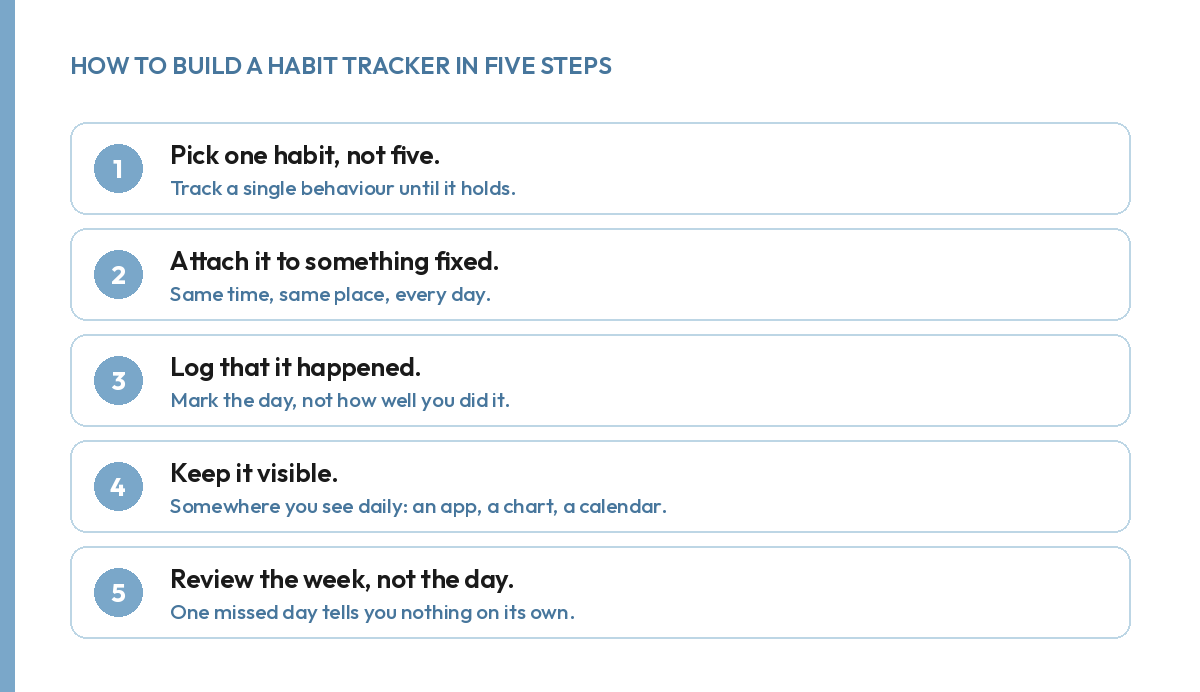
Pick one habit, not five. Tracking three new habits at once splits your attention across all three and usually kills all three. Choose the one that actually matters most and leave the rest for later.
Attach it to something fixed. A habit that happens "sometime today" is harder to log than one that happens right after breakfast, or right before your training. Anchor it to a moment that already exists in your day.
Log that it happened, not how well. A tracker is a yes or no, not a grade. The day you did a rushed, mediocre version of the habit still counts. Grading it invites you to skip the days that would not score well.
Keep it visible. A tracker buried three menus deep gets forgotten. It needs to live somewhere you already look, which is the whole argument for tracking a new habit next to things you already track, like your nutrition or your sleep, instead of in a separate app on its own.
Review the week, not the day. One missed day tells you almost nothing on its own. A string of missed days across a full week tells you the habit, or the anchor you picked for it, is not working and needs to change.
Is 21 days really how long it takes?
No. As the research above shows, the honest answer is closer to two months for a typical person, with wide variation either way. Treating three weeks as the finish line sets most people up to feel like they failed right around the point where the habit was actually still forming.
What to track first.
If you are not sure where to start, start with adherence itself before you start with outcomes. Did you do the workout. Did you log the meal. Did you go to bed close to your target time. Those yes-or-no questions are easier to track honestly than a number on a scale, and they are also the behaviours that actually produce the number on the scale, eventually.
This is what a weekly check-in is for: a short, regular look at the week's adherence rather than a daily judgement on a single day. It is a habit tool in its own right, separate from tracking any one behaviour.
Where this lives.
We built a habit tracker into The Health Project because logging a behaviour in a fourth app nobody opens is how most tracking habits die. It sits next to your training and your nutrition, and a short weekly check-in asks about your weight, energy, sleep, stress and wins for the week, in about two minutes. Nothing here interprets the result for you. It shows you the pattern. What you do with it, including anything that belongs to a doctor rather than an app, is still yours.
If a new training habit is what you are trying to build, how to get back in the gym covers the specific version of that problem. If tracking itself is the sticking point, goal setting apps for health and fitness compares what different tools actually do with a goal once you have set one, and health tracker apps looks at what is worth tracking at all versus what just adds noise.
FAQ.
How long does it actually take to build a habit?
A median of 59 to 66 days in a 2024 review of 20 studies and 2,601 people, though individuals ranged from 4 to 335 days. It depends on the habit and the person, not a fixed number of weeks.
Is 21 days really how long it takes?
No. That figure comes from a 1960s book about plastic surgery patients, not a study of habits. The research puts the real median at two to three times that.
What should I track first?
One habit, not a list. Pick the behaviour you actually want to keep, log whether it happened, and add a second habit only once the first one is automatic.
Do I need a special app for this?
No. A paper chart works. What matters is that you look at it, which is why keeping the habit next to your training and nutrition, where you already look, tends to hold up better than a separate app you forget to open.