How to Run an Online Coaching Business

TL;DR. How to run an online coaching business well is mostly a question of rhythm, not effort. A set weekly routine, structured check-ins, and clear boundaries on when you reply let your roster grow without your week growing with it. Retention matters more than new leads, and reacting to messages all day is the single biggest thing that makes the job feel unmanageable.
What running it well actually looks like week to week.
Starting the business is a project with an end. Running it never ends, and the coaches who burn out are usually not overloaded with clients, they are overloaded with reacting. Every message answered the moment it arrives, every check-in read the day it comes in, every programme written the night before it is due. None of that scales, and all of it is optional.
The fix is not fewer clients. It is a rhythm you run every week regardless of how many clients are on it.
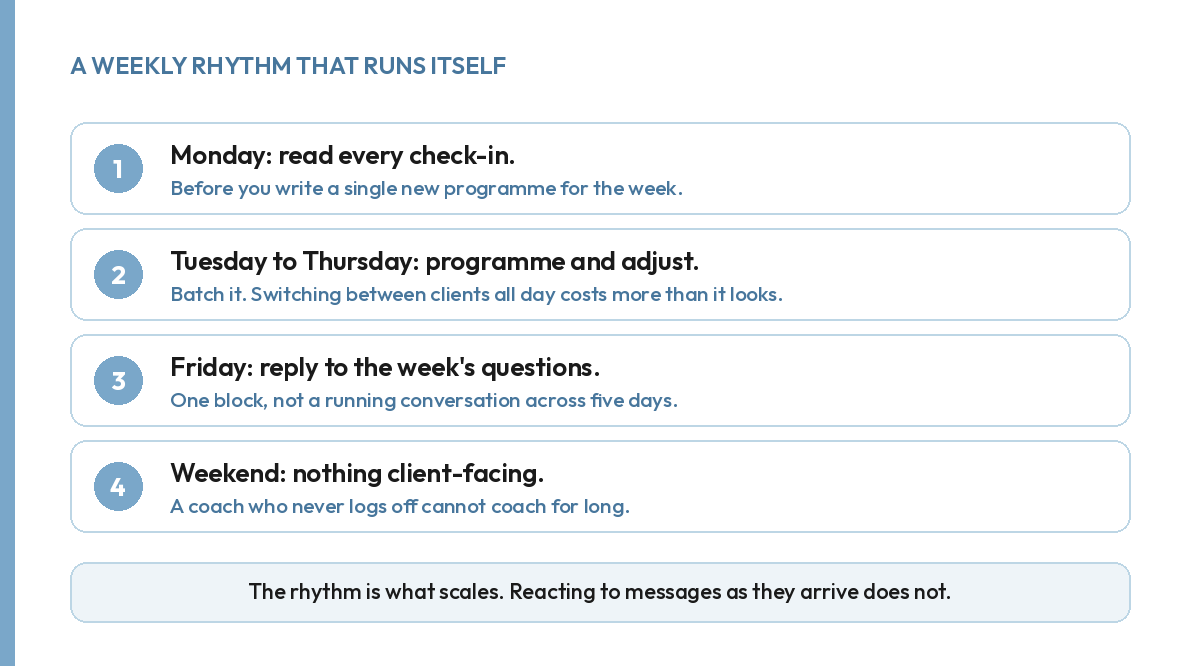
Build the rhythm once, then run it on autopilot.
Pick a day to read every check-in before you write anything new. Pick a block, not a whole day, to programme and adjust for the week ahead. Pick one window to reply to questions, rather than treating your phone as an open line from Monday to Sunday. The exact days matter less than having them fixed, because a fixed rhythm is the thing that stops the week from expanding to fill whatever time you give it. The right software makes the block shorter, because it holds the programme, the check-in and the message in one place. The rhythm becomes three sittings, not three separate tools to open.
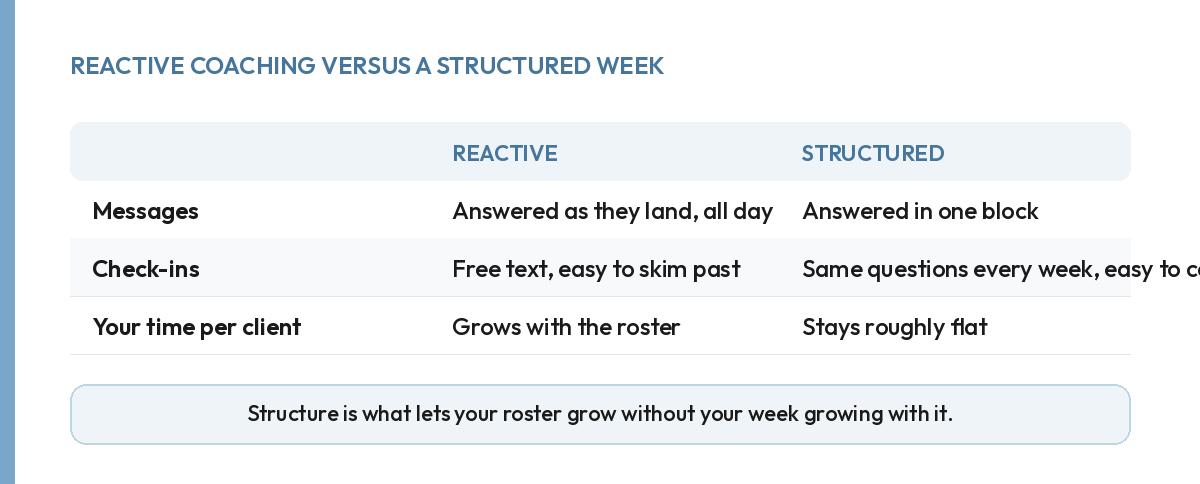
Keep check-ins structured, not open text.
An open "how was your week" invites a paragraph you have to read and interpret. The same questions every week, weight, energy, sleep, stress and wins, invite a short answer you can scan and compare against last week in seconds. Structure is what makes a roster of twenty clients as fast to review as a roster of five. You are reading the same four numbers each time, not a different essay from every client. It is the same principle behind a goal that actually sticks: specific and trackable beats vague, for a check-in as much as for a client's own goal.
Set boundaries on when clients can reach you.
Tell every new client when you reply, and hold that line from day one. A client who gets an instant answer on a Sunday night will expect one every Sunday night after that, and that expectation is yours to set, not theirs. A clear reply window is not a worse service. Clients notice consistency far more than they notice speed.
Read the whole picture before you react to one bad week.
A client who skipped two sessions looks, from the training log alone, like a client losing motivation. The same client's sleep and stress numbers might tell you they had a rough week at work and trained less because of it, not because they stopped caring. Coaches running clients on our platform see training, nutrition and sleep next to the weekly check-in. A dip reads as a full week rather than one missed session, before you write back with the wrong response to the wrong problem.
Retention is the real growth lever, not new clients.
A client who stays for six months is worth more than three who each churn after six weeks. They also cost you a fraction of the admin, because you already have them. The rhythm above is most of what protects retention. Clients stay when they feel seen on a schedule they can rely on. They do not stay for one fast reply followed by a slower one every week after. Chasing new leads to replace churn is treating the symptom. Fix the rhythm first, and the churn that rhythm was causing goes with it.
Have a plan for the client who goes quiet.
Every roster has one eventually. A client who was answering every check-in stops replying, or replies with less each week. The instinct is to wait and see, and waiting is usually the wrong call. A short, direct message asking what changed, sent the week the pattern starts rather than three weeks later, saves more clients than any check-in question ever will.
This is also where a fixed rhythm earns its keep. If you only look at check-ins on your set day, a quiet client is easy to notice against the pattern of everyone else's. If you are reading messages at random points through the week, a slow fade looks like nothing. By the time you notice, the client has already decided to leave and is telling you as a courtesy.
Review your own numbers, not just your clients'.
Track your own roster size, your average reply time, and how long clients actually stay, the same way you track a client's training. Most coaches can tell you their client count from memory and cannot tell you their average retention in months. Retention is the number that tells you whether the rhythm above is actually working, and it is worth checking monthly rather than assuming it from how the business feels that week. A roster that retains well is also the one marketing your coaching business actually works for, since a happy, long-staying client is the referral source the rest of your growth depends on.
So, how to run an online coaching business well long term?
By treating the week as a system rather than a queue. Set the rhythm, keep the check-ins structured, protect your reply window, and look at the whole client before you respond to one number. None of this requires more hours. It requires the same hours spent on a schedule you chose, instead of one your inbox chose for you.
FAQ.
How many hours a week does running an online coaching business take?
It depends on your roster and your rhythm, not just your client count. A structured week costs less time per client than a reactive one, at any roster size.
Should I answer client messages the same day?
You can, in a set block. Answering all day as messages arrive is what makes the business feel unmanageable long before your roster actually is.
What matters more, new clients or keeping current ones?
Keeping current ones. A client who stays six months is worth more than three who each stay six weeks, and costs you far less time to find.
Do I need to reply to every check-in individually?
Yes, but briefly. A short, specific reply to a structured check-in takes less time than it looks and is most of what keeps a client engaged.