Limited Training Time: Three Ways to Still Get Stronger
TL;DR. Limited training time does not mean no progress. Three different approaches all showed real strength gains in the research: single-set training in about 30 minutes, exercise snacks of a few minutes scattered through the day, and even a single longer session once a week. Pick the one that actually fits the shape of your week, not the one that sounds the most serious.
What limited training time still gets you.
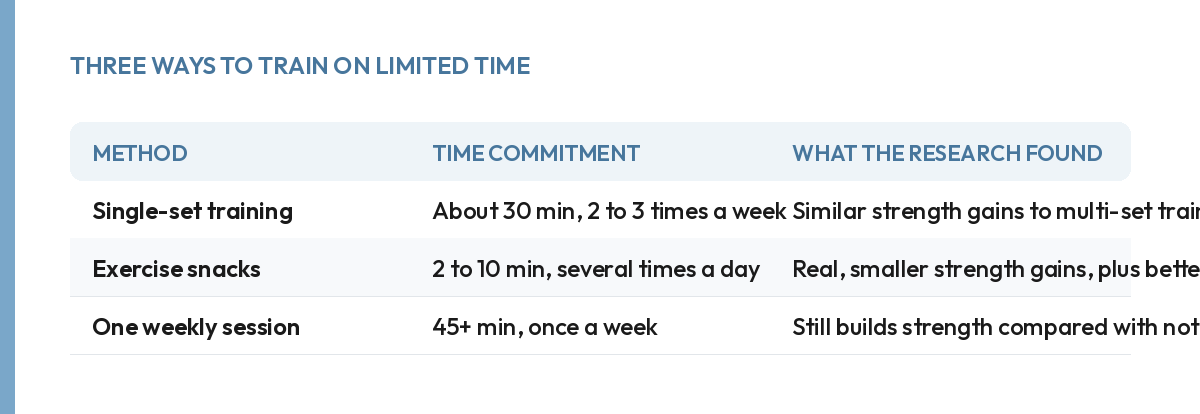
An overview of minimal dose resistance training found that several low-time approaches produce genuine strength gains, not a token amount either. The methods differ mainly in how the same limited total effort gets spread across your week.
Source: minimal dose resistance training strategies, an overview.
Single-set training: one hard set per exercise.
Seven to ten exercises, one working set each, 6 to 20 reps at 60 to 85 percent of your max effort, taken close to failure. About 30 minutes, done 2 to 3 times a week.
The research found this produced strength improvements comparable to standard multi-set training once total weekly volume was matched fairly. The part doing the work is not the number of sets, it is that the one set you do is taken seriously, close to the point where another clean rep is not available.
This is where most single-set attempts actually fail, and it has nothing to do with the method itself. A single set stopped five reps short of failure is a warm-up, not a working set, and it will not produce the results the research measured. The tradeoff for cutting three sets down to one is that the one remaining set has to do all the work the other two would have shared, which means it needs to be genuinely hard, not merely completed.
Pick compound, multi-joint movements for this approach rather than small isolation exercises. A single set of squats or rows recruits far more muscle in the time you have than a single set of a curl, and with only one shot per exercise, that difference matters more than usual.
Exercise snacking: minutes instead of a session.
One to five exercises, one set each, roughly 12 reps, done one to three times through the day rather than as a single block. Two to ten minutes per snack, seventy to a little over a hundred minutes across the week in total.
Strength gains from this approach were smaller than the other two methods, in the range of 5 to 6 percent on strength measures, but real, and studies also reported better everyday movement and less pain in people who did short bouts through the day. This is the option for a day built entirely out of gaps rather than one open block.
A snack is a set you can do in normal clothes, next to a desk or a kitchen counter, without changing into training gear or driving anywhere. That is the entire appeal. It trades some of the strength benefit of a longer, more focused session for something that fits into a day that genuinely has no spare thirty minute block in it, rather than one that is merely inconvenient to find.
Is one session a week actually enough?
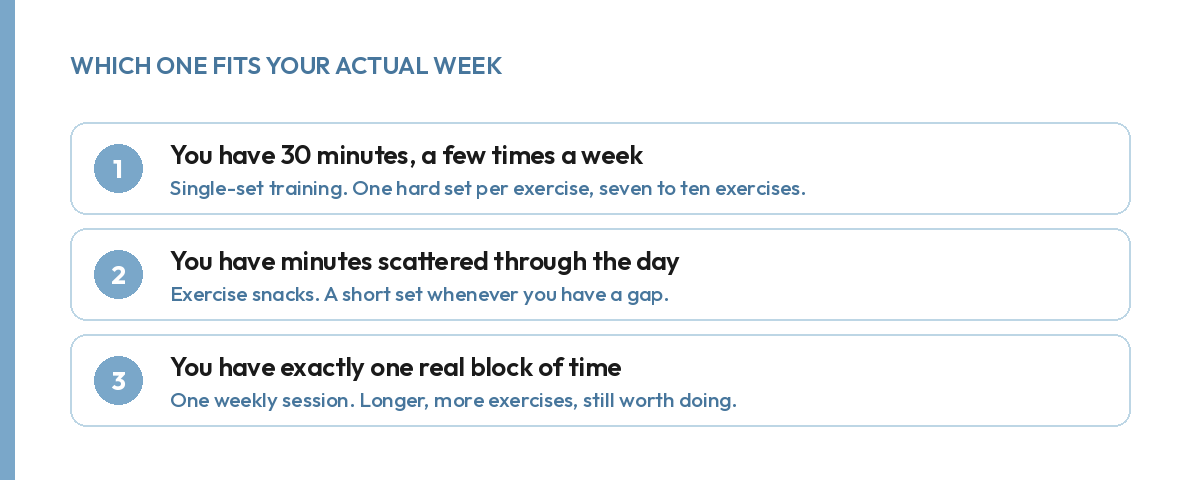
Yes, more than most people assume. A single weekly session, 8 to 14 exercises, 1 to 3 sets each, 8 to 12 reps at 45 or more minutes, still produced measurable strength gains compared with not training at all. Weekly progress will be slower than training more often, but "slower than optimal" and "not working" are very different outcomes, and this approach sits firmly in the first category, closer to a normal training result than to no result at all.
Pick whichever of the three actually matches the shape of your week. A perfect plan you do once and abandon loses to an imperfect one you keep doing every week for a year.
You can also move between them as your week changes rather than picking one forever. A week with a single open evening suits the longer session. A week where every day is fully booked but has small gaps in it suits snacking instead. The method is allowed to flex around your actual calendar, and doing so is not a compromise, it is the entire point of having three real options rather than one.
How your own numbers make this easier to see.
A short session is easy to skip logging, which is exactly backwards. A ten minute snack still counts, and seeing three of them logged on a Tuesday is what shows you the week actually happened, rather than feeling like a day where nothing got done. This is what we built The Health Project for. Log a full session or a two minute snack the same way, and progressive overload still reads your history and suggests the next step, whichever format your week actually looked like.
If how many sets and reps to put into each of those short sessions is the part you are unsure of, that decision applies here too, just compressed into less time. A short session is also usually a home session, and training at home vs gym training looks at how little that actually costs you. And if you would rather have a coach design a plan around the time you actually have, rather than the time you wish you had, that is what my coaching is for.
FAQ.
Can you get stronger with very little training time?
Yes. Single-set training, brief exercise snacks, and even one session a week all showed real strength gains in the research.
Is one set as good as three sets?
When total weekly volume is matched, single-set protocols produced similar strength gains to multi-set training in the research.
What is exercise snacking?
Short bouts of one or two exercises, a couple of minutes each, done several times through the day instead of one long session.
Is once a week actually enough to train?
It is enough to build real strength compared with not training at all, though more frequent training generally does more.