Training at Home vs Gym Training: Does Equipment Matter?
TL;DR. Training at home vs gym training comes down to less than most people assume. The American College of Sports Medicine's 2026 update, built from 137 systematic reviews covering more than 30,000 people, found that equipment type did not consistently change strength or muscle outcomes for the average healthy adult. A head to head trial backs that up directly: 12 weeks of elastic tubing produced 16 to 44 percent strength gains across muscle groups, close to the 25 to 46 percent from conventional weight machines in the same study. What actually changes between the two settings is the load ceiling on a handful of heavy lifts, and the cost and convenience of getting there.
Training at home vs gym training: what the evidence actually says.
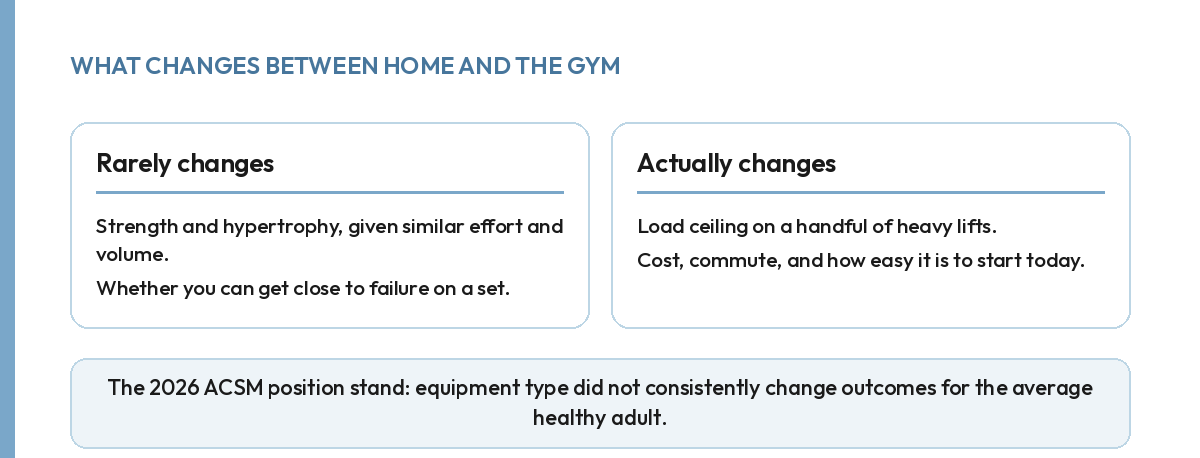
The gym has an obvious edge on maximum load. A barbell loaded to 150kg does not fit in most living rooms.
For nearly everything else, the evidence does not support treating a gym membership as a requirement for results. The variables that drive strength and muscle gains, effort, volume, and progression over time, do not care whether the resistance came from a plate-loaded machine or a resistance band.
Does equipment actually matter?
Not much, according to the largest review of the evidence to date. The American College of Sports Medicine's 2026 position stand synthesized 137 systematic reviews representing more than 30,000 participants, the first major update to its resistance training guidance since 2009. It found that using specific types of equipment, machines versus free weights, did not consistently impact outcomes for the average healthy adult, and it explicitly names bands, bodyweight training and home-based routines as producing meaningful gains in strength, hypertrophy and physical function.
Source: American College of Sports Medicine, 2026 resistance training guidelines update.
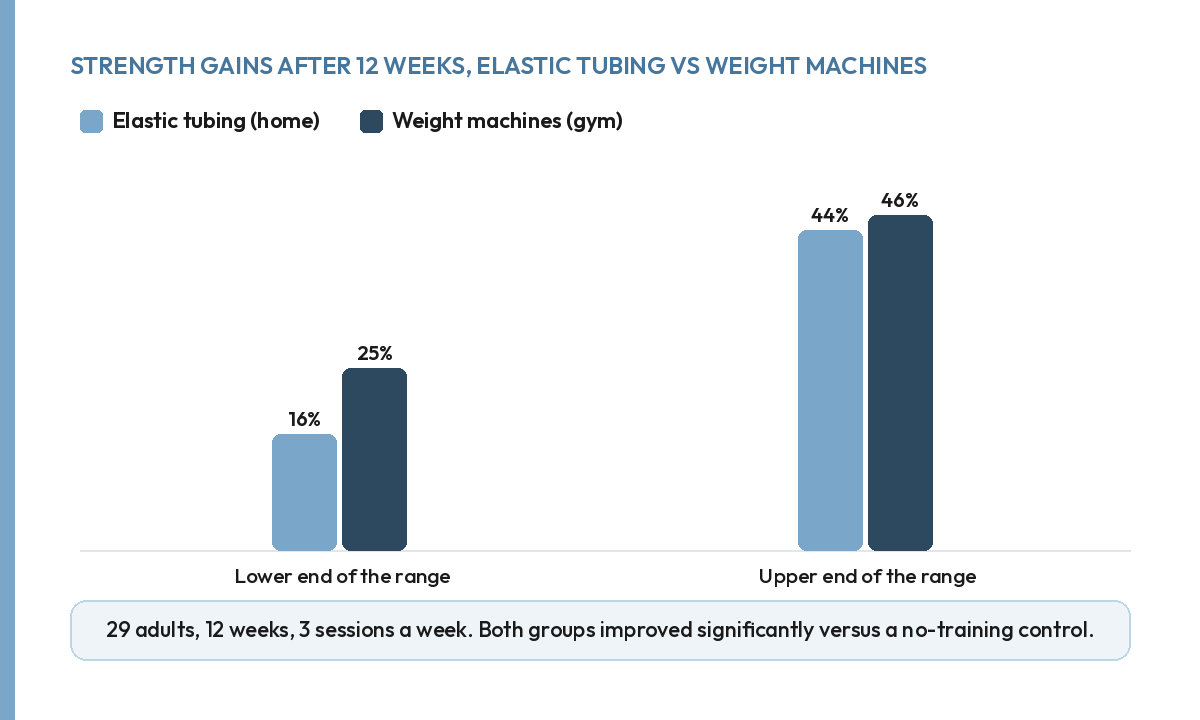
A head to head trial makes the same point with real numbers. Twenty-nine middle-aged to older adults trained for 12 weeks, three sessions a week, either with low-cost elastic tubing or conventional weight machines. Muscle force improved 16 to 44 percent in the tubing group and 25 to 46 percent in the machine group, both statistically significant against a non-training control group.
Source: a randomized trial of elastic tubing versus weight machine training, BMC Sports Science, Medicine and Rehabilitation.
The machine group came out slightly ahead, but both groups made large, real gains, and the gap between them is small next to the gap between training and not training at all.
Where the gym still wins.
Load ceiling is the honest answer. A serious lifter chasing a heavy squat or deadlift will eventually outgrow what a resistance band or a pair of adjustable dumbbells can offer. Elastic tubing gets noticeably harder to control as it stretches further, which is part of why the machine group in the trial above edged ahead on the heaviest compound movements. If your goals are built around a specific heavy barbell number, the gym is the more direct route, and there is no honest substitute once a lift outgrows what home equipment can load.
Equipment variety is the other one. A cable stack, a leg press and a full rack of dumbbells cover movement patterns that are awkward or expensive to replicate at home. None of that is required for the gains most people are actually training for, but it removes some of the improvising a home setup demands, and it gives you a machine built for a movement instead of a band pressed into doing that movement's job.
Where home training wins.
Cost and friction. No commute, no membership, no waiting for a bench. Training at home removes the two biggest reasons people give for skipping a session, and skipped sessions cost far more over a year than a small gap in equipment quality does.
It also scales down cleanly. A pair of bands and an adjustable set of dumbbells covers a full body programme for a fraction of what a gym membership and the fuel to get there cost over a year. And it removes the version of the barrier that has nothing to do with strength at all: feeling watched, waiting for equipment, or simply not having thirty minutes free at a time that lines up with when the gym is open. None of that shows up in a strength trial, and all of it shows up in whether someone is still training in month six.
Getting real results either way.
The structure matters more than the setting. Sets and reps written out for a full week works whether the exercises use a barbell or a band, because the sets and reps logic does not know which one you are holding. Progressive overload is the same story: what has to increase is the demand, not specifically the number on a plate.
If cardio is part of your split, the same home versus gym choice comes up again, and a cardio conditioning class or training on your own covers that side of it.
Whichever setup you train in, tracking is where most home programmes quietly fall apart, since there is no whiteboard and no trainer writing your numbers down for you. Inside The Health Project, your training log holds every session the same way regardless of where you did it, so a home workout gets exactly the same record a gym session would.
If you want a programme built specifically around the equipment you actually have, that is what my coaching is for.
FAQ.
Can you build the same strength training at home as at the gym?
Yes, for most people. A 12-week trial found elastic tubing produced 16 to 44% strength gains across muscle groups, close to the 25 to 46% from weight machines in the same study.
Do you need a gym membership to get stronger?
No. The 2026 ACSM position stand, built from 137 systematic reviews, found that equipment type did not consistently change outcomes for the average healthy adult.
What does the gym actually give you that home training does not?
A higher load ceiling on a small number of heavy barbell lifts, and equipment that is awkward to own, like a squat rack or a full stack of plates.
Is training at home enough for a beginner?
Yes. The variables that move results, effort, volume and progression, work the same whether the resistance comes from a barbell or a band.