Lose Fat and Build Muscle Workout: The Best Split
TL;DR. A lose fat and build muscle workout split works when strength training stays the priority three or four days a week, protein goes up rather than down, and the calorie deficit stays small enough that your recovery holds. Full body sessions beat body part splits here, because they put a training stimulus on every major muscle group more often, which is what protects muscle while you are eating less. Protein needs also rise inside a deficit: research on trained lifters puts the useful range at roughly 2.3 to 3.1 grams per kilogram of body weight a day, above the 1.4 to 2.0 that covers most other training goals.
What a lose fat and build muscle workout actually needs.
Doing both at once is not a trick. It is what happens when three ordinary things line up: a training stimulus your muscles have not fully adapted to, enough protein to support repair, and a calorie deficit small enough that your body still has the resources to recover.
Miss any one of the three and the balance tips. Train too little and there is nothing telling your body to hold onto muscle while calories are down. Eat too little protein and the deficit starts pulling from muscle as well as fat. Cut calories too hard and recovery collapses, so even a good workout stops paying off.
This is easiest for beginners, people returning after time off, and anyone who has more fat to lose, because their bodies respond to a new training stimulus and a deficit at once. If you are already lean and well trained, the same split still works, but the muscle gain slows and the fat loss becomes the main outcome.
A four-day split you can run.
Full body strength sessions, spaced out over the week, work better here than a traditional split that trains one or two muscle groups a day. Training the whole body more often keeps every muscle group getting a signal to grow or at least hold its ground, which matters more than usual while you are in a deficit.
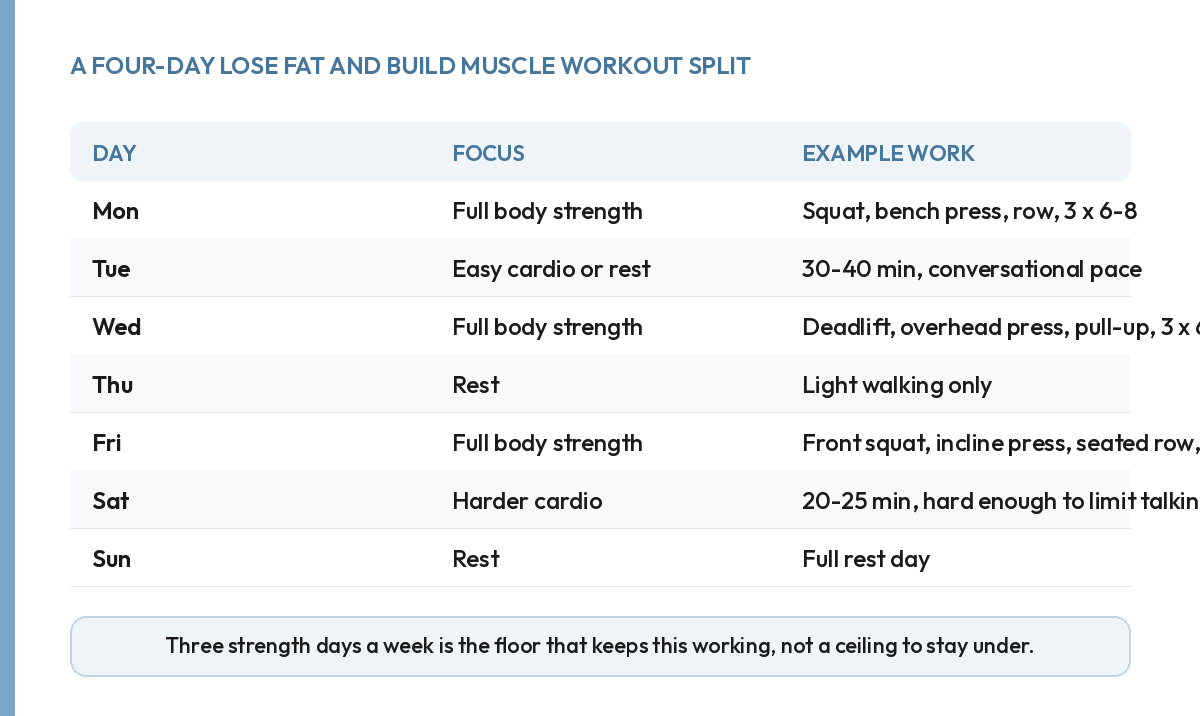
Three strength sessions a week is the floor, not a target to stay under. Four works well for most people balancing this against a job and a life. Keep the sets in the 3 to 4 range per exercise and stay in the 6 to 10 rep range most weeks, heavy enough that the last couple of reps are genuinely hard.
Cardio sits on separate days where your schedule allows it. Doing a hard cardio session right after a strength session on the same day works against you here, since it adds fatigue on top of the thing you most need to recover from.
How big the calorie deficit should be.
Smaller than you would use for fat loss alone. A deficit of roughly 10 to 20 percent below your maintenance calories is enough to lose fat steadily while leaving room for muscle to hold or grow. A steeper cut speeds up the number on the scale and works against the muscle side of the goal, because your body has less to work with for repair and growth.
This is also where patience matters most. A lose fat and build muscle workout split is a slower route to a lower number on the scale than a harder deficit alone, and that trade is the point. The extra time buys you a body composition change instead of just a smaller one.
Why protein matters more here than usual.
Protein is doing two jobs during a deficit: repairing the muscle your training just broke down, and signalling your body to hold onto the muscle it already has instead of using it for fuel. Both jobs get harder the larger your deficit is, which is why the target moves up rather than down.
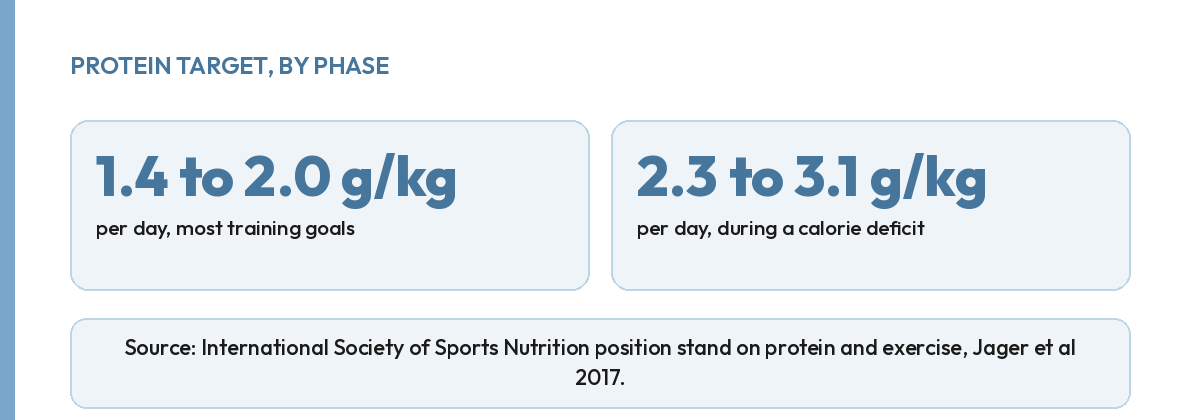
The International Society of Sports Nutrition's position stand on protein and exercise puts general training intake at 1.4 to 2.0 grams per kilogram of body weight a day. Inside a calorie deficit, it points resistance trained people toward the higher end of a wider range, 2.3 to 3.1 grams per kilogram, to protect lean mass while calories are down. Source: International Society of Sports Nutrition position stand, protein and exercise.
Spread that protein across three to four meals rather than loading most of it into one. Even distribution through the day supports muscle repair better than a single large serving at dinner.
Can one workout split really lose fat and build muscle at the same time?
Yes, for most people starting out or returning after a break, though how much of each depends on where you are starting from. Someone new to strength training, or coming back after months away, carries the biggest advantage: their body responds to the training stimulus and the deficit at once, so both things move in the same window.
Someone already lean and well trained sees less muscle gain from the same split. The deficit still costs a little recovery capacity even with protein and training dialed in, so the more advanced you are, the more the outcome leans toward fat loss with muscle held steady rather than muscle genuinely growing. That is still a good outcome. It is just a different one than a beginner gets from the identical plan.
Tracking whether the split is working.
The number that matters most is not the scale on its own. Strength going up on your main lifts, weight trending down slowly, and a waist measurement that keeps shrinking together tell you more than any single number by itself.
Inside The Health Project, your training logs every set, and progressive overload suggestions read your last session and point you to the next step, so you are not guessing whether to add weight this week. Your protein and calories live in the same place: your nutrition targets are set to fit a deficit like this one and adjust as your weight, training and recovery change, with no requirement to log every bite if that is not how you want to work.
If you want more on the trade-offs behind this whole approach, our post on progressive overload covers how to keep adding difficulty once the basic split above stops feeling hard, and what calorie balance actually means walks through how the deficit itself is calculated. For the exact sets, reps and rest periods behind the numbers on the split above, see a worked sets and reps example.
We show you the trend. We do not tell you what your result means. If something looks off, that is a conversation for your doctor.
FAQ.
Can one workout split really lose fat and build muscle at the same time?
Yes. It works best for beginners, returning trainees, and anyone carrying fat to lose, since their bodies respond strongly to strength training and a deficit at the same time.
Should I do cardio on the same days as strength training?
No. Keeping the two on separate days where your schedule allows protects the recovery your strength sessions need most.
How much protein do I need on this split?
Somewhere between 1.4 and 2.0 grams per kilogram of body weight a day covers most training goals. In a calorie deficit, research on trained lifters puts the useful range higher, around 2.3 to 3.1 grams per kilogram, to protect the muscle you already have.
How long before I see changes on a lose fat and build muscle workout split?
Most people notice strength moving within two to three weeks. Visible body composition change usually takes eight to twelve, and the pace differs by person and training history.