Muscle Soreness and Pain: How to Tell the Difference

TL;DR. Soreness and pain both show up after training, and telling them apart comes down to three things: when it started, where it sits, and whether it eases with light movement or gets worse. Normal muscle soreness starts one to three days after training, spreads across the muscle you worked, and usually clears up within five days. Pain that starts suddenly, sits in one specific spot or joint, or keeps getting worse points toward an injury rather than ordinary soreness, and is worth a doctor's opinion.
Soreness and pain: the quick way to tell them apart.
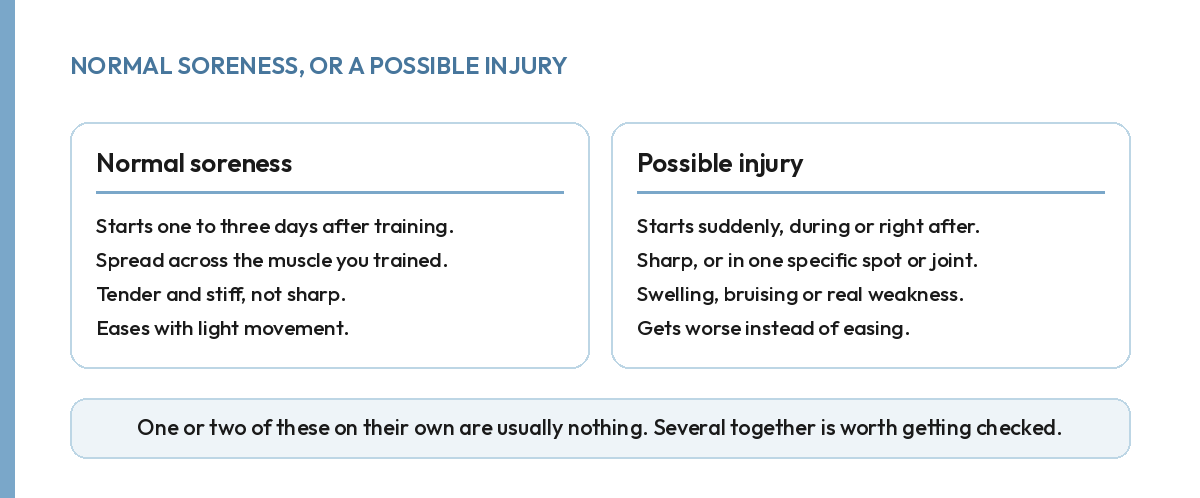
Three questions do most of the work. When did it start: soreness shows up a day or two later, injury pain usually shows up right away or during the activity itself. Where is it: soreness spreads across a whole muscle you trained, injury pain often sits in one specific spot, joint or tendon. What happens when you move: soreness tends to ease as you warm up, injury pain tends to stay sharp or get worse.
None of these three is proof on its own. Together, they are a reasonable way to decide whether to train through it or get it looked at.
What normal muscle soreness actually is.
The soreness that shows up a day or two after a hard session, formally called delayed onset muscle soreness, comes from small amounts of damage to muscle fibers during the workout itself, especially during the lowering part of a movement. That damage is part of how the muscle adapts and gets stronger, not a sign that something went wrong.
It tends to show up after a new activity, a new type of training, or a session harder than what your body is used to, which is why the first week of a new programme is often the most uncomfortable one. As your body adapts to that specific movement, the same session produces noticeably less soreness the second or third time around.
Source: Cleveland Clinic, delayed onset muscle soreness.
Where pain crosses a line into an injury.
An injury tends to announce itself differently. It often starts suddenly, during the movement itself, rather than building up over the following day. It usually sits in one place, a joint, a tendon, or a specific spot in a muscle, rather than spreading across the whole muscle group you trained. And it tends to come with something soreness does not: real swelling, bruising, or a joint or limb that feels noticeably weaker or harder to move than usual.
Sharp pain that stays sharp, rather than easing as you move and warm up, is one of the clearer signals. So is pain that gets worse over the days after training instead of better.
How long each one should last.
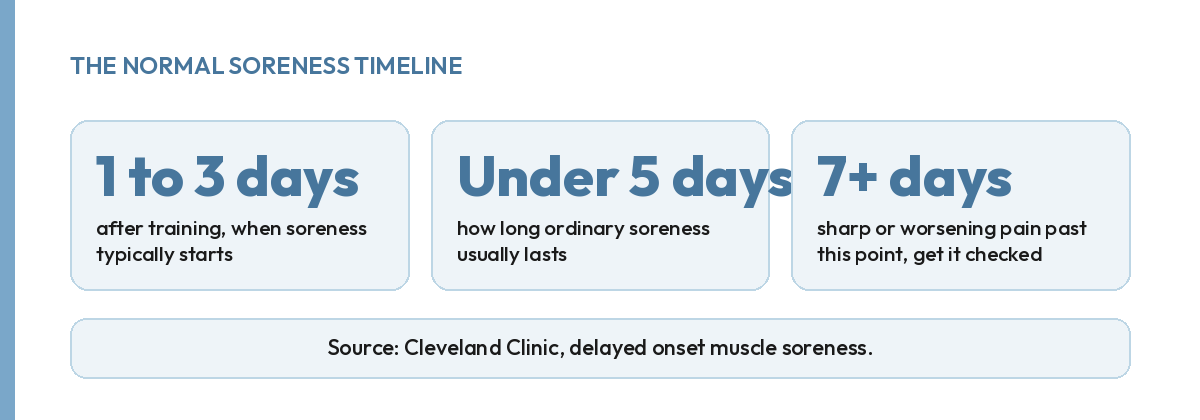
Ordinary soreness usually clears up within about five days, and often sooner. Pain that lasts longer than a week, according to Cleveland Clinic's guidance on delayed onset muscle soreness, is one of the specific signs worth getting checked by a doctor rather than waiting out.
Is it ever normal for soreness to last more than a week?
Not usually, and this is one of the more reliable warning signs. Ordinary delayed onset muscle soreness peaks around one to two days after training and fades out well within a week for most people. Soreness that is still sharp, still limiting how you move, or still there past seven days has gone on longer than the normal pattern, and that duration alone is a reasonable reason to get it looked at rather than assuming it will pass.
Other signs worth the same response, according to Cleveland Clinic: pain that feels sharp and constant rather than a dull ache, significant swelling around a muscle or joint, and urine that looks unusually dark, which can signal something beyond ordinary muscle soreness.
What to do about ordinary soreness.
Light movement, walking, and a normal amount of daily activity tend to help ordinary soreness more than sitting still does. Training a different muscle group is usually fine while another one is sore. Going straight back into a heavy session on the exact muscles that are still sore is where people most often turn manageable soreness into a slower week, simply by not giving the tissue the day or two it was already asking for.
This is also a normal moment to check in on training volume. Soreness that shows up every single week, long after your body should have adapted to the routine, often means the programme is adding difficulty faster than recovery can keep up with. Our post on progressive overload covers how to add difficulty at a pace your body can actually absorb, and rest days covers what an actual rest day should look like.
When to stop and get it checked.
Stop and get a professional opinion rather than training through it when any of the following show up: pain that is sharp and constant instead of a dull ache, real swelling around a joint or muscle, bruising you cannot explain, a joint or limb that feels genuinely weaker than usual, or soreness that has lasted more than a week without easing. One of these on its own is sometimes nothing. Several together, or any one of them getting worse, is worth a doctor's time.
If your soreness keeps showing up in the same pattern week after week, a deload week is often the simpler first step, before assuming an injury: sometimes the body is asking for a lighter week, not a diagnosis.
Tracking recovery over time.
Recovery is more than sleep. Inside The Health Project, your training log shows what you actually did each session, so a week that feels unusually sore is easy to check against what changed: a new exercise, a jump in weight, or simply more volume than you have run before.
We show you the trend. We do not tell you what your result means. If something looks off, that is a conversation for your doctor.
FAQ.
How long does normal muscle soreness last?
Usually a few days, and rarely more than five. Soreness that lasts past a week is worth getting checked rather than waiting out.
Is it normal for soreness to be worse two days after a workout than the day after?
Yes. Soreness commonly peaks around 24 to 48 hours after training before easing, which is where the name delayed onset muscle soreness comes from.
Should I train again if I am still sore?
Light movement or training a different muscle group is usually fine. A heavy session on the same sore muscle group before it has eased is worth pushing back a day or two.
What is the biggest warning sign that separates pain from soreness?
Pain that is sharp, sits in one specific spot or joint, or gets worse instead of easing over a few days. Any of those is worth a doctor's opinion rather than a guess.