Starting an Online Training Business

TL;DR. Starting an online training business changes what limits your roster. In person, your hours cap it. Online, your admin per client caps it, and that number is set by three decisions: your delivery model, your price, and your software. Make those three before you take a client, not after.
What actually changes when you take clients online.
The coaching does not change. A client still needs a programme that fits their week, someone checking whether they did it, and a plan for when they did not. What changes is everything around the coaching.
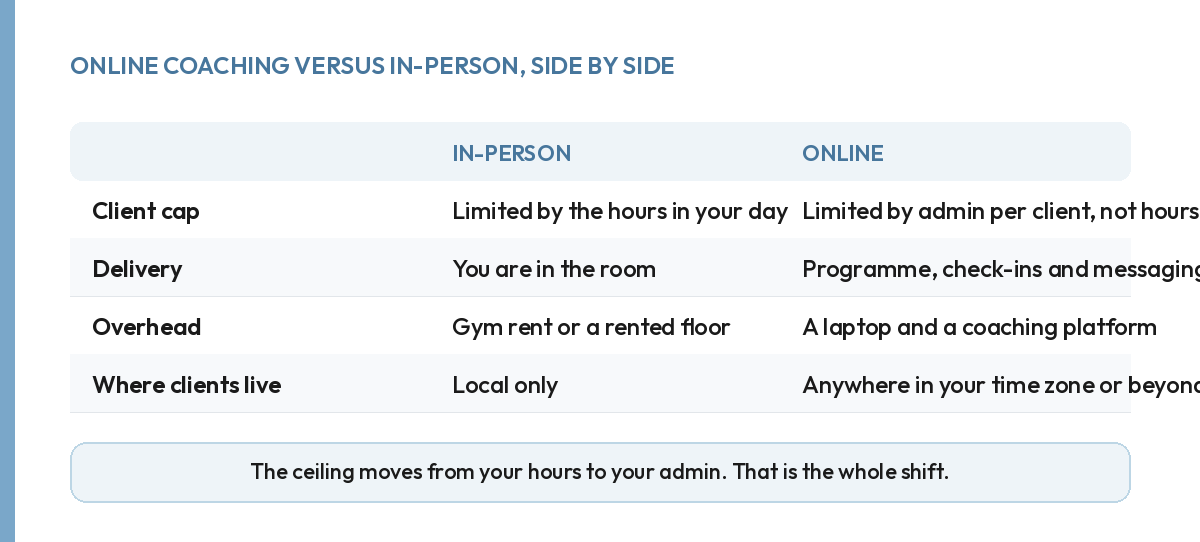
You are no longer trading your hours for a session fee. You are trading your admin time per client for a monthly rate, and that admin time is the real ceiling on your roster. A coach who spends fifteen minutes a week per client on programming and check-ins can carry far more clients than one who spends an hour, at the same quality of coaching. Starting an online training business is mostly a project of getting that fifteen minutes right before you scale past a handful of people.
Choose your delivery model first.
Three models cover almost everyone starting out.
One to one. You write and adjust an individual programme for each client. Highest price per client, lowest number of clients, most personal.
Small group. A shared programme structure with individual load and progression inside it. Lower price per person, more clients per hour of your time.
Hybrid. A group programme as the base, with individual sessions or calls layered on for clients who pay for them. Most coaches who scale past twenty or thirty clients end up here, because pure one to one runs out of hours again even online.
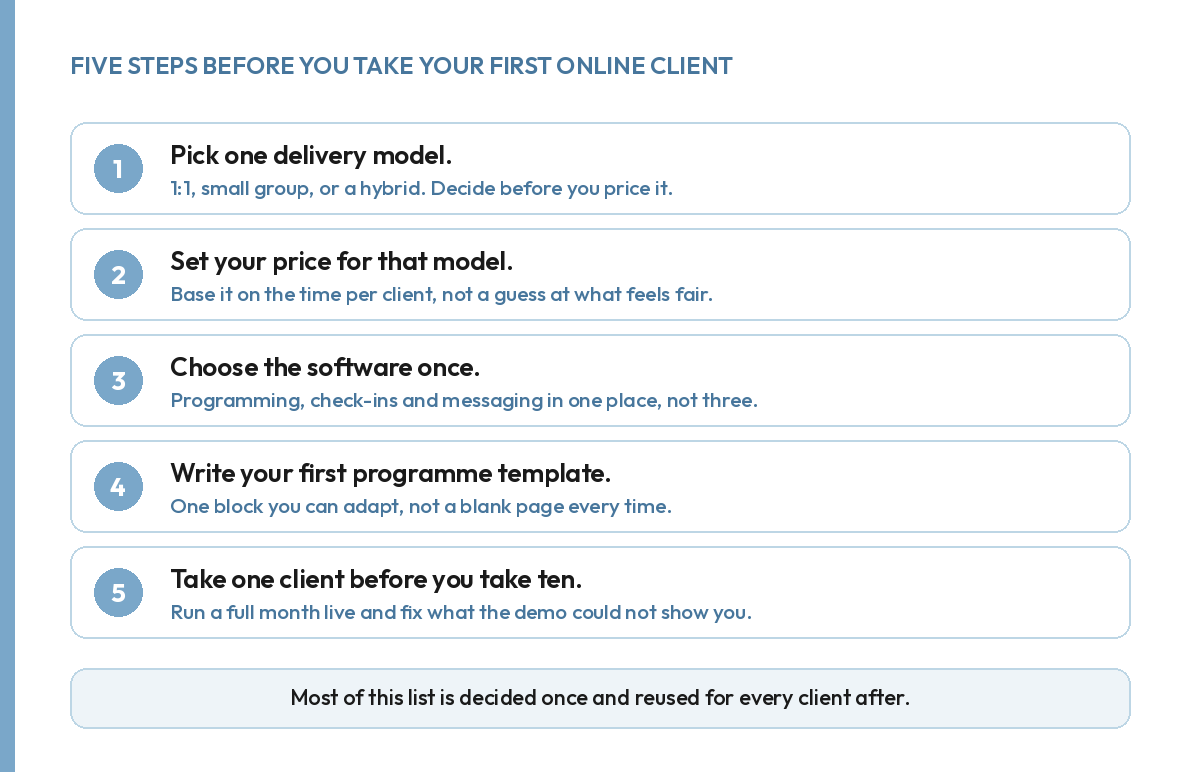
Pick one to start. You can add the others later, but pricing and software both depend on this choice, so it comes first.
Price the model you picked.
Price by the admin time the model actually costs you, not by what a competitor charges or what feels fair. Work out roughly how long a client takes you each week to programme, check in on and message. Set a rate that pays you properly for that time, at the roster size you actually want.
A common mistake is pricing low to win the first few clients, then finding the rate cannot support the admin once the roster grows. Raise the price for new clients as your time gets tighter rather than discounting your way to a full roster you cannot actually service well.
The software question.
Software is where most of the admin time either disappears or piles up. What to look for in a platform covers the criteria properly. For starting out, the short version is that you need one place that holds the programme, the check-in and the message, because three separate tools is three separate places a client can fall through.
Coaches on our own platform run their clients with training logged down to the set. Meals are logged from a photo or the food library, sleep is pulled in from a watch or ring, and a weekly check-in covers energy and stress as well as weight. The reason a client stalls is visible without a month of messages to reread. A client needs nothing more than the app itself, joined by an invite link.
Write one programme template before you write ten.
Your first real time cost is not finding clients. It is rebuilding a programme from scratch for every one of them. Write a single well-structured template for your chosen model first: the block, the progressions, the substitutions for common limitations. Every client after the first is then an adjustment of that template, not a new document.
Decide how you onboard a new client.
Onboarding is the part new coaches skip because it feels like admin rather than coaching. It is not. A structured first check-in, current training history, current eating pattern, sleep, stress, injuries and what a good week looks like for them, is what your programme template actually adjusts against. Skip it and your template stays generic for weeks while you find this out one message at a time.
The same applies to setting a goal with them, not for them. A goal a client actually sticks to is specific and has a timeline attached, and it works better coming out of a conversation in week one than handed down as a number you decided alone. Build this into your onboarding once, as a short form or a first call script, and you never improvise it again.
Take one client before you take ten.
Run a single real client through a full month before you open to a full roster. A demo account or a friend testing the app for a week will not show you what an actual paying client's week looks like. The gaps, a check-in question nobody answers properly, a template that does not flex for someone who trains three days instead of five, only show up with a real person and a real month.
So, is starting an online training business worth it?
For most coaches, yes, once the model, price and software are decided rather than improvised. The ceiling moves from how many hours you have to how well your admin scales, and that ceiling is a much higher one. It is not easier work than coaching in person. It is different work, and almost all of the difference sits in the setup you do before your first client, not in anything that happens after. Once clients are actually on your roster, how you run the week matters more than anything you decided before the first one signed up.
FAQ.
Do I need certifications to start an online training business?
Yes. The certifications a client would ask for in person are the same ones they should ask for online. Nothing about a screen changes what qualifies you to programme for someone's body.
How many clients can one coach run online?
More than in person, because your cap moves from hours in the day to admin per client. The real number depends on how much of that admin your software removes.
Do I need my own app to start?
No. You need somewhere to deliver programmes, take check-ins and message clients. A platform you did not build works fine for that.
What is the biggest mistake new online coaches make?
Taking ten clients before running one client through a full month live. The gaps in your process only show up with a real person in them.