Training Log Examples Worth Copying

TL;DR. These training log examples cover the three situations most people actually train for: a strength log built around one or two main lifts, a hypertrophy log built around weekly sets per muscle group, and a general fitness log that stays as simple as exercise, weight and reps. Copy the one that matches your goal rather than the most detailed one you can find.
Three training log examples, one for each goal.
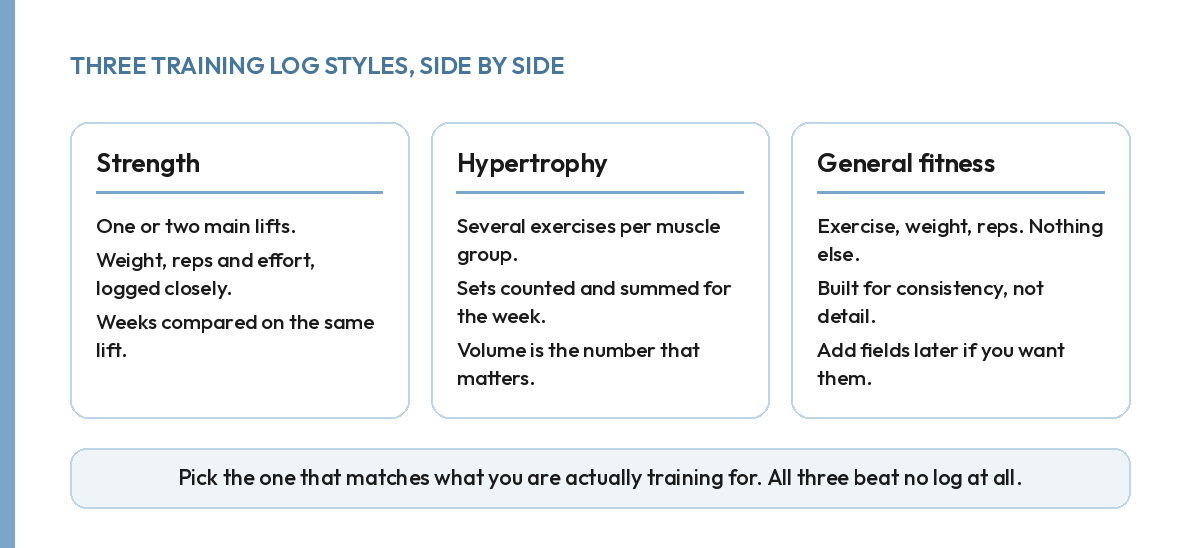
A log built for the wrong goal is worse than no log at all, because it either buries you in fields you never use or leaves out the one number you actually need. Match the format to what you are training for, not to whichever template looks the most thorough.
Example one, a strength log.
Monday, squat day.
Squat: 3 sets of 3 at 275 pounds, RPE 8. Front squat (accessory): 3 sets of 6 at 155 pounds, RPE 7.
That is close to the whole log. A strength log tracks one or two main lifts closely, with effort noted every session, because the entire point is comparing this Monday's top set to last Monday's. Accessories get logged lighter, mostly as a record that the work happened.
The effort number is doing more work here than it looks like it is. RPE 8 on 275 for 3 reps this week against RPE 7 on the same weight last week is the clearest possible sign that you have room to add weight next session, even though the number on the bar has not moved yet. A log that only records the weight would have missed that entirely, and told you nothing had changed.
Example two, a hypertrophy log.
A hypertrophy log tracks more exercises, and the number that matters is not any single lift, it is total sets per muscle group across the week.
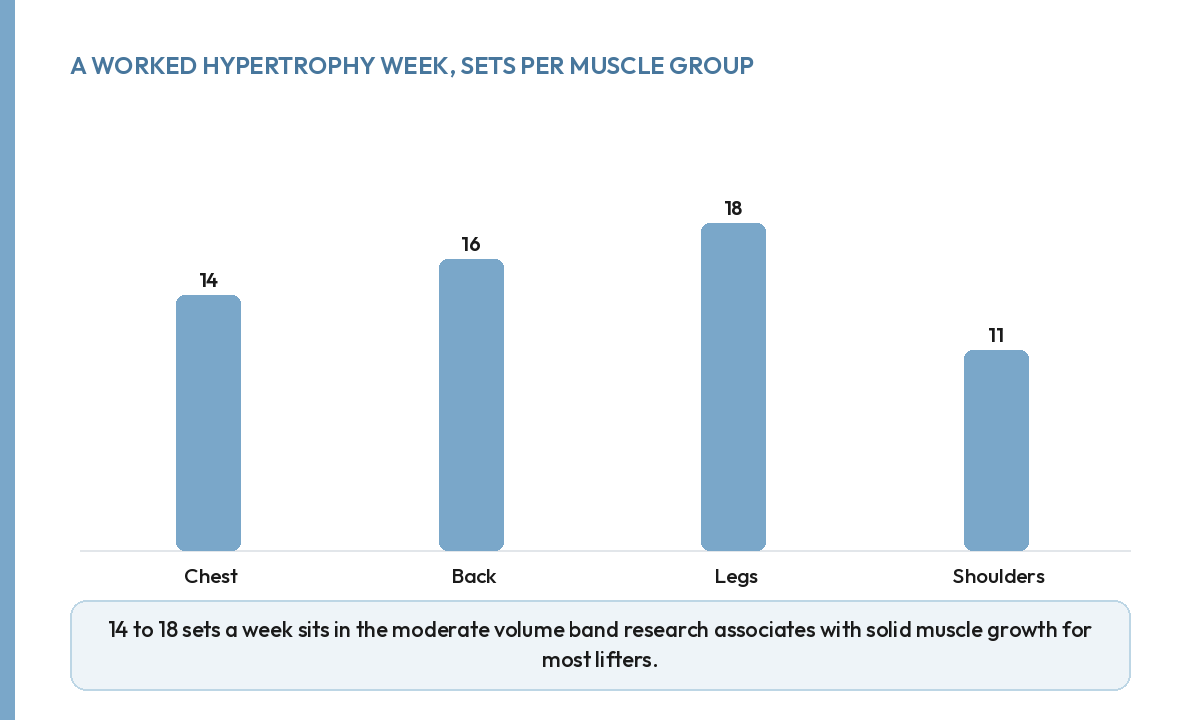
A systematic review of resistance training volume groups weekly sets per muscle group into three bands: low, under 12 sets, moderate, 12 to 20, and high, more than 20. The worked week above lands chest, back and legs in the moderate band, which is where most lifters see solid results without the recovery cost of the high band. A hypertrophy log is what tells you which band you are actually in, since almost nobody can add up a week of scattered sets from memory.
Source: Baz-Valle and colleagues, a systematic review of resistance training volume.
Example three, a general fitness log.
Exercise, weight, reps. That is the entire format.
Monday: goblet squat, 35 pounds, 3 sets of 12. Push-up, bodyweight, 3 sets of 10. Row, 40 pounds, 3 sets of 12.
No effort rating, no rest timing, no weekly volume tally. The goal of this version is not precision, it is keeping the habit of writing something down every session until logging itself stops being the hard part. Add effort or volume tracking later, once the habit is the easy part and you want more out of the numbers.
Most people who quit logging quit because they started with the hypertrophy version on day one. Counting sets across a whole week is a skill you build, not one you start with, and a log abandoned after two weeks tells you nothing. A simpler log kept for two months tells you a great deal.
The same logic applies if your week barely has room for training at all. Limited training time covers three ways to still build strength, each short enough to log in a single line.
Which example should you copy?
Copy the strength log if you have a small number of lifts you care about improving and you already know roughly what those lifts should look like each week. Copy the hypertrophy log if your goal is size or general muscle development across several exercises. Copy the general fitness log if you are new, or if the last log you tried was too detailed to keep up with past the first two weeks.
None of the three is more correct than the others. The correct one is whichever one is still open a month from now. It is also fine to move between them. Start with the general fitness version to build the habit, move to the hypertrophy version once you are training several muscle groups with intent, and narrow to the strength version once you have one or two lifts you actually care about pushing. The log should follow the goal, and the goal is allowed to change.
How your own numbers make this easier to see.
Writing any of these three by hand works, and the format is what matters more than the tool. Where a written log runs out of road is the summing: adding sets across the week for a hypertrophy log, or pulling up a lift from four weeks ago for a strength log. This is what we built The Health Project for. Your sessions are logged down to the set, with built in templates for a plan like these or room to build your own, and progressive overload reads your history so the comparison a log exists for is already sitting there.
If how many sets and reps to actually put in each session is the part you are still deciding, that decision comes before the log, not after it. And if you would rather have a coach set the format and read the numbers with you, that is what my coaching is for.
FAQ.
Which training log example should I copy?
Match it to your goal. Strength wants a close log on one or two lifts, hypertrophy wants weekly sets counted, general fitness wants the simplest version you will actually keep.
Do I need to log every exercise, or just the main ones?
For a strength log, just the main lifts. For a hypertrophy log, everything that counts toward a muscle group's weekly sets.
How many sets a week should a muscle group get?
Research groups weekly volume as low under 12 sets, moderate 12 to 20, and high over 20. Most lifters do well in the moderate range.
Can one log format work for everyone?
No single format suits every goal. The three examples here cover the situations most people actually train for.