VO2 Max by Age: What a Good Score Looks Like

TL;DR. VO2 max by age falls into rough bands: excellent, good, fair and poor, and the threshold for each one drops as you get older and differs between men and women. A man in his thirties needs a VO2 max above roughly 45 ml/kg/min to count as excellent; a woman the same age needs above roughly 38. Knowing your category is useful once. Knowing whether your number is rising or falling is useful every month after that.
What counts as excellent, ages 30 to 39.
Categories like excellent, good, fair and poor come from population data, usually built from large groups tested on a treadmill or bike. Marathon Handbook's breakdown, built on Mayo Clinic-referenced ranges, puts the excellent threshold for men aged 30 to 39 above 45 ml/kg/min, and for women the same age above 38.
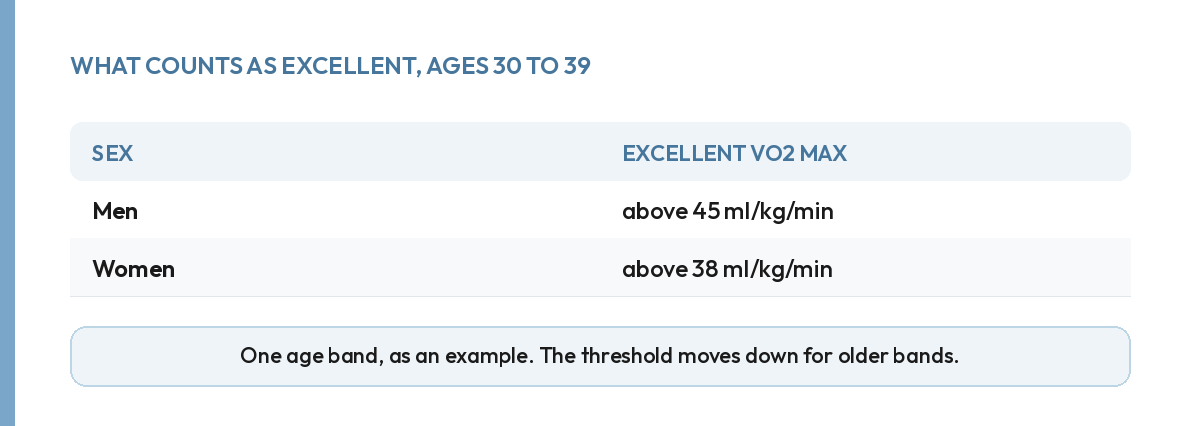
Source: Marathon Handbook, good VO2 max by age and sex.
Why the threshold moves with age.
The same categories apply at every age, but the number needed to reach them changes. VO2 max declines by roughly 10 percent per decade after age 30 on average, so the excellent threshold for someone in their fifties sits well below the excellent threshold for someone in their thirties. Comparing your score only against your own age band, not against a twenty five year old's chart, is what makes the category meaningful.
Training slows this decline. It does not reverse the fact that the comparison group itself gets easier to beat as you age, which is exactly why the age band matters as much as the raw number.
Why VO2 max by age differs between men and women.
At every age band, the thresholds for each category sit lower for women than for men. Differences in heart size, hemoglobin levels and lean muscle mass explain most of the gap, and it holds up across trained and untrained populations alike. This is not a limitation to work around. It is why a useful VO2 max chart always splits by sex rather than reporting one set of numbers for everyone.
What a category lookup does not tell you.
A category answers one question well: where do you sit today, compared to other people your age and sex. It answers a different question badly: is what you are doing working.
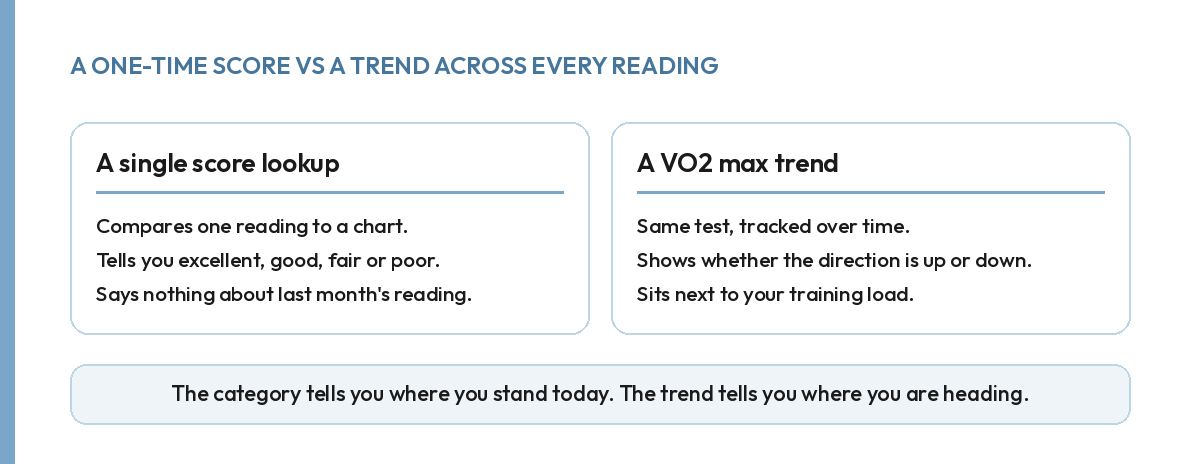
Two people can both land in the "good" category and be heading in opposite directions, one climbing toward excellent and one sliding down from excellent. The category looks identical. Only a series of readings, taken the same way each time, shows you which one you actually are.
How the categories are usually built.
Most VO2 max by age charts, including the thresholds above, come from grouping a large number of test results by age band and sex, then setting category cutoffs at fixed percentiles within each group. Excellent typically means near the top of your age and sex group, good sits above average, fair sits below average, and poor marks the bottom of the distribution.
That method is reasonable, and it is also why two different charts can disagree slightly on exact numbers: they were built from different underlying groups. A Dutch registry of non-athletes and a database drawn from more competitive testing centers will not produce identical cutoffs even when both are done carefully. Treat the category as a useful rough position, not a precise line.
What actually moves your category over time.
Training is the main lever, and the type of training matters. Sustained aerobic work, done consistently over months, raises VO2 max more reliably than short bursts of effort done occasionally. Body weight also plays a role, since the number is calculated per kilogram: losing weight without losing fitness raises the score even if your heart and lungs have not changed at all.
This is worth knowing before you read too much into a single jump or drop. A reading taken after a stressful week, a poor night's sleep, or a change in body weight can move without any real change in your underlying fitness. That is exactly why one reading, however carefully it is categorized, tells you less than a handful of readings taken the same way over a few months.
Does VO2 max always decline with age?
On average, yes, and the decline is close to linear once you are past your mid twenties peak. Regular training does not stop the decline, but studies consistently show it slows noticeably compared to a sedentary person of the same age. That is the practical reason to track it rather than check it once and file the number away.
Watching your own VO2 max move.
Inside The Health Project, VO2 max is one of the things your training dashboard tracks over time, alongside your training and your sleep. It connects with your Apple Health, Google Fit, Garmin, Fitbit, Oura and Whoop, and you see the trend rather than a single reading that gets overwritten the next time you test, the same way a recovery watch turns HRV into a trend instead of a one-off score. If you already run one of several health tracker apps side by side, the dashboard is where the VO2 max number joins the rest of them instead of sitting on its own. The full averages by age band, drawn from a study of 4,637 people, are in our VO2 max chart by age and sex, if you want the population averages alongside the category thresholds here.
We show you the trend. We do not tell you what your result means. If something looks off, that is a conversation for your doctor.
FAQ.
What is a good VO2 max for my age?
It depends on your age and sex, and the threshold for excellent drops as you get older. A man in his thirties needs above roughly 45 ml/kg/min for excellent; a woman in her thirties needs above roughly 38.
Is VO2 max by age the same for men and women?
No. At every age band, the thresholds for each category run lower for women than for men, largely due to differences in heart size, hemoglobin and lean muscle mass.
Does VO2 max always decline with age?
On average, yes, roughly 10 percent per decade after 30. Regular training slows that decline noticeably, though it does not stop it entirely.
Should I worry if my score falls in the fair category?
A category is a snapshot, not a verdict. What it is doing over the next few months matters more than which box it falls into today.