Cardio Conditioning Drills to Build a Real Engine
TL;DR. Cardio conditioning drills are structured bouts of harder and easier effort, not just "cardio" in general. The baseline most guidelines agree on is 3 to 5 days a week, at 55 to 90 percent of your max heart rate, for 20 to 90 minutes a session. Within that baseline, short interval drills and even sub-minute "exercise snacks" can build real fitness, and research reviewed in Sports Medicine in 2023 found interventions of 15 minutes or less, done at least three times a week for six weeks, raised VO2max by about 1 MET.
What a cardio conditioning drill actually is.
"Cardio" usually means anything that raises your heart rate. A conditioning drill is narrower: a structured bout of harder work, followed by easier work or rest, repeated for a set number of rounds. Coates and colleagues, writing in Sports Medicine in 2023, point out that exercise science does not even agree on one definition of high-intensity interval training, partly because public health bodies, researchers and coaches all measure intensity differently. What the field does agree on is the shape: "repeated bouts of relatively hard work interspersed with recovery periods of easier work or rest."
That shape is what separates a drill from a jog. A jog is continuous. A drill has rounds.
The baseline, before you pick a drill.
Before choosing between an interval drill and a steady session, it helps to know the floor most general guidelines sit on. A 2022 systematic review in Frontiers in Physiology (Guo and colleagues) cites the American College of Sports Medicine's position stand for apparently healthy adults:
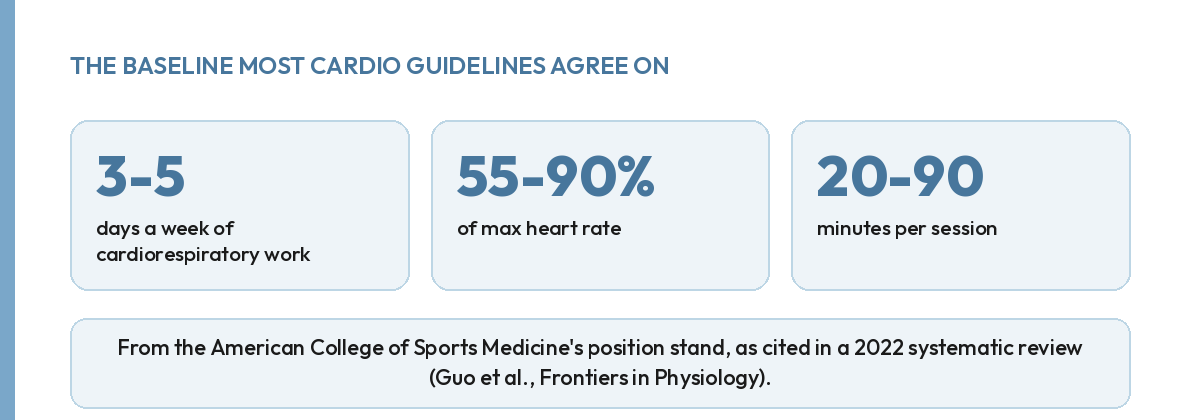
That range is wide on purpose. It covers a 20-minute hard session and a 90-minute easy one. A conditioning drill is one way to spend time inside that range, not a replacement for it.
Three cardio conditioning drills, by time available.
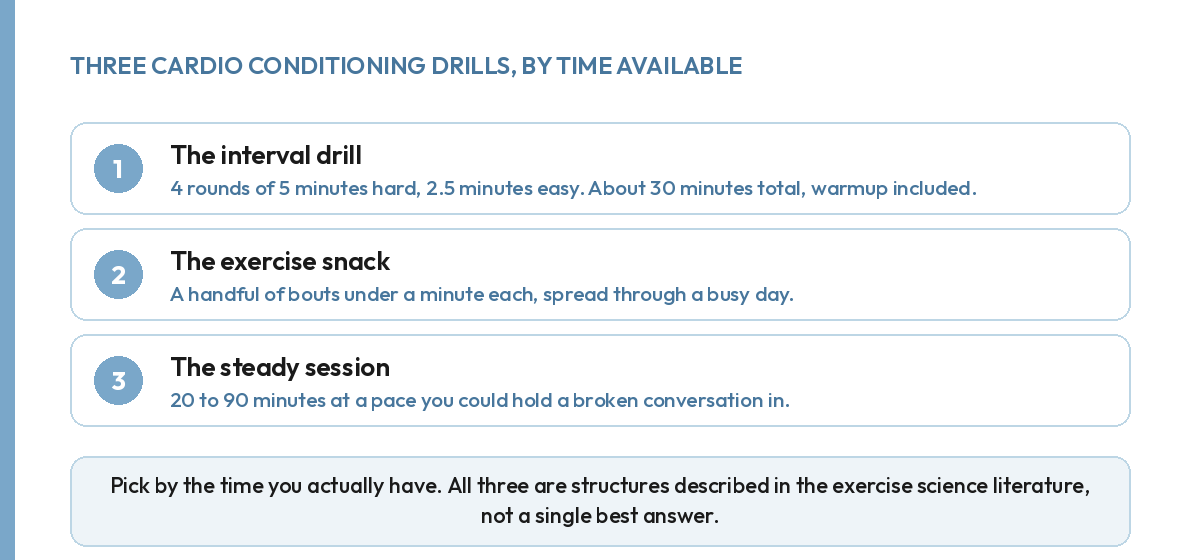
The interval drill. Four rounds of five minutes hard, two and a half minutes easy, is one of the interval structures Coates and colleagues describe in their review of the research. Hard means an effort you could not hold a full conversation in. Easy means you could. Warm up before the first round and cool down after the last.
The exercise snack. The same review describes "exercise snacks," bouts of about a minute or less, as a studied structure for people who cannot find a continuous block of time. Spread four or five of these through a day, climbing stairs hard or pushing the pace on a short walk, and you have done a real session in pieces.
The steady session. Twenty to ninety minutes at a pace you could hold a broken conversation in. No rounds, no recovery periods, just time at a moderate effort. This is the ACSM baseline on its own, without any interval structure layered on top.
Does interval training actually work better?
The honest answer is: it depends on the comparison. Coates and colleagues report that short, frequent interval sessions, totaling 15 minutes or less per session and done at least three times a week for six weeks, raised VO2max by roughly 1 MET in the studies they reviewed. They also report that systematic reviews have found HIIT can produce cardiorespiratory fitness gains comparable to steady cardio with a smaller time investment, and larger gains when the total training volume is matched between the two.
They are careful to add that these findings "are not universal." The size of the advantage depends on the population, the exact protocol, and how long the training runs. A drill is a tool for people short on time, not a proof that steady cardio is obsolete.
What the bigger studies found.
Two examples from the same review are worth knowing before you pick a side.
In a study by Rønnestad and colleagues, three weeks of repeated sprint intervals improved VO2max in elite cyclists, while a comparison group doing longer intervals at a matched perceived effort did not improve at all over the same three weeks. Harder, shorter work moved the number; a gentler version of the same training time did not.
At the other end of the fitness spectrum, the Generation 100 study, which followed more than 1,500 older adults, found larger increases in peak heart rate in the group doing interval training than in groups doing steady moderate training or simply following general activity guidelines. Interval work showed an advantage even in a population that was not training for competition at all.
Neither result means intervals are the only correct choice. It means the drill you pick changes what you get, and "more time spent moving" is not the same question as "which structure moved this specific number."
Picking a drill without overthinking it.
If you have never run a conditioning drill before, start with one interval session a week and keep the rest of your cardio steady. Add a second interval day only once the first one feels routine rather than wrecking. A drill that leaves you unable to train the next day has cost you more than it gave you.
Progression here looks like adding a round before it looks like adding intensity. Three rounds of five minutes becomes four, four becomes five, before the hard minutes themselves get harder. The guideline range above, 55 to 90 percent of max heart rate, is wide enough to hold that whole progression without you ever leaving it.
Where this fits next to your training.
A conditioning drill is one session in a week that should also include your strength work and a proper warm-up. If VO2max is the number you actually care about tracking, VO2 max by age covers what a good score looks like before you start chasing one. And if you are weighing whether to run these drills alone or in a cardio conditioning class, the attendance research there is worth a look before you commit either way.
The Health Project logs your cardio sessions the same way it logs your lifts: duration, effort and how you felt, sitting next to your training plan rather than in a separate app you have to remember to open.
FAQ.
How many days a week should I do cardio conditioning drills?
Three to five, per the ACSM baseline above. More than that is not automatically better and raises injury risk if your recovery cannot keep up.
Is HIIT better than steady cardio for conditioning?
Research reviewed by Coates and colleagues found HIIT can match steady cardio's fitness gains in less time, and sometimes beats it, but the comparisons are not universal and depend heavily on the population and protocol.
Can a one-minute drill actually do anything?
The same review describes "exercise snacks" of a minute or less as a studied structure, not a shortcut. Several of these spread through a day are a real session, just a short one.
Do I need a heart rate monitor for interval drills?
It helps but is not required. Effort you could describe as hard but sustainable for the work period, and easy enough to talk in short sentences during recovery, gets you into the right range without one.