How to Log Your Training Properly
TL;DR. To log your training properly, write down the exercise, the weight, the sets and reps, and one word for how hard it felt, and do it during the session rather than after. That is genuinely most of it. The habit that actually matters more than the format is timing: a log filled in from memory an hour later is measurably less accurate than one filled in on the spot.
Why log your training at all.
A log is not for today. Today you already know what you lifted. A log is for four weeks from now, when you are trying to answer a question memory cannot: was this actually heavier than last time, or does it just feel that way because today was a bad day?
Without a written number, every session gets judged against a feeling. Feelings are a poor record of a squat you did three weeks ago. A log turns the question from "do I think I am improving" into "here is the number from last time, beat it or match it."
What to actually write down.
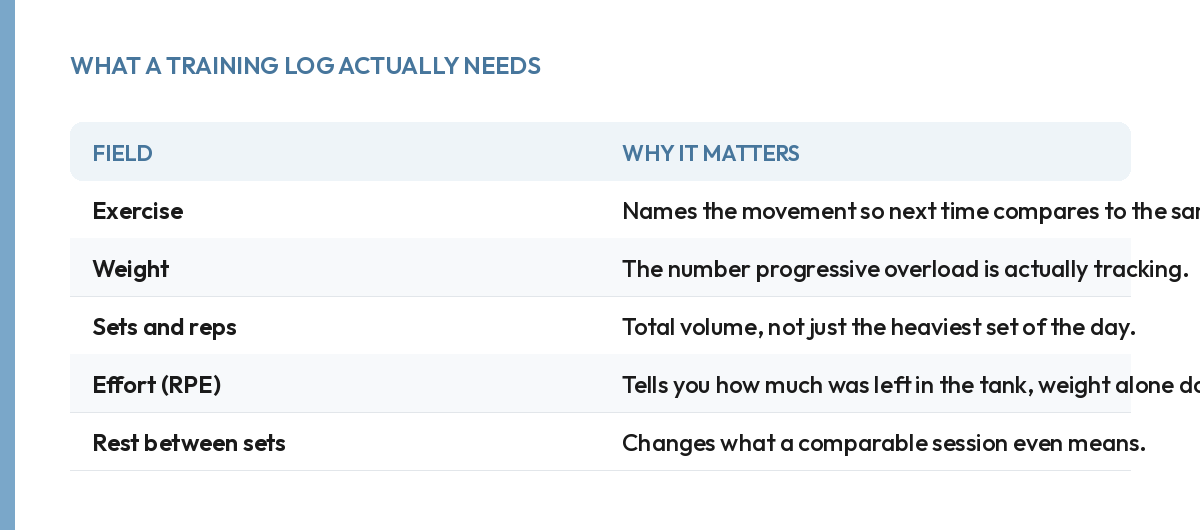
The exercise name, the weight, and the sets and reps are the three that progressive overload runs on. Without them, there is nothing to compare next session to.
Effort is the fourth, and the one most logs skip. A single word, easy, moderate, or all out, tells you something the weight alone cannot: whether a session that matched last week's numbers took the same amount out of you, or noticeably more. Rest between sets belongs in there too if you train for anything time sensitive, because five sets of five with two minutes rest is not the same session as five sets of five with ninety seconds.
None of this needs to be elaborate. A phone note with five short lines per exercise covers all of it. The goal is not a detailed diary, it is a record specific enough that a future session can be measured against a real number rather than a memory of how the last one felt.
Log during the session, not after.
This is the part people skip, and it costs more accuracy than most people expect. A study comparing self-reported exercise logs against an objective record of the same sessions found participants overestimated their own numbers by an average of 12.7 percent, with individual entries ranging from a large underestimate to more than double the real figure. The gap was not explained by dishonesty. It was explained by memory, filling in a plausible number rather than the actual one.
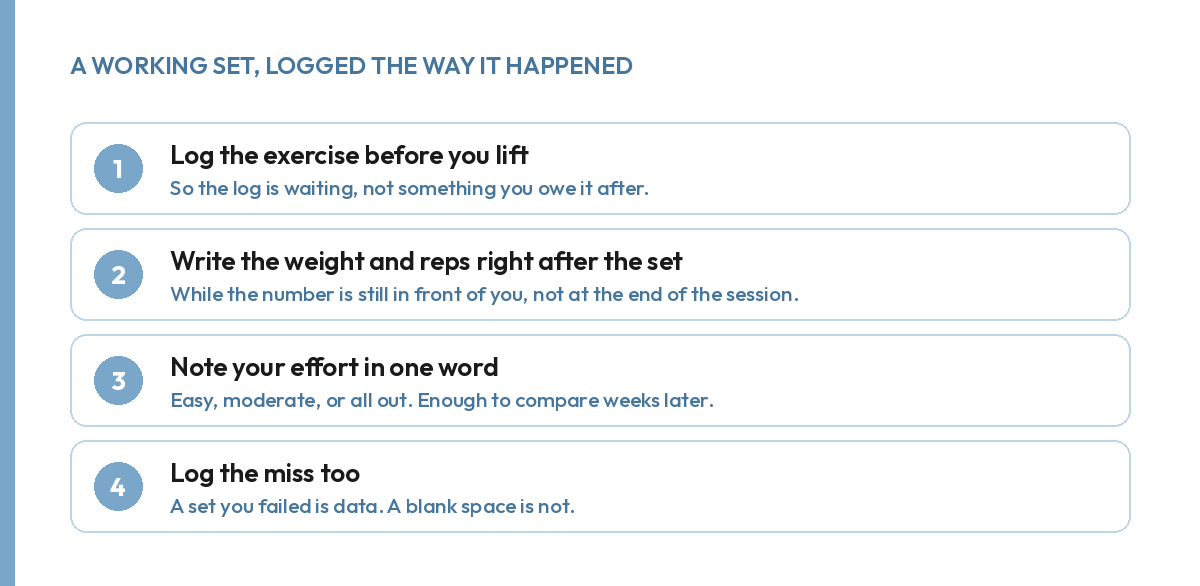
The fix is not a better memory. It is not needing one. Log the set right after you finish it, while the weight and the reps are still in front of you, rather than reconstructing the whole session in the car afterward.
Source: self-reported versus objectively assessed exercise, a comparison study.
What if you forget to log a session?
Write down what you remember as soon as you remember it, and mark it as a recalled entry in your own head even if the app cannot. A rough number today beats a guessed number in three weeks when you are trying to compare against it. What you should not do is skip the session in the log entirely because it was not captured perfectly. A log with an approximate entry is still more useful than a gap.
A worked week, logged properly.
Monday, squat. 3 sets of 5 at 185 pounds, moderate effort, 2 minutes rest.
Wednesday, squat. 3 sets of 5 at 185 pounds again, but easy effort this time.
That single word, easy instead of moderate, is the whole insight. The weight did not move. The session got easier. That is exactly the signal that tells you it is time to add weight next week, and a plain number without the effort word would have missed it completely.
Compare that to a log with no effort word at all: two identical entries, 185 pounds for 3 sets of 5, with nothing to separate a week where you were grinding through the last rep from a week where you had two more in the tank. The weight alone tells you what you did. The effort word tells you whether you should do more of it, which is the actual decision a log exists to help you make.
This single-lift format is only one shape a log can take. If your goal is hypertrophy or you are just building the habit, see three training log examples built for those situations instead.
How your own numbers make this easier to see.
Writing all of this down by hand works, and plenty of people do. The part that is easy to lose is the comparison: pulling up last Monday's squat session while you are standing at the rack this Monday. This is what we built The Health Project for. Your sessions are logged down to the set, progressive overload reads your last session and suggests the next step, so the comparison that matters is already sitting there rather than something you have to dig for.
If rest days and deload weeks are the other half of managing your training, a log is what tells you when either one is actually due, rather than guessing. And if you would rather have a coach read the log with you and adjust the plan, that is what my coaching is for.
FAQ.
What is the minimum I actually need to log?
Exercise, weight, sets and reps. Everything else is useful. Those three are the ones progressive overload actually depends on.
Should I log during the session or after?
During. Waiting until later loses accuracy, even when you are trying to remember something you did an hour ago.
Do I need to log a set I failed?
Yes. A failed set is the clearest evidence you have about where your limit actually sits this week.
Is an app better than a paper notebook?
Either works if you actually use it. An app that fills in your last session for you removes the one step people skip.