Losing Fat and Building Muscle at the Same Time
TL;DR. Losing fat and building muscle at the same time, often called body recomposition, works best for people newer to structured strength training, a returning trainee, or someone carrying more body fat than muscle. It gets slower and less reliable the longer you have trained. The two levers that matter most are a small calorie deficit and enough protein, kept up alongside consistent strength training.
Who losing fat and building muscle at the same time actually works for.
Body recomposition is not a myth, but it is not universal either. Muscle protein synthesis responds strongly to new training stimulus, which is why people early in their training history, or returning after months off, can build muscle even while eating below maintenance. That window narrows as your training history gets longer.
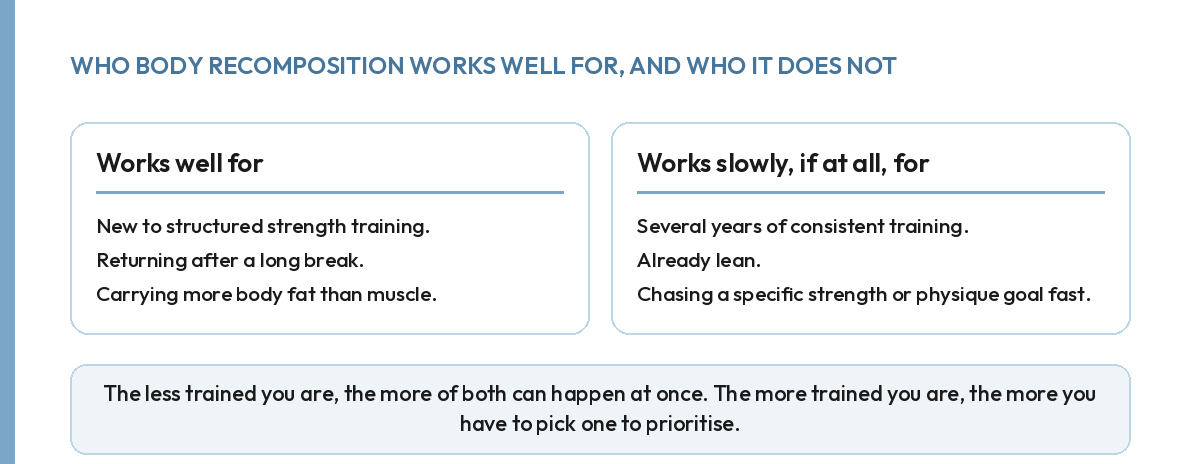
If you have trained consistently for several years, or you are already lean, the honest expectation should be slower muscle gain and a fat loss phase that mostly protects the muscle you already have, rather than adding a meaningful amount of new muscle on top of it.
The two levers that decide how well it works.
Two things matter more than anything else once training is consistent: protein intake, and the size of the calorie deficit.
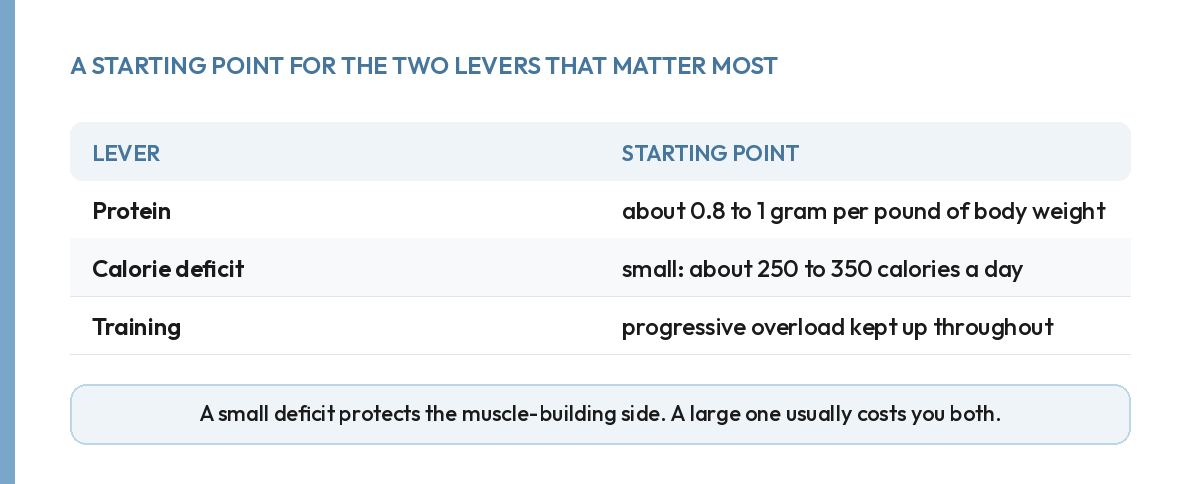
Protein. Roughly 0.8 to 1 gram per pound of body weight is a reasonable starting point for someone strength training regularly. Protein is the raw material for the muscle you are trying to build or protect, and it is the single easiest lever to under-do by accident while eating less overall.
The size of your deficit. A small deficit, around 250 to 350 calories a day below maintenance, leaves more room for muscle-building to happen alongside fat loss. A larger deficit speeds up fat loss but tends to blunt muscle growth almost entirely, which defeats the point of recomposition in the first place.
How to set up losing fat and building muscle at the same time.
Start with your current maintenance calories, not a number pulled from a generic chart. Subtract a small amount, in the 250 to 350 calorie range, and hold that for a few weeks before judging the result. Set your protein target first, then let carbohydrate and fat fill in the rest of your calories.
Keep your training focused on progressive overload: adding a small amount of weight, a rep, or a set over time, rather than chasing variety for its own sake. Recomposition needs a consistent training stimulus more than it needs a clever programme, the same stimulus that drives building muscle mass on its own.
Why is it harder for experienced lifters to recomp?
The biology behind losing fat does not slow down the longer you have trained. The biology behind building new muscle does. That mismatch is the entire reason advanced lifters are usually better served choosing one goal at a time: a dedicated muscle-building phase eating at maintenance or slightly above, followed by a dedicated fat loss phase.
How long it realistically takes.
Because both sides of the process move slowly when they happen together, recomposition rewards patience more than most training goals. A realistic timeline for a beginner is small, visible changes in both body composition and strength over eight to twelve weeks, not a dramatic transformation. For someone with more training history, the muscle side of the equation may take several months to show up on the scale or in the mirror, even while lifts are clearly improving.
This is the point where a lot of people quit early, usually because the scale is not moving the way a pure fat loss phase would move it. Weighing progress by strength gained and how clothes fit, alongside the number on the scale, gives a more accurate picture of what is actually happening to your body.
Training frequency and recovery matter more here.
Because you are asking your body to build and repair muscle on fewer calories than it would prefer, recovery becomes less forgiving than it is in a muscle-building phase eating at maintenance. Sleep, rest days and managing training volume all carry more weight than they would if you were purely bulking. Skimping on any of them tends to show up first as a stalled lift, and only later as fatigue you can feel day to day.
A programme built around two to four full-body or upper/lower sessions a week, with enough rest between sessions to recover, generally outperforms a higher-frequency programme squeezed into a calorie deficit, simply because recovery is the scarcer resource in this specific situation.
Tracking both sides of the same target.
Trying to lose fat and build muscle at once means your calorie and protein targets have to move together, not separately. In your nutrition inside The Health Project, targets are set by you or your coach and adjusted as your weight and training change, so a small deficit and a protein target stay linked rather than drifting apart over a few weeks. It connects with your training log, so a stalled lift and a shrinking waistband show up in the same place instead of two separate apps.
The same small-deficit approach used here is the same idea behind setting your daily calorie target: start from a real number, then adjust it based on what actually happens.
FAQ.
Can beginners lose fat and build muscle at the same time?
Yes. New and returning trainees respond to strength training strongly enough that both can happen together, especially with a smaller calorie deficit and enough protein.
How big should my calorie deficit be to build muscle while losing fat?
Small. About 250 to 350 calories a day below maintenance protects muscle-building better than a larger deficit, which tends to cost you both fat loss quality and muscle.
How much protein do I need for body recomposition?
Roughly 0.8 to 1 gram per pound of body weight is a reasonable starting point, adjusted for your own training and how you respond.
Why is it harder for experienced lifters to recomp?
Muscle-building slows down the longer you have trained, while the biology behind losing fat does not. That imbalance is why advanced lifters usually get better results picking one goal at a time.