Gym Apps Free to Start: What Actually Matters
TL;DR. The gym apps free to download all do the same basic job: log a set, store the history. That means fast logging, visible history and a clear suggestion for your next set. Most free workout trackers do the first two. Fewer do the third. One honest note. We make one of the apps mentioned here, so judge ours against the same criteria as the rest.
What a gym app is actually for.
Progress in the gym comes from progressive overload, which means doing slightly more than last time. To do that, you have to know what last time was. See how the same logic applies to a full training week for the mechanics of adding load.
That is the entire job. Everything else is decoration.
So the questions worth asking are narrow:
- How fast is logging a set, mid workout, with cold hands?
- Can you see what you did last time, on this exercise, without hunting?
- Does it tell you what to aim for today?
- Can you build your own routine, or only use theirs?
A slow app gets abandoned before any of the rest matters. Speed is not a nice-to-have, it decides whether you are still logging in week three.
The main gym apps free to try.
Hevy describes itself as a free gym workout tracker and planner for iOS and Android, for planning lifting routines, logging workouts and tracking progress. Logging is fast and it has a social side, so you can see what friends or other users are training.
Strong describes itself as a workout tracker and gym log. It is a long standing, straightforward logger with a clean interface. It sticks to logging and history and does not try to be a social feed or a coaching platform.
Strava is built for running, cycling and hiking rather than lifting. If your training is mostly cardio it belongs on your list, and if it is mostly barbells it does not. It logs distance, pace and route well and treats set and rep logging as an afterthought.
The Health Project, which we make, logs workouts down to the set, reads your last session and suggests the next step, and has built in programmes and templates or lets you build your own. Your training sits next to your nutrition, your sleep and any markers you keep, so a heavy week and a short night of sleep show up next to each other instead of in two different apps.
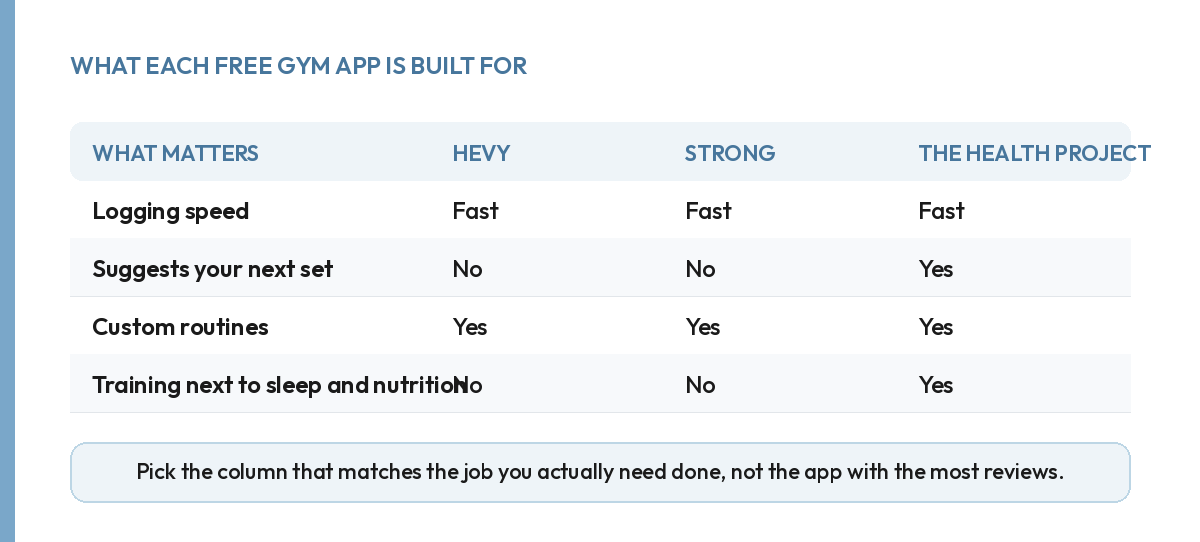
None of these apps are wrong. They are built for different jobs, and the table above is about matching the job to the app rather than picking a winner.
The feature that decides it.
Suggesting your next set.
An app that only stores your history makes you do the thinking: find last week, read the numbers, decide today's target, while resting between sets. An app that reads your last session and proposes the next step removes that decision, and removed decisions are what survive a bad day, a short night of sleep, or a workout you are rushing through before work.
Weekly volume is the other thing worth being able to see. Research groups training volume into low, under 12 sets per muscle group per week, moderate, 12 to 20, and high, over 20. You cannot manage that if nothing is counting it for you, and counting it by hand on a whiteboard rarely survives past the first busy week.
Source: Baz-Valle and colleagues, a systematic review of resistance training volume.
If you want to see what that looks like worked out set by set across a real week, a full sets and reps example walks through one.
What does a free tier leave out?
Free tiers on workout trackers usually cover logging, history and basic routines. Paid tiers typically add advanced analytics, unlimited custom routines and export, and sometimes remove ads from the logging screen.
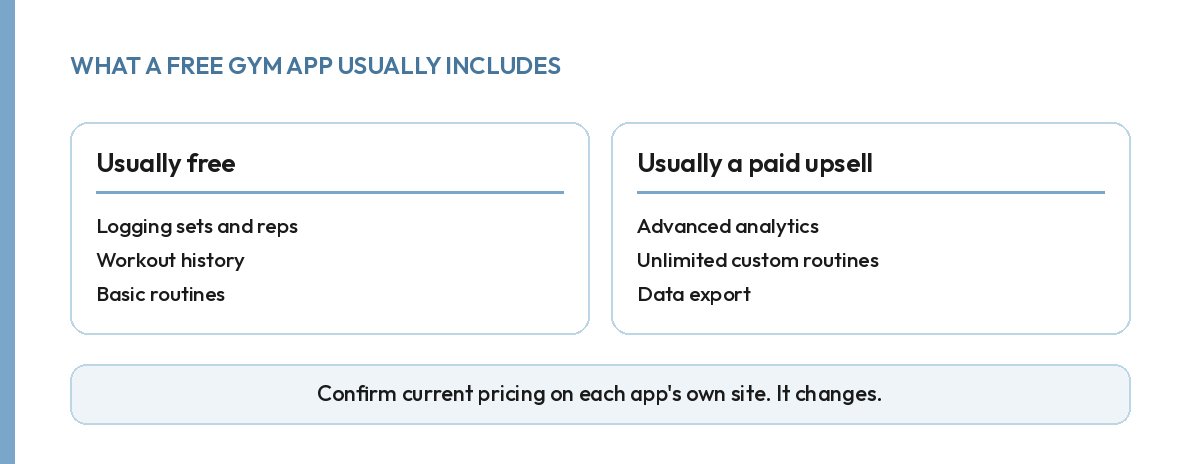
Check the current pricing on each app's own site. It changes often enough that any number written here would mislead you by the time you read it.
How rest fits into the app you pick.
A gym app is not only about the days you train. The days you do not train still belong in the log, because a rest day you did not plan looks the same in your history as one you did, and only one of those is progress. If you are working out how many rest days your own schedule actually needs, this breakdown of rest days at different training volumes is a useful next read. Whichever app you pick, look for one that lets you log a rest day on purpose rather than just leaving a gap.
How to choose.
If you want the fastest pure logger with a community attached, Hevy is built for that. If you want a simple, proven log and nothing else, Strong is built for that. If your training is endurance, Strava is built for that. If you want your lifting to sit next to your nutrition, your sleep and your markers in one place, that is what we built.
Start by logging one real workout in whichever app you are considering, mid session, with the phone you actually train with. That single test tells you more about whether you will keep using it than any feature list, including this one.
Pay attention to how many taps it takes to add a set, whether the app remembers your last weight on that exercise without you typing it again, and whether you can find last week's numbers in under a few seconds while you are resting. If any of those feel slow on the first try, they will still feel slow on day thirty, once the initial novelty of a new app has worn off.
Whichever app you pick, it only helps once it is holding a real target and not just a history. See what a goal setting app needs to do if you want the log to actually point somewhere.
For a broader look at what separates the apps worth keeping from the ones you delete after a week, here are five things worth checking first.
FAQ.
What is the best free gym app?
The one you will still be logging in three months. Speed of logging predicts that better than any feature list.
Do you need an app to track workouts?
No. A notebook works. An app is faster to search and harder to lose.
Can you use a gym app without a subscription?
Yes. The main free tiers cover logging, history and routines.
What should a workout tracker show you?
What you lifted last time on this exercise, and what to aim for today.